Category: News

How to Choose A Reconciliation Software:  A Buyer’s Guide

Choosing a reconciliation software comes down to one question: can it match your transactions at the level and volume you actually operate at? Start with automation depth and data coverage, then weigh controls, traceability, scalability, and time-to-value.

Every vendor call will tell you their tool is intelligent, fast, and easy to implement. None of that tells you whether it will hold up on your data, at your volume, under an audit. 

This guide walks through the seven criteria that actually predict that, a checklist you can take into your own evaluation.

You’ll also find the questions worth asking vendors, the red flags to watch for, and how the right answer shifts depending on your team and industry.

What reconciliation software should do

Strip away the marketing language and the category does three things:

  • It matches transactions and records across systems (bank statements, payment processors, ERPs, internal ledgers) without someone lining up rows in a spreadsheet by hand.
  • It flags what doesn’t match.
  • It keeps an audit trail of every match it makes through automated matching logic.

How deep that automation goes, and how much of the process it actually covers, is where tools start to differ. That’s what the criteria below are for.

For the fuller picture of how reconciliation fits into close and reporting, see what is financial close software.

How to choose reconciliation software: 7 criteria that matter

Seven criteria separate a reconciliation tool that scales with your business from one you’ll outgrow within a year.

1. Automation depth (rules-based vs. AI-driven matching)

how to choose reconciliation software

AI can genuinely help match your transactions, that part isn’t controversial.

Whether it should decide, unsupervised, what counts as reconciled every time the process runs is the real question, and the answer depends on how much risk you’re willing to accept without a clear trail back to why a match happened. 

Some reconciliation automation relies on fixed rules that need to be reconfigured every time your data changes; other tools use AI or agentic matching that adapts as it processes more transactions.

Ask any vendor for their actual auto-match rate on data that looks like yours, not a generic benchmark, and ask what happens to the matches it can’t resolve on its own.

2. Transaction-level vs. trial-balance reconciliation

choosing reconciliation software

Two totals can match perfectly while the details underneath are wrong in ways that cancel each other out. That’s the risk with trial-balance reconciliation, which only confirms that summary balances agree.

Transaction-level reconciliation matches every individual transaction, so a discrepancy can be traced back to its source instead of just flagged as “off.” If your team needs to investigate differences rather than just confirm totals, this is one of the more consequential criteria on this list.

3. Data sources and ERP integration

A reconciliation tool is only as good as what it can actually see.

Check how many of your real data sources it connects to natively, from payment processors and banks to payment gateways and ERPs, and how.

No-code connectors and open APIs for ERP integration mean faster setup and less dependence on engineering time later. Ask what happens with a source that isn’t natively supported: is it a custom build, a manual workaround, or out of scope entirely?

4. Exception management and controls

How to choose the right reconciliation software for your business?

Reconciliation software should support exception management by routing exceptions to the right person, tracking how they’re resolved, and reinforcing internal controls like segregation of duties.

A static list of unmatched items that nobody owns doesn’t count as exception management.

Ask how exceptions are identified, whether resolution steps are logged, and how access is controlled by role.

5. Scalability for transaction volume

The tool that impressed everyone in the demo was tested on your current volume.

Ask what happens at two or three times that, because that’s the volume you’ll actually be running in a couple of years and scalability problems tend to surface quietly, as manual workarounds nobody planned for.

6. Security and audit-readiness

Look for role-based access, an immutable audit trail, and relevant security certifications, then push vendors to prove it rather than take their word for it.

Sample audit trails, certification documentation, and access control settings are all fair to request during evaluation.

7. Implementation time and ROI

“Go live in days” sounds great in a pitch deck and rarely survives contact with your actual data sources. Time-to-value depends on how many sources you’re connecting and whether implementation requires engineering support.

Ask for a realistic estimate based on your specific sources, then weigh ROI against that date rather than the one you saw in the demo.

A reconciliation software evaluation checklist

Use this reconciliation software comparison checklist to evaluate vendors side by side:

  1. Auto-match rate has been tested against data similar to yours, a vendor’s generic benchmark doesn’t count
  2. The tool supports transaction-level drill-down, beyond simple balance-level checks
  3. It connects natively to your actual data sources (processors, banks, ERPs)
  4. Exceptions are routed, tracked, and resolved with a visible audit trail
  5. Performance holds up at 2-3x your current transaction volume
  6. Security certifications and audit trail exports are available on request
  7. You have a realistic time-to-value estimate tied to your specific data sources

Build vs. buy: when to build reconciliation in-house

For a lot of finance teams, building reconciliation in-house was never really a decision, it’s just what happened, usually in a spreadsheet, when volume was low enough that nobody minded.

The cost shows up later: maintenance falls on whoever built it (often IT, not finance), there’s little to no audit trail, and the process doesn’t scale without adding headcount.

That doesn’t make buying automatically right for every team, it depends on your volume, your data complexity, and how much internal engineering time you’re willing to spend maintaining a homegrown process.

The point of asking the question explicitly, instead of defaulting to whatever you already have, is making sure the decision matches where the business is headed, not just where it is today.

See how Simetrik handles reconciliation at scale: Request a demo.

Questions to ask a reconciliation software vendor

Use these questions to get past the demo script:

Matching & coverage 

  • What’s your auto-match rate on data structured like ours?
  • Can we drill down from a summary match to the individual transaction level?
  • Which of our specific data sources do you connect to natively, and which require custom work?
  • Do you use AI or machine learning in your matching logic? If so, how does it interact with deterministic controls and what happens to the audit trail when the model changes? 

Exceptions & audit 

  • How are exceptions routed, and how are they resolved and logged?
  • If a discrepancy surfaces during an audit, how does root-cause investigation work end to end, and who owns it?
  • What security certifications do you hold, and can we see a sample audit trail?

Integration & architecture 

  • Can we connect via API or webhooks for real-time processing, not just batch file uploads?

Implementation & support 

  • What’s a realistic implementation timeline given our data sources?
  • What ongoing support is included after go-live?
  • How often do you release rule or platform updates, and does that require re-testing on our side?

Cost 

  • How does pricing scale with transaction volume?

Red flags when comparing reconciliation software

Not every red flag shows up in a feature comparison. Watch for:

  • The tool only reconciles at the balance level, with no way to drill into transactions
  • Any configuration change requires submitting a ticket to IT
  • Audit trails exist but can’t be exported or reviewed independently
  • Performance or accuracy drops noticeably as data volume increases
  • Demos are run only on clean, “toy” datasets rather than data resembling yours
  • Matching is entirely AI-driven, with no deterministic layer and no explainable audit trail. 

Matching the software to your team and industry

There’s no universal answer to which criteria matter most, it depends on who’s using the reconciliation software.

A finance operations team processing high volumes from multiple payment processors will likely weigh automation depth and data source coverage heaviest.

An accounting team focused on month-end close may care more about exception management and audit-readiness.

Industry shifts the picture too: payment service providers and banks both need reconciliation that holds up across processors, acquirers, and bank statements, while retailers reconcile different types of transactions at different volumes, which changes which criteria carry the most weight in practice.

Frequently asked questions

What is the best reconciliation software?

There’s no single best tool.

The right one depends on your transaction volume, data sources, and whether you need transaction-level matching or just balance-level checks.

Use a criteria checklist rather than a generic ranking.

See how Simetrik approaches it.

How much does reconciliation software cost?

Pricing usually scales with transaction volume, data sources, and use cases rather than a flat license, so compare on total value and time-to-value, not just sticker price.

Ask vendors for a scoped quote. 

Get a scoped estimate from Simetrik.

How long does reconciliation software take to implement?

It ranges from weeks to months depending on data sources and whether setup is no-code or requires engineering.

Pre-built connectors and templates shorten time-to-value; ask for a realistic timeline with your sources.

See how Simetrik scopes implementation 

Next step: see reconciliation software in action

Once you have your own criteria and a shortlist of vendors, the best next step is seeing how a platform performs against your actual data, not a demo script.

Simetrik’s reconciliation software is built around exactly that test. Request a demo to see it against your own data.

The challenge of operating without pause: financial control in Betting & iGaming

A sportsbook or online casino never closes. While one player deposits funds to bet on a game starting in minutes, another requests a withdrawal of their winnings. At the same time, a gateway processes transactions, applies fees, and settles payments. Everything happens simultaneously, across multiple providers, markets, and jurisdictions.

The challenge is not just volume, but variability. Each provider reports with different formats, identifiers, criteria, and timelines. References don’t always match across systems, and a minor change in a file can interrupt an entire control flow.

Every new gateway or jurisdiction adds a different logic to the operation. And in an industry where the business depends on verifying every deposit, withdrawal, fee, or in-game purchase, any discrepancy can translate into losses, cash errors, or regulatory exposure.

Without continuous, transaction-level reconciliation, two critical capabilities break down: real visibility into cash flow and traceability of outstanding items.

The blind spot in the cash position

Knowing how much capital is actually available, by provider and by region, is the foundation for sound financial and operational decisions.

The blind spot emerges because every movement crosses different systems. The same transaction may be recorded in the internal core system, at the payment provider, and at the bank with different identifiers, dates, or criteria.

When control is performed at an aggregate level, it becomes difficult to trace the gap between what the platform recorded, what the provider confirmed, and what actually landed in the bank account.

Withdrawals follow a similar pattern: they may be approved, in processing, executed, or confirmed to the player. Without a transaction-level view, it is not always possible to know which stage they are at or which items remain outstanding.

If reconciliation is only run in batches or at month-end close, the cash position stops being a verified figure and becomes an estimate. And that is not enough to define working capital, calculate immediate obligations, or demonstrate operational solvency to a regulator.

When outstanding items have no context or owner

The second breakdown is less visible, but can be just as costly.

It is not enough to detect that a transaction did not reconcile. You also need to know which one it is, how long it has been outstanding, at what stage it stalled, and who is responsible for resolving it.

Without that information, each item remains an open exposure: a duplicated credit, a missing transaction, a delayed settlement, an incorrect fee, or a discrepancy against the provider’s report.

When these cases are managed across spreadsheets, emails, or scattered exchanges, the team may identify the discrepancy without having the elements needed to close it. Many are only detected during the monthly reconciliation, by which point reconstructing the transaction, filing a claim with the provider, or correcting the record is far more difficult.

That is why reconciliation does not end when an anomaly is identified. Control must also encompass its investigation, assignment, and resolution.

Continuous, transaction-level, evidence-based control

Recovering visibility over cash and traceability over outstanding items demands more than aggregating reports or dashboards. It requires a scheme of continuous, transaction-level reconciliation, in which every position can be explained and backed by evidence.

Simetrik’s solutions make it possible to follow the complete journey of money: from when a transaction is initiated through to its settlement, accounting entry, and, if a discrepancy arises, its investigation and resolution. This is achieved through Domains: control modules designed to cover specific layers of the operation.

Some of the most relevant for the sector are:

  1. Cash In and Cash Out validate every inflow and outflow against internal operational data, payment provider information, and, where applicable, the bank movement. This allows deposits, withdrawals, and disbursements to be tracked from origin to settlement or confirmation, and identifies duplicates, missing transactions, rejections, incorrect amounts, or movements that have not yet completed their journey. Together, both Domains enable a verifiable view of cash flow: how much money is actually available, which provider holds it, and which items remain outstanding.
  2. Fees & Billing controls the fees and charges applied by any payment provider, operator, or third party involved in settlement. Rather than assuming an invoice is correct, it cross-checks the charges applied against the agreed conditions and the transactions that originated them. In an industry where margin depends on multiple billing schemes, this control detects variances that might otherwise remain hidden within aggregate figures.
  3. Unified Oversight & Alerts integrates these controls into a single view. It enables review of cash positions, distinguishes reconciled from unreconciled items, and tracks each outstanding item by status and owner. Control does not end when an alert fires. Simetrik also retains the evidence of what happened next: how the discrepancy was investigated, who was involved, and how it was resolved.

Simetrik has eight control Domains in total, adaptable to each operation’s structure and providers.

Two major players in Latin America have implemented Simetrik and demonstrate how this model works in practice.

BetWarrior: end-to-end financial control across four regions

BetWarrior operates a sports betting and entertainment platform in Argentina, Peru, Brazil, and other Latin American markets. With regional expansion, each gateway functioned as a separate universe: teams combined reports, resolved inconsistencies, and maintained increasingly complex manual controls.

With Simetrik, BetWarrior consolidated its six PSPs across each of the four regions where it operates, automated deposit and withdrawal reconciliation, and gained provider-level visibility with near real-time monitoring. Every movement can be tracked from origin to settlement, without relying on manual reviews or batch consolidations. Undefined statuses and inconsistent classifications are detected before they become losses.

Learn more about the BetWarrior case.

Bplay: available cash and traceable outstanding items by provider

Bplay, Boldt’s sports betting and online casino platform, operates in Argentina, Paraguay, and Brazil. It processes deposits, withdrawals, and settlements through different gateways, each with its own formats, rules, and timelines.

This fragmentation made it difficult to centralize movements, validate fees, and control settlements. In addition, journal entries to SAP were generated manually, increasing operational workload and the risk of errors.

With Simetrik, Bplay automated 1:1 reconciliation across its five gateways, validating fees and agreed timelines per transaction. In a single view, teams can consult the available cash by provider and the status of each discrepancy.

The model also automatically generates 20 types of journal entries to SAP, reducing the manual workload at month-end close.

Learn more about the Bplay case.

Financial control without blind spots

BetWarrior and Bplay started from different operations, but faced the same problem: isolated gateways, late discrepancies, and cash positions based on unvalidated information.

Continuous control makes it possible to move from aggregate totals and after-the-fact reviews to a model where every movement can be explained, every discrepancy managed, and every financial position backed by transactional evidence. This is how Simetrik works for the Betting & iGaming industry.

The difference is concrete: operating with verified data or making decisions based on estimates that are only corrected at month-end close.

In an industry where money never stops moving, control cannot either.

Request a personalized demo and discover how Simetrik can bring greater visibility, traceability, and control to your financial operation.

Simetrik launches Simetrik Agent: fully agentic financial control, with the deterministic certainty audit demands

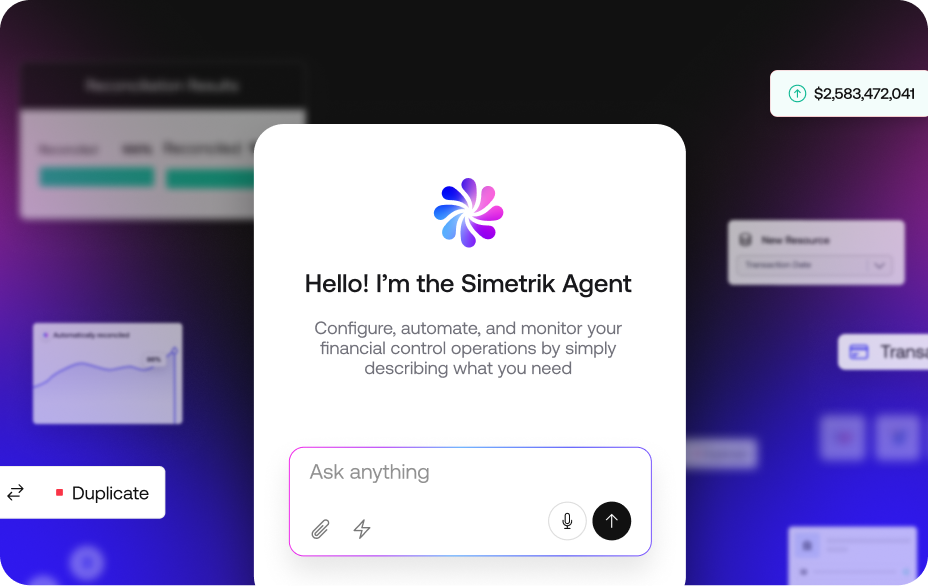
An autonomous agent that runs end to end without human intervention, decides when to lean on its deterministic core for an exact, verifiable result, and when to bring a person in. All inside an open box that is auditable end to end. It is joined by MCP connectivity and a CLI for technical teams.

San Francisco. Simetrik, the AI-powered financial operations control platform, introduces Simetrik Agent: an autonomous agent that executes financial control work end to end, in natural language and with no need for human intervention. It interprets the request, reviews the working environment, integrates the sources, identifies dependencies, and on its own configures, implements, reconciles, and analyzes exceptions.

Agentic, with exact results when they matter.

What sets Simetrik Agent apart from a generic agent is that it does not improvise where the business needs certainty. When a result must be exact, verifiable, and auditable, the agent turns to Simetrik’s deterministic core: more than 110 specific financial-control functions. The agent knows when to reason probabilistically and when to lean on that deterministic core, which always returns the same verifiable result.

That combination is where Simetrik’s deep knowledge of the financial industry makes the difference: an agent that alternates probabilistic reasoning and its deterministic core according to what each task demands, with the governance guardrails needed to audit every step and prevent errors. This is how Simetrik becomes a natural part of the CFO tech stack.

Autonomous and open box.

It is not a black box, it is an open box. Unlike opaque AI, where no one knows for certain why it did what it did, with Simetrik Agent every decision is expressed in financial language any person understands, can supervise, and can change whenever they want. And the agent itself recognizes when a person’s involvement is key and asks for it. Far from slowing it down, that collaboration makes it more powerful.

One control, three ways to operate it

To extend that control beyond the platform, Simetrik adds two complementary paths. With Model Context Protocol (MCP), organizations connect the agents they already use, their own or built on models like Claude, Copilot, or Gemini, with Simetrik’s financial knowledge and control capabilities, without rebuilding reconciliation logic from scratch. And a command-line interface (CLI) lets technical teams create and run reconciliations, configure sources, automate exports, and integrate controls with CI/CD pipelines.

Whether through the agent, MCP, or the CLI, everything runs on the same Simetrik capabilities and under a single standard of permissions, traceability, and financial control.

“The future of financial control is agentic and autonomous. The difference lies in building an agent that truly understands the financial world: one that knows when a result must be exact and auditable, when it is worth bringing a person in, and that keeps everything visible so the team stays in control. That is Simetrik Agent”, says Santiago Gomez, Co-Founder and COO of Simetrik.

Simetrik Agent, MCP, and CLI are now available to Simetrik customers. Learn more at simetrik.com.

About Simetrik

Simetrik is the AI-powered financial operations control platform. Its mission is to give finance teams the control to operate with speed, accuracy, and confidence in an increasingly complex environment. With an autonomous agent backed by a deterministic, auditable core, Simetrik automates complex reconciliations and end-to-end financial controls, and provides a single source of truth over which people retain full control. Today, more than 180 leading companies across 50+ countries trust Simetrik to process 2.5 billion daily records, cut losses, and accelerate growth.
From gray zone to regulated: 5 financial controls to prepare for the CLARITY Act

As of August 25, 2026, the Digital Asset Market CLARITY Act (H.R. 3633) has not been enacted. The bill passed the House in 2025 and the Senate Banking Committee advanced an amended version by a 15–9 vote on May 14, 2026. It remains proposed legislation while the Senate considers the bill.

The bill would establish a federal market structure for digital assets and clarify oversight roles. Because the final text and effective dates may still change, crypto companies should treat the five controls below as operational readiness measures, not as a definitive compliance checklist.

Companies that strengthen these controls now can be better prepared for audits, institutional due diligence, and future scale. Here are the five financial controls you need to have in place and why each one matters more than ever under the new regulatory reality.

1. Settlement Confirmation Across Every Payment Rail

Settlement confirmation across internal data, partner reports, and bank statements

Why this control matters: A more defined digital asset market structure could increase institutional participation. More counterparties and settlement methods create more points where records can diverge between intent and execution.

The control: You need to confirm that every dollar (or token) that should have moved actually moved accurately and on time. That means reconciling your internal operational data against partner settlement reports and bank statements across every payment source, every day. Not at month-end. Not in a spreadsheet.

How Simetrik solves this: Simetrik integrates your internal databases, partners’ operational and settlement reports, and bank statements to validate equivalent data points while maintaining full traceability throughout every stage of the transaction lifecycle. When you’re processing fiat-to-crypto conversions across multiple custodians and sponsor banks, this is how you prove the money arrived.

2. Fee Validation Against Every Contract and Network

Why this control matters: Proposed oversight for digital asset exchanges, dealers, and brokers increases the importance of proving how fees are charged, collected, and reported. Platforms should be able to validate trading fees, spreads, custody fees, or other charges against transaction-level records.

The control: You need to validate that the fees you’re being charged by processors, networks, and banking partners match what’s in your contracts and that the fees you’re collecting from customers are applied correctly across every transaction. Fee discrepancies at scale erode margins silently.

How Simetrik solves this:  Simetrik integrates your partner fee agreements, settlement reports (incoming and outgoing), and internal databases to validate fees against rules and contracts, detect overcharges, and turn fee transparency into negotiation leverage. For crypto companies, where fee structures vary by network, token, and volume tier, this control can help protect margins and support measurable ROI.

3. Audit-Ready Reporting with Full Traceability

Verification engine producing an audit-ready report from operational, financial, and accounting data

Why this control matters: Existing customer due diligence, suspicious activity reporting, and AML obligations already make verified, traceable data essential for in-scope entities. Future market-structure rules may add reporting expectations, but the exact requirements will depend on the final law and implementing regulations. 

The control: Crypto companies subject to reporting requirements need to generate compliance reports based on reconciled data that traces back to the original source. Every match, exception, and resolution should be documented and audit-ready at all times.

How Simetrik solves this:  Simetrik generates audit-ready reports for regulators and stakeholders based on verified data from your operational, financial, and accounting controls. Every report maintains full traceability back to the original data sources, reducing regulatory risk and cutting audit preparation time.

4. Continuous Accounting Controls

Why this control matters: As digital asset classifications and oversight continue to evolve, crypto companies cannot afford to discover accounting errors weeks after the close. Accounting rigor and traceable records remain essential regardless of the final bill text.

The control: You need to continuously automate revenue recognition, accruals, and provisions at transaction scale. Journal entries should be generated from reconciled and verified data, not from raw exports that someone manually cleaned up.

How Simetrik solves this: Simetrik automates operational accounting by generating journal entries from reconciled data, calculating provisions, and integrating with ERPs like SAP, Oracle, and NetSuite. The result: financial close accelerated by 1 to 2 weeks, with audit-ready documentation at every step.

5. Real-Time Oversight and Anomaly Detection

Why this control matters: The bill would introduce new definitions and oversight boundaries for digital asset activities. Whatever final classifications apply, platforms need visibility into reconciled transactions, exceptions, and control evidence.

The control: You need real-time dashboards that track KPIs across your entire operation, with intelligent alerts that flag anomalies before they become losses or regulatory findings. You can’t monitor what you can’t see, and you can’t report what you haven’t reconciled.

How Simetrik solves this:  Simetrik provides customizable dashboards tracking real-time KPIs, intelligent alerts on anomalies, consolidated views of reconciled balances across sponsor banks, and drill-down from summary to transaction detail all based on reconciled and verified data.

The Bottom Line

The Clarity Act isn’t a surprise. The regulatory direction has been clear for years. Now that the Clarity Act is taking shape, crypto companies have a window to get ahead of it.

The companies that treat compliance as a strategic advantage will be the ones that earn institutional trust, close their books faster, and scale without adding headcount. That’s the difference between building controls reactively and building them on a platform designed for exactly this kind of complexity.

Simetrik already processes 2.5 billion daily records and reconciles over $500 billion in annual TPV for 160+ enterprise clients across 50+ countries, including some of the largest fintechs and digital asset platforms in the world. The controls described above aren’t theoretical. They’re live, in production, today.

Ready to get ahead of the Clarity Act?

Schedule a personalized demo to see how Simetrik maps to your specific crypto operations.

The Operation Center has arrived

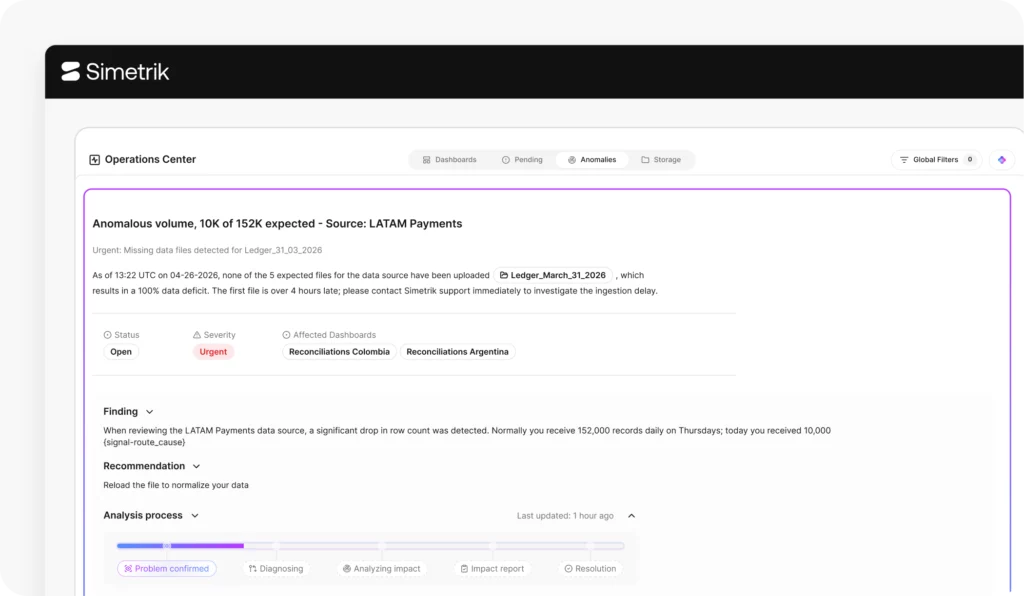
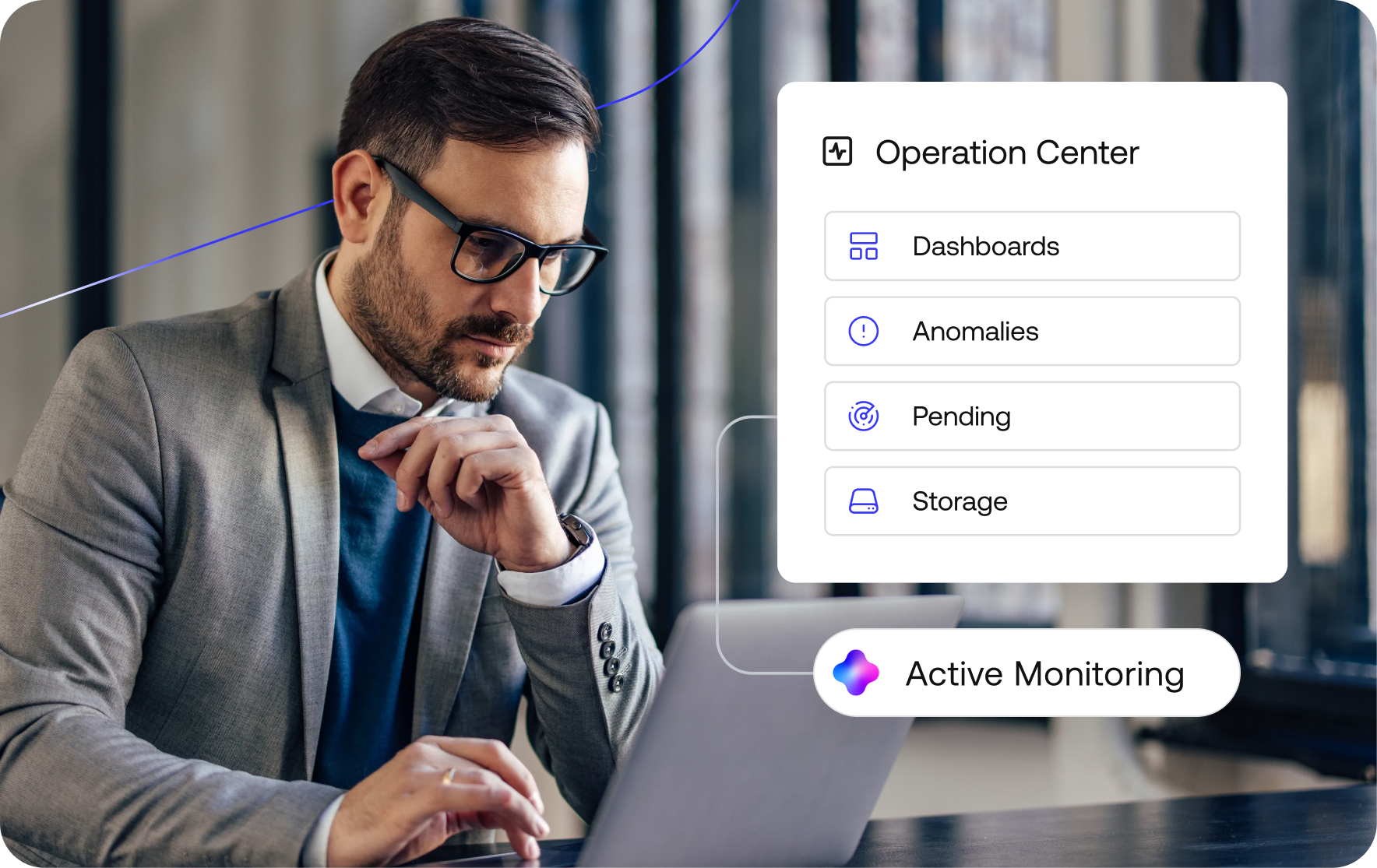
In our new version, the Operation Center arrives: the module that unifies the visualization, analysis, and resolution of your financial operations in one place.

DEPLOY DATE
June 16, 2026

7:00 p.m. GMT-5 — Global
8:00 p.m. GMT-6 — Mexico
9:00 p.m. GMT-3 — Brazil
9:00 p.m. GMT+5:30 — India

All features will be rolled out progressively.

OPERATION CENTER
Operate, detect, and resolve from one place

Dashboards, datasets, anomalies, and pending items unified in a single module. Go from observing to acting without switching tools.

DashboardsAnomalies and pending items
Multiple dashboards organized by pages and various chart types. Switch views without losing the context of your operation. Build queries in seconds with the AI Copilot, directly in your datasets.Incidents detected automatically with identified root cause. Manage and resolve pending items individually or in bulk with full traceability.
Record and certify with more flexibility

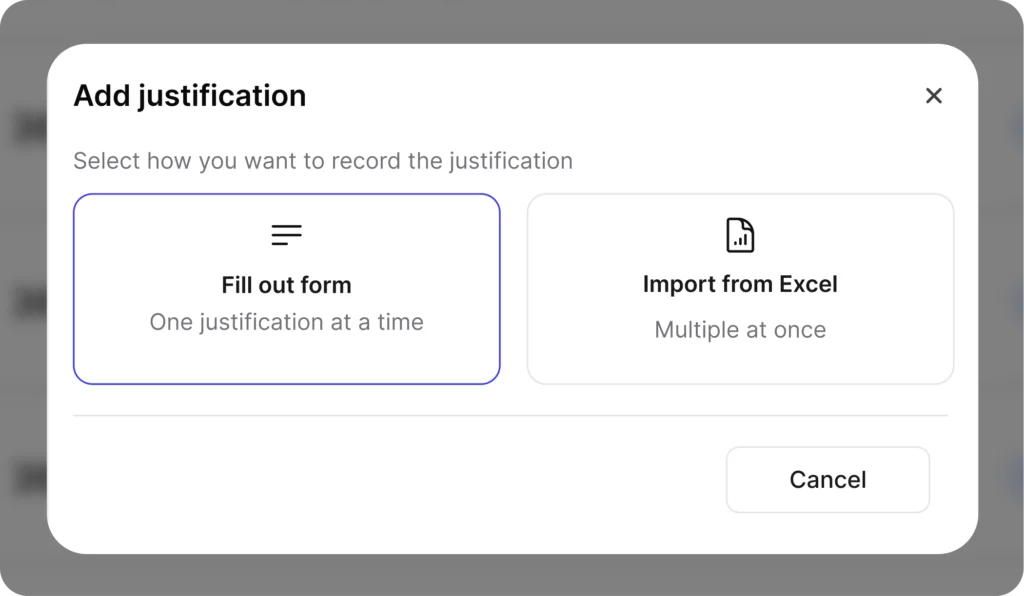
Generate journal entries directly from data sources, without prior reconciliation. And document in your control the differences between ERP and reconciled balance with auditable evidence.

More freedom to automate your journal entriesFull control over your closing differences
Automatically generate journal entries from your sources, without prior reconciliations. Journal entries are automatically reversed when records are deleted.Centralize the justification of differences and monitor their evolution each period.
Turn off and reactivate without deleting your accounting automations

Turn off an accounting automation without deleting it. Keep its configuration for reference or as a base for new ones, and automatically release the associated resources for editing

Run reconciliations when your data is ready and manage columns safely

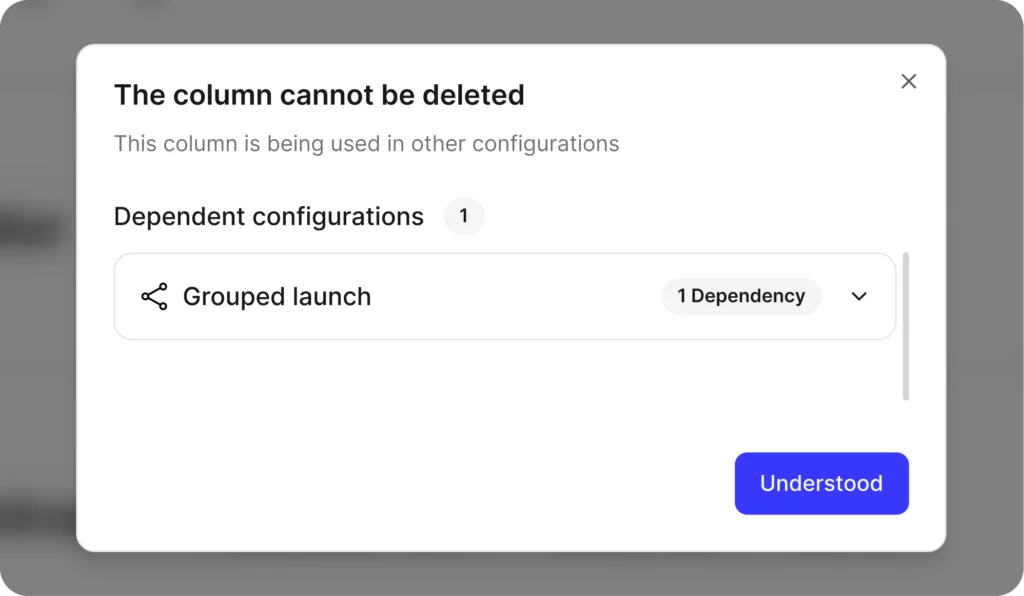
Define when your processes are triggered and delete columns without affecting existing configurations.

A+B TriggerColumn deletion
Run only when all required inputs are available. Set a maximum wait time to guarantee the daily close.Delete columns with automatic dependency validation. The system blocks the action and indicates exactly which resources are using it.

The previous module-based navigation will no longer be available. From now on, smart navigation will be the only one available on the platform.

What Simetrik’s Selection into Mastercard Start Path Means for You

We’re excited to share that Simetrik has been selected for Mastercard Start Path, the global startup engagement program that has supported over 500 companies from more than 60 countries to accelerate growth and innovation in the financial ecosystem.

This is a meaningful milestone for us, but more importantly, it’s a meaningful milestone for the issuers, acquirers, fintechs, and financial institutions we serve every day. Here’s what it means in practice.

Closing the gap between payments and accounting

Digital payments have scaled fast. The back office hasn’t kept up. Finance teams at banks, payment processors, and fintechs are still reconciling manually, chasing exceptions, and building controls they shouldn’t have to build from scratch.

Simetrik exists to close that gap. Our AI-native platform gives every participant in the payments chain complete visibility and traceability across every transaction continuously, not just at month-end.

The Mastercard Start Path recognized this approach. Through the Corporate Solutions track, we’ll have the opportunity to collaborate directly with Mastercard to bring automated reconciliation and financial controls to high-volume, high-complexity payment ecosystems around the world.

“Digital payments scaled fast. The back office didn’t. Finance teams at the world’s largest banks and payment processors are still reconciling manually, chasing exceptions, and building controls they should never have had to build themselves. Simetrik exists to close that gap. Our vision is to be the AI-native platform for global financial operations, giving every participant in the payments chain, from fintechs and banks to acquirers and issuers, full confidence in every transaction from start to finish.”

— Santiago Gómez, Co-Founder & COO, Simetrik
Four exciting benefits for our customers and partners
1. Go live faster with pre-built templates

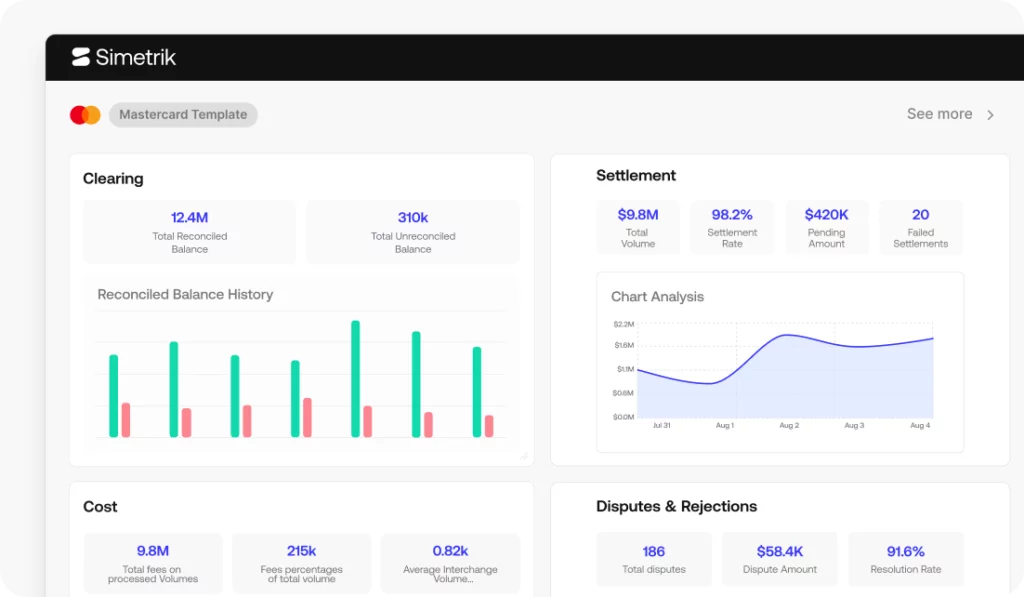
If you’re processing issuing or acquiring flows, you won’t need to start from scratch. Simetrik’s pre-built templates for workflows mean your finance and operations teams can build and modify reconciliation processes without engineering support. This can deploy transaction-level controls in weeks, not months. No custom code. No long integration timelines.

2. Third-party validation for regulated environments

For issuers, acquirers, and other regulated entities, vendor selection isn’t just about capability. It’s about trust. Simetrik aligns with the governance, security, and operational standards that global card networks expect. At a moment when regulators are raising the bar on transaction-level evidence, that independent validation matters for your audit trail and financial control framework.

3. Pre-validated integrations for your payment infrastructure

Integration headaches are one of the biggest barriers to adopting new financial operations tools. Simetrik’s connectors meet the connectivity and data-format standards that global financial institutions require. That means the platform works with your existing payment infrastructure without custom development.

4. A direct channel into Mastercard’s ecosystem

Mastercard Start Path opens a direct connection for Simetrik to reach Mastercard’s corporate clients and partners. For our customers, that creates opportunities for joint pilots and co-solutions across issuing, acquiring, and cross-border payment operations, shortening the path from evaluation to production.

What’s next

This opportunity with Mastercard can advance what we’ve been building since day one: a single platform that gives finance and operations teams full confidence in every transaction, across every partner, in every market they operate in.

If you’re already using Simetrik, you’ll benefit from deeper integrations and faster template rollouts. If you’re evaluating us, this is a good time to schedule a personalized demo and see how we can help you take control of your financial operations.


About Mastercard Start Path

Mastercard Start Path is a global startup engagement program that partners with later-stage startups and fintech innovators to accelerate growth. Since inception, the program has supported over 500 companies from 60 countries, providing access to Mastercard’s technology, expertise, and global network. Learn more at mastercard.com/startpath.

Simetrik raises $85M to redefine financial reconciliation with AI

Back in 2024, we landed our Series B led by Growth Equity at Goldman Sachs Alternatives. It was an exciting time even then, but we didn’t know what was coming. Since then, we’ve raised a Series B1, witnessed a rapid shift in the financial ecosystem, and watched the AI boom transform the world of software forever.

Simetrik’s Series B reaches $85 million

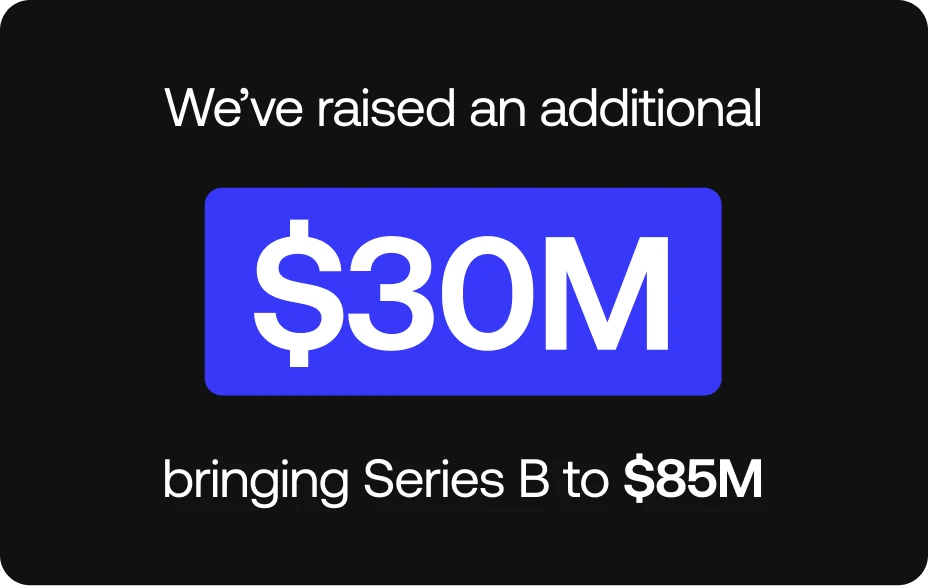
How much funding did Simetrik raise? Simetrik’s Series B reached $85 million in June 2025 after a $30 million follow-on investment led by Growth Equity at Goldman Sachs Alternatives. The financing is intended to accelerate Simetrik’s expansion into the United States and other high-volume, highly regulated markets.

Why AI is reshaping financial reconciliation

Reconciliation today is an outdated function that plagues even the best teams with wasteful manual work and margin-eroding technology costs. Until now, it has been impossible to process and reconcile enterprise transaction volumes at any scale, leaving significant visibility gaps and exposing financial operations to substantial risk.

Simetrik is an AI reconciliation platform that automates transaction matching, mitigates risk, and supports compliance workflows at enterprise scale. We simplify complex financial operations for our customers, with reconciliation at the heart of everything we do.

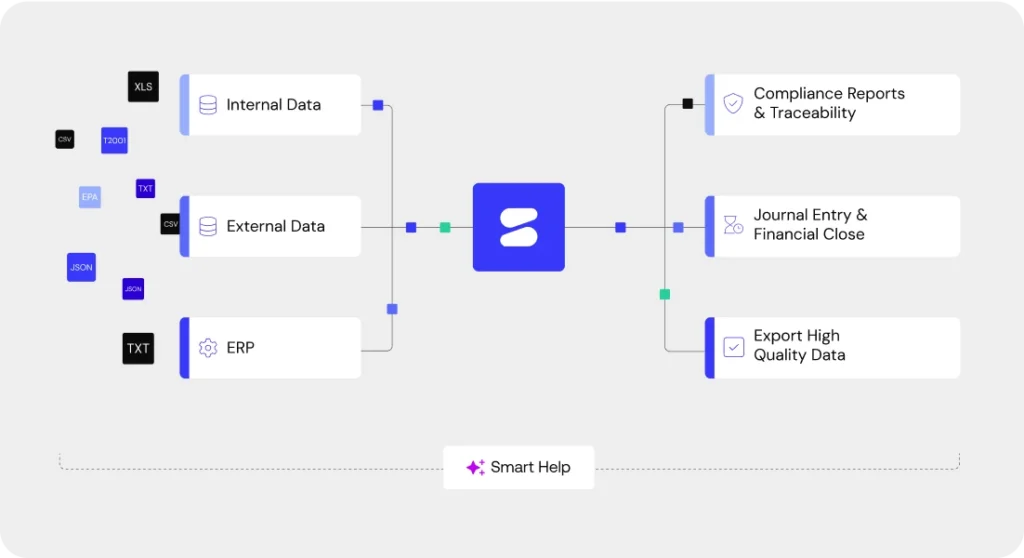
Simetrik connects internal, external, and ERP data to financial reporting and close workflows

By applying agentic AI and no-code automation to reconciliation, exception management, and compliance workflows, we help companies achieve new levels of financial oversight and efficiency at every level. The platform now processes more than one billion records per day in 40+ countries, automatically reconciling multi-way transaction data and then aligning it with journal entries and operational balances. 

“Fragmented systems, skyrocketing volumes, and shifting regulations are pushing traditional reconciliation to a breaking point.”

Santiago Gómez, Simetrik’s co-founder and COO.

“We give FinOps teams the automated workflows and controls they need to stop making costly errors, shorten the monthly close by days, and export AI-ready data for forecasting, risk modeling, and product innovation. All without writing a single line of code.” 

For companies subject to multiple nuanced regulations and internal audits, this approach to automation has powerful downstream effects. Reconciled data is reported accurately down to the transaction level, simplifying audits and alerting the finance team to exceptions in real-time. Simetrik customers automate 100% of their reconciliation workflows, strengthen margins, and open up new paths to innovation in an increasingly complex international payments environment.

What the investment enables

“Goldman Sachs’ continued support validates the global demand for a purpose-built AI reconciliation platform.”

“With this investment, we’ll scale our US presence and deliver even faster time-to-value, helping finance teams cut waste, act immediately on discrepancies, and turn reconciled data into a strategic advantage.”

Alejandro Casas, co-founder and CEO of Simetrik.

Simetrik’s customers include Stax Payments, Santander Group, Sephora, Possible Finance, Mercado Libre, Oxxo, Rappi, PayU, PagBank, Falabella, Itaú, and Nubank, among others, and strategic partners such as Deloitte. This trusted base has fueled the company’s 100% year-over-year revenue growth and rapid international footprint.

Simetrik funding facts at a glance

Did Simetrik disclose a valuation? No valuation was disclosed in the June 2025 funding announcement.

Did Simetrik disclose its revenue? Simetrik reported 100% year-over-year revenue growth in the announcement but did not disclose an absolute revenue figure.

To learn more about Simetrik, request a demo.