Agentic commerce is commerce where an AI agent acts on a person’s behalf across some or all of the shopping journey: finding a product, comparing it against alternatives, and completing checkout, without the person clicking through a website themselves. It’s a change to how online shopping happens, not a new product category on top of it.
It’s what you get when agentic AI, a branch of artificial intelligence built to plan and carry out multi-step actions toward a goal rather than just answer a question, gets applied to buying and selling. The person still sets the intent: “find running shoes under $100,” “reorder the coffee I usually get.” From there, an autonomous agent, sometimes a chatbot, sometimes an AI assistant built into a browser or an app, and increasingly one of a growing set of intelligent agents built for this specifically, does the researching, comparing, and transacting.
None of the underlying pieces are new by themselves. Generative AI and large language models (LLMs) that can reason over messy, unstructured text have been around for a few years. Conversational interfaces that swap a search bar for a chat window aren’t new either. What changed is combining generative AI, automation, and enough shared infrastructure between AI platforms and merchants to actually complete a transaction, not just recommend one.
How Agentic Commerce Actually Works
The mechanics break down into three stages, and each one depends on the merchant and the agent agreeing on a common format.
- Product discovery. Instead of typing into a search box, a person describes what they want to a chatbot or AI assistant. The agent pulls from product feeds and structured product data, titles, prices, availability, variants, shipping details, that merchants expose through APIs. If that data is incomplete or stale, the agent either surfaces the wrong thing or fails quietly. There’s no person eyeballing a product page to catch the mismatch.
- Comparison and decision-making. The agent weighs price, reviews, availability, and delivery time, sometimes across more than one retailer or marketplace, and narrows it down. Depending on how it’s configured, it might ask a clarifying question or just present its best option.
- Checkout and payment. Once the person confirms, the agent completes the purchase using a payment token, a stand-in credential scoped to that agent, that merchant, and usually that specific transaction, rather than the person’s real card number. The merchant still gets paid the way it always has. The token is what lets the agent transact without holding a real card number, and it’s also what lets a bank shut off one agent’s access without touching the person’s underlying card.
The Protocols Behind It: ACP and UCP
For an agent to buy from a merchant it’s never dealt with before, both sides need to speak the same language: how a product is described, how a cart is built, how a payment credential gets passed along. That’s the job of the open standards emerging around agentic commerce, most visibly the Agentic Commerce Protocol (ACP) and the Universal Commerce Protocol (UCP), the two standards currently shaping this next stage of digital commerce.
- ACP was released by OpenAI and Stripe in September 2025. It powers Instant Checkout inside ChatGPT, starting with Etsy sellers and expanding to Shopify merchants. It’s an open standard rather than a proprietary API limited to those two companies, and it’s built specifically around the conversational checkout session: building a cart, applying a payment token, confirming an order.
- UCP came from Google, announced in January 2026 and co-developed with retailers including Shopify, Etsy, Target, Walmart, and Wayfair, with more than 20 companies across payments and retail endorsing it, Mastercard and Visa among them. Where ACP centers on the checkout moment inside a chat, UCP is meant to work across a broader set of surfaces, Search’s AI Mode, Gemini, and product discovery generally, plus post-purchase support like order tracking.
The two aren’t really rivals so much as different layers of the same shift, which is small comfort to a retailer deciding which one to integrate, or, more realistically, both, on top of whatever a payment network requires. The alternative, a custom integration for every AI platform a merchant wants to sell through, is exactly the problem open standards exist to avoid. In practice, most retailers will end up supporting more than one protocol regardless.
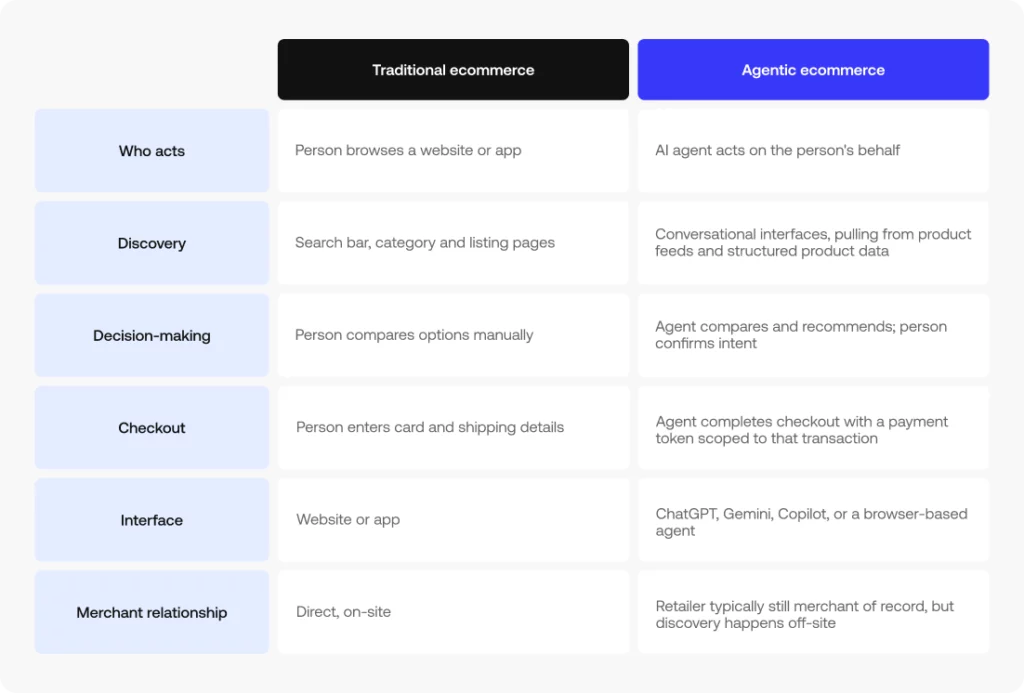
Agentic Commerce vs. Traditional Ecommerce
Who’s Building Agentic Commerce
OpenAI built Instant Checkout into ChatGPT on top of ACP. Google is rolling UCP-powered checkout into Gemini and AI Mode in Search. Microsoft launched its own Copilot Checkout in partnership with Shopify. Perplexity took a different route with Comet, a browser-based agent built for autonomous shopping that can navigate and act across sites, including ones that haven’t opted into any protocol, using the same session a person would use themselves.
That last approach has run into resistance. Amazon does not support third-party shopping agents browsing its site the way Comet does, and the dispute between the two companies has become one of the first real tests of what authorization actually means once AI agents are the ones showing up at checkout.
Where Agentic Commerce Gets Complicated
- Who’s actually authorized to be there. Amazon sued Perplexity in late 2025, arguing Comet accessed its site without permission and made it harder to separate real shoppers from automated traffic before that traffic reached advertisers. A federal judge agreed in March 2026 and temporarily blocked Comet from accessing Amazon accounts. The Ninth Circuit later lifted that block, ruling that it’s the person using the agent, not the software itself, that counts as “accessing” the site. Perplexity kept fighting the underlying case. Whatever the final outcome, the dispute previews a question every platform with agentic traffic is going to face: does a person’s permission to their own AI agent override a platform’s right to decide who gets in.
- Fraud detection has to relearn what normal looks like. Most fraud models are trained on how people behave: mouse movement, session timing, device fingerprints, browsing patterns. An autonomous agent doesn’t move like a person, which means the systems built to catch bots now have to tell a bad actor apart from a legitimate agent transacting on someone’s real behalf. Amazon’s complaint against Perplexity leaned on exactly this point, arguing it had to build new filtering just to keep AI-generated traffic from skewing what it charges advertisers.
- Structured data stops being optional. A person who hits a “sold out” banner understands what happened and looks for something else. An agent handed bad inventory data can quietly fail the checkout, or worse, complete it and create a fulfillment problem downstream. Accurate product feeds and metadata aren’t just a ranking input anymore; they’re closer to a revenue requirement, and it’s part of why agentic commerce overlaps with GEO. The same structured, accurate product information that helps an agent complete a purchase is what helps a generative engine cite that product in an informational answer in the first place.
- Interoperability means picking more than one standard. If every AI platform and every retailer needed a custom integration with each other, the math doesn’t work, which is exactly why ACP and UCP exist. But supporting an open standard isn’t free, and most retailers will end up integrating with more than one, plus whatever tokenization a given card network requires on top. The complexity doesn’t stop at checkout, either: supply chain and fulfillment still have to handle the exceptions, wrong size, canceled order, duplicate purchase, that used to get caught by a person reviewing their own cart before hitting buy.
- Subscriptions, pricing, and the reconciliation gap. When an agent renews a subscription or accepts a price on someone’s behalf, somebody still has to confirm the charge matches what was actually authorized, at the price that was actually agreed to, and reconcile it against what settled. Multiply that across two or three commerce protocols, several payment tokens formats, and transactions no person saw happen in real time, and the operations problem gets harder, not easier. This is where mismatched authorizations, duplicate charges, and disputes tend to surface, usually well after the fact, and usually as a number that doesn’t match at close.
The Part That Doesn’t Show Up in the Demo: Financial Control
None of the reconciliation problem above disappears because a transaction started with an AI agent instead of a person clicking “buy.” It just becomes less visible until it shows up as a chargeback, a duplicate charge, or a settlement file that doesn’t match what was authorized.
That’s the layer Simetrik works in. Simetrik was recently selected for Mastercard Start Path’s inaugural Agentic Commerce and Services cohort, a program built for companies working on the infrastructure behind AI-driven transactions.
As an AI-native financial control platform, Simetrik can function as a control layer between the records generated by processors, banks, and internal systems, comparing what was authorized against what actually settled and routing the differences for investigation, regardless of which protocol or AI platform initiated the transaction.
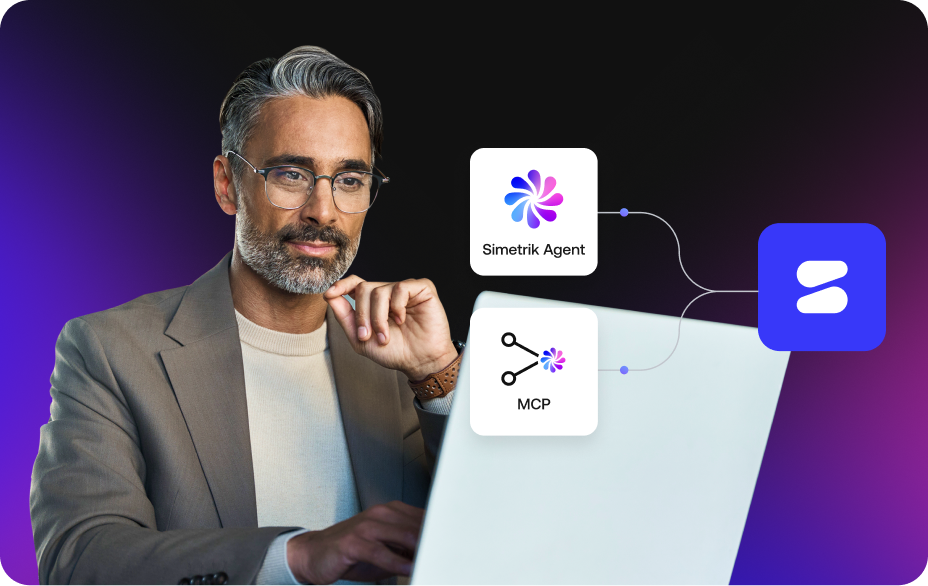
The same interoperability problem shows up on the infrastructure side, too. Simetrik connects with external agents and workflows through MCP, the same kind of open connection standard that both ACP and UCP support for linking agents to backend systems, so reconciliation and control work can plug into the tools a finance or operations team already uses.
Agentic commerce is still early. The protocols are still settling, the legal questions are still being argued, and most merchants are still deciding which standards to support. What isn’t going to change is that every one of these transactions eventually needs to be verified.
Frequently asked questions about agentic commerce
What is agentic commerce in simple terms?
It’s when an AI agent shops and pays for something on your behalf, instead of you clicking through a website or app yourself.
What’s the difference between agentic commerce and traditional ecommerce?
In traditional ecommerce, a person browses a site or app and completes checkout manually. In agentic commerce, a person states what they want to a chatbot or AI assistant, and an autonomous agent handles discovery, comparison, and checkout, usually through a conversational interface rather than a storefront.
What’s the difference between ACP and UCP?
ACP (Agentic Commerce Protocol), built by OpenAI and Stripe, focuses on the checkout session inside conversational surfaces like ChatGPT. UCP (Universal Commerce Protocol), built by Google with a group of retailers and payment companies, covers a wider set of surfaces, including Search and Gemini, across discovery, checkout, and post-purchase support. Most retailers are expected to need both.
Who is the merchant of record when an AI agent makes a purchase?
Under both ACP and UCP, the retailer typically remains the merchant of record. The AI platform provides the interface and the agent, but the sale, the customer relationship, and the settlement still belong to the merchant.
Is agentic commerce safe?
It’s early enough that the safety questions, especially around authorization and fraud detection, are still being worked out. Payment networks address part of this with tokenized credentials scoped to a specific agent and merchant, so a person can revoke an agent’s access without exposing their actual card. Whether an agent is allowed on a given site at all is a separate, ongoing legal question.
How does agentic commerce affect financial reconciliation?
Transactions started by an agent still need to be verified against what settles, the same as any other transaction, but with fewer human touchpoints along the way to catch mismatches early. That makes reconciliation and financial control more important, not less, as agentic commerce scales.