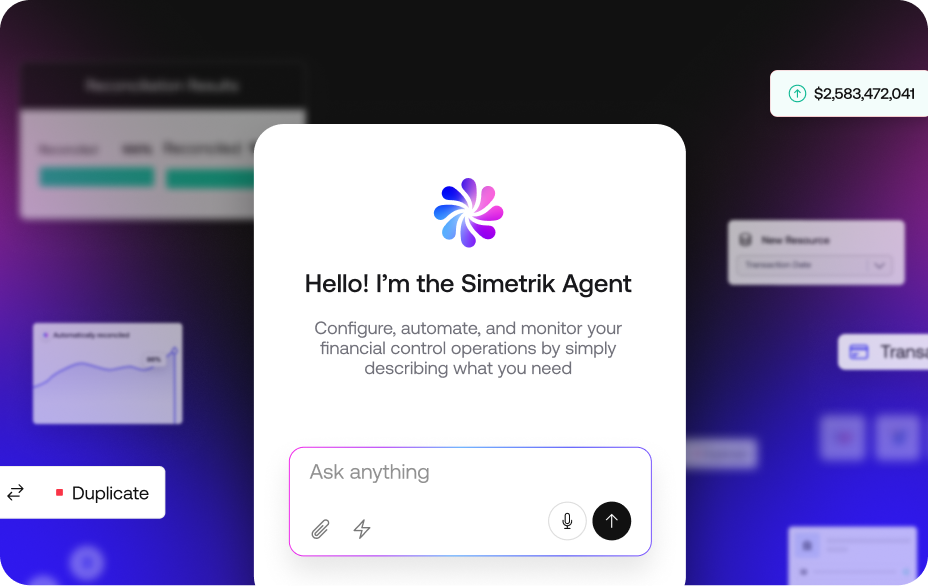
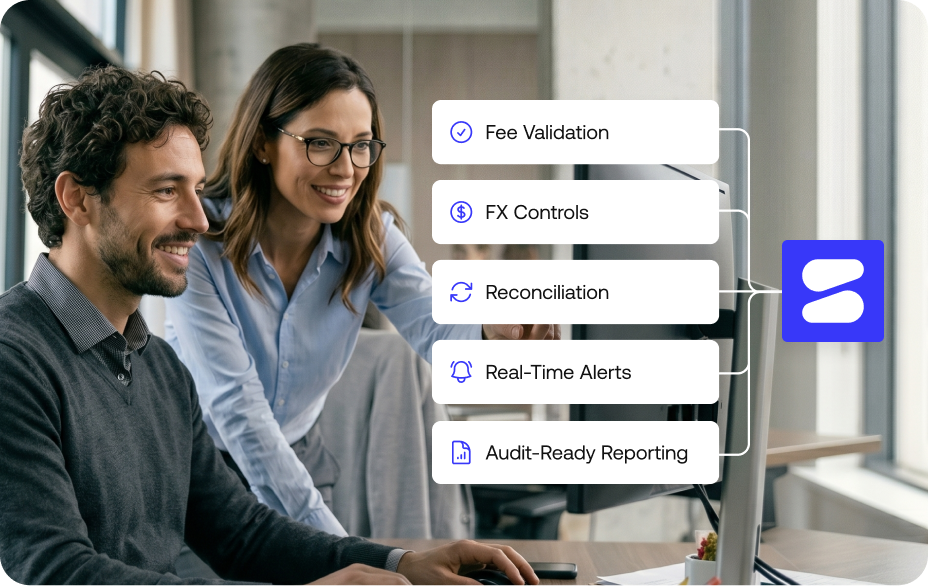
An autonomous agent that runs end to end without human intervention, decides when to lean on its deterministic core for an exact, verifiable result, and when to bring a person in. All inside an open box that is auditable end to end. It is joined by MCP connectivity and a CLI for technical teams.
San Francisco. Simetrik, the AI-powered financial operations control platform, introduces Simetrik Agent: an autonomous agent that executes financial control work end to end, in natural language and with no need for human intervention. It interprets the request, reviews the working environment, integrates the sources, identifies dependencies, and on its own configures, implements, reconciles, and analyzes exceptions.
Agentic, with exact results when they matter.
What sets Simetrik Agent apart from a generic agent is that it does not improvise where the business needs certainty. When a result must be exact, verifiable, and auditable, the agent turns to Simetrik’s deterministic core: more than 110 specific financial-control functions. The agent knows when to reason probabilistically and when to lean on that deterministic core, which always returns the same verifiable result.
That combination is where Simetrik’s deep knowledge of the financial industry makes the difference: an agent that alternates probabilistic reasoning and its deterministic core according to what each task demands, with the governance guardrails needed to audit every step and prevent errors. This is how Simetrik becomes a natural part of the CFO tech stack.
Autonomous and open box.
It is not a black box, it is an open box. Unlike opaque AI, where no one knows for certain why it did what it did, with Simetrik Agent every decision is expressed in financial language any person understands, can supervise, and can change whenever they want. And the agent itself recognizes when a person’s involvement is key and asks for it. Far from slowing it down, that collaboration makes it more powerful.
One control, three ways to operate it
To extend that control beyond the platform, Simetrik adds two complementary paths. With Model Context Protocol (MCP), organizations connect the agents they already use, their own or built on models like Claude, Copilot, or Gemini, with Simetrik’s financial knowledge and control capabilities, without rebuilding reconciliation logic from scratch. And a command-line interface (CLI) lets technical teams create and run reconciliations, configure sources, automate exports, and integrate controls with CI/CD pipelines.
Whether through the agent, MCP, or the CLI, everything runs on the same Simetrik capabilities and under a single standard of permissions, traceability, and financial control.
“The future of financial control is agentic and autonomous. The difference lies in building an agent that truly understands the financial world: one that knows when a result must be exact and auditable, when it is worth bringing a person in, and that keeps everything visible so the team stays in control. That is Simetrik Agent”, says Santiago Gomez, Co-Founder and COO of Simetrik.
Simetrik Agent, MCP, and CLI are now available to Simetrik customers. Learn more at simetrik.com.
About Simetrik
Simetrik is the AI-powered financial operations control platform. Its mission is to give finance teams the control to operate with speed, accuracy, and confidence in an increasingly complex environment. With an autonomous agent backed by a deterministic, auditable core, Simetrik automates complex reconciliations and end-to-end financial controls, and provides a single source of truth over which people retain full control. Today, more than 180 leading companies across 50+ countries trust Simetrik to process 2.5 billion daily records, cut losses, and accelerate growth.
Our client, a leading US-based recruitment platform, was scaling fast across international markets, but its payment infrastructure was quietly creating risk it couldn’t see.
There’s a particular kind of operational problem that doesn’t announce itself loudly. It doesn’t crash systems or trigger alarms. It just accumulates, in spreadsheet tabs that grow longer every month, in analyst hours spent cross-checking numbers that should already match, in overcharges that slip through because nobody had time to catch them.
That was the reality for the finance team at a leading US-based SaaS platform, operating across multiple markets in the US and EU. The company ran its payment stack across seven different processors, each with its own reporting format, its own fee structure, and its own logic. Seventy-seven integrations in total. All of it landed on the desks of a three-person team and their manager, armed with Excel.
How can finance teams reconcile transactions across multiple payment processors? In this case, multi-processor payment reconciliation meant standardizing data from seven processors in one control layer, matching transactions against third-party reports, validating fees and FX charges, and surfacing discrepancies for review.
The problem nobody could see all at once
The finance team wasn’t struggling because they were disorganized. They were struggling because the data itself was fragmented by design. Each processor reported differently. Comparing fee structures across partners meant manually translating one set of numbers into another before any analysis could even begin. In the team’s own words: they couldn’t “compare apples to apples.”
Fee validation alone consumed more than ten hours every week. Tier-based pricing models, where rates shift depending on transaction volume, made the work especially unforgiving. A small miscalculation early in the month could cascade quietly into a billing discrepancy that nobody would catch until someone had the bandwidth to dig.
FX issues were worse. Cross-currency charges that deviated from contractual rates were flagged reactively, if at all. The team knew discrepancies were happening. They just didn’t know how often, or how much they were being absorbed silently into the cost base.
The $300,000 moment made it concrete. Before any new tooling was in place, the team discovered a six-figure overcharge through manual review, not through a system, not through an alert, but through sheer persistence. It was a wake-up call. If that one had slipped through, it would have been paid without question.
Reporting added another layer. Financial data lived across disconnected spreadsheets. Before any number could be used, for bookkeeping, for analysis, for revenue recording, someone had to manually consolidate it first. There was no single layer where all processor data was standardized and ready to work with.
How the company unified seven payment processors
The company came to Simetrik looking for a way to unify its processor ecosystem without ripping it apart. The goal wasn’t to consolidate providers; it was to build a control layer above them, one that could ingest data from all seven processors and surface it in a consistent format.
Phase one focused on the fundamentals: consolidating the 77 integrations into a single standardized data layer, automating fee validation, and replacing ad hoc exception handling with proactive controls.
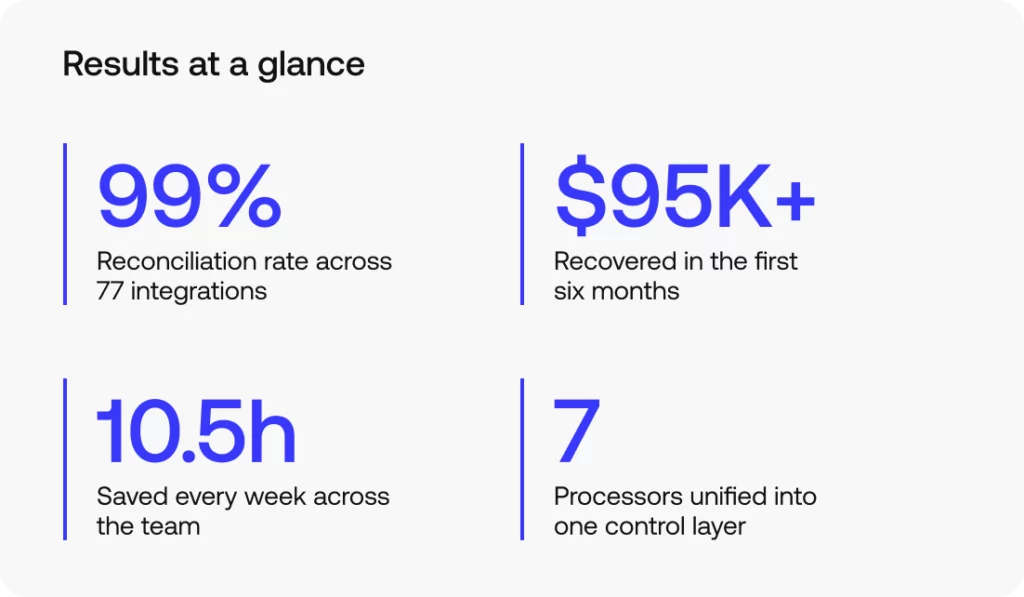
The mapping, transformation, and tier-pricing aggregation that had previously consumed a significant portion of three analysts’ weeks was now handled automatically. When a processor billed incorrectly, whether due to a rate misapplication, an FX deviation, or a billing error, Simetrik surfaced it. The team stopped discovering overcharges after the fact and started catching them as they happened. Every processed transaction was confirmed and matched against third-party reporting in real time, giving the team a single number they could trust: a 99% reconciliation rate across the full processor ecosystem.
The financial impact was immediate. In Phase 1 alone, the platform identified six-figure savings from processor overcharges and billing discrepancies. Over the first six months, the team recovered more than $95,000 in overcharged fees and reclaimed more than ten hours of analyst time every week. Each team member got back roughly 10% of their workday.
The broader pattern
There’s a version of this story that happens at nearly every company operating a multi-processor payment stack. The fragmentation isn’t a failure. It is the natural result of building across markets, adding partners as the business grows, and managing complexity one integration at a time. The problem is that the tools built to handle early-stage complexity don’t scale with it.
Excel is remarkable at what it does. But a three-person team running manual fee validation across seven processors and tier-based pricing models is a system operating beyond its capacity.
What this case illustrates is that the path to financial control in a complex payment environment isn’t simplification. It’s unification. Building a layer that standardizes data across sources, automates the validation work, and surfaces exceptions before they become losses. That is what turns a fragmented processor ecosystem into something a finance team can actually govern.
The $300,000 overcharge was already hiding in plain sight before Simetrik was implemented. The question isn’t whether there are more like it in your stack. The question is whether you have the infrastructure to find them.
Payment operations domains in scope
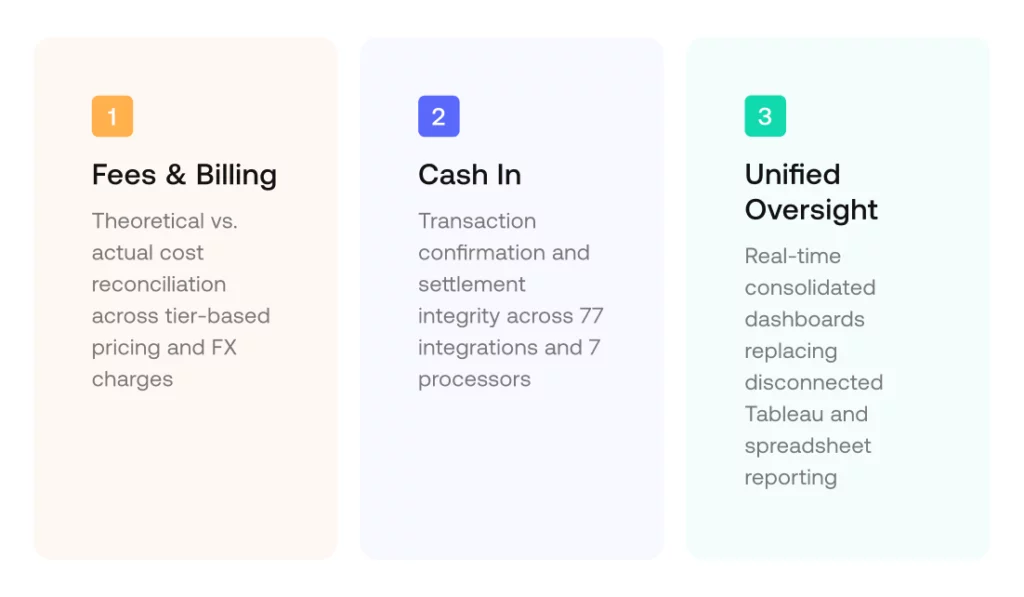
Simetrik organizes financial operations control around eight domains, each one covering a distinct area where money moves, fees are applied, or financial data needs to be trusted. In any given engagement, the domains in scope reflect where a company’s risk actually lives. For this customer, three domains were at the center of the work.
Cash In: Transaction confirmation and settlement integrity controls across 77 integrations, ensuring every processed transaction is accurately confirmed and reconciled against third-party reporting.
Fees & Billing: Theoretical vs. actual cost reconciliation across tier-based pricing structures and FX charges, replacing manual Excel validation across seven processor contracts.
Unified Oversight & Alerts: Real-time consolidated dashboards replacing disconnected spreadsheet reporting, giving finance and treasury leadership a single source of truth across the full processor ecosystem.
Company identity has been anonymized at the client’s request.
As of August 25, 2026, the Digital Asset Market CLARITY Act (H.R. 3633) has not been enacted. The bill passed the House in 2025 and the Senate Banking Committee advanced an amended version by a 15–9 vote on May 14, 2026. It remains proposed legislation while the Senate considers the bill.
The bill would establish a federal market structure for digital assets and clarify oversight roles. Because the final text and effective dates may still change, crypto companies should treat the five controls below as operational readiness measures, not as a definitive compliance checklist.
Companies that strengthen these controls now can be better prepared for audits, institutional due diligence, and future scale. Here are the five financial controls you need to have in place and why each one matters more than ever under the new regulatory reality.
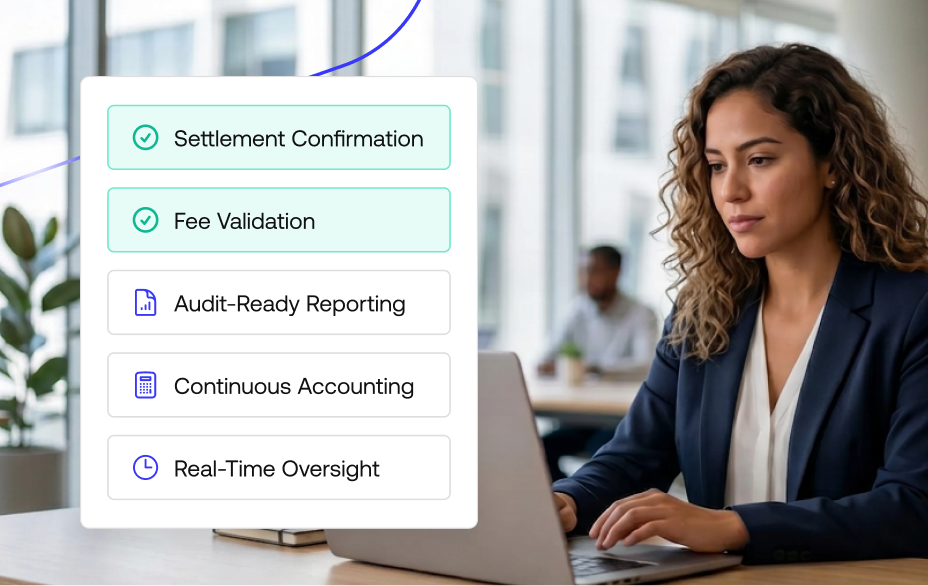
1. Settlement Confirmation Across Every Payment Rail
Why this control matters: A more defined digital asset market structure could increase institutional participation. More counterparties and settlement methods create more points where records can diverge between intent and execution.
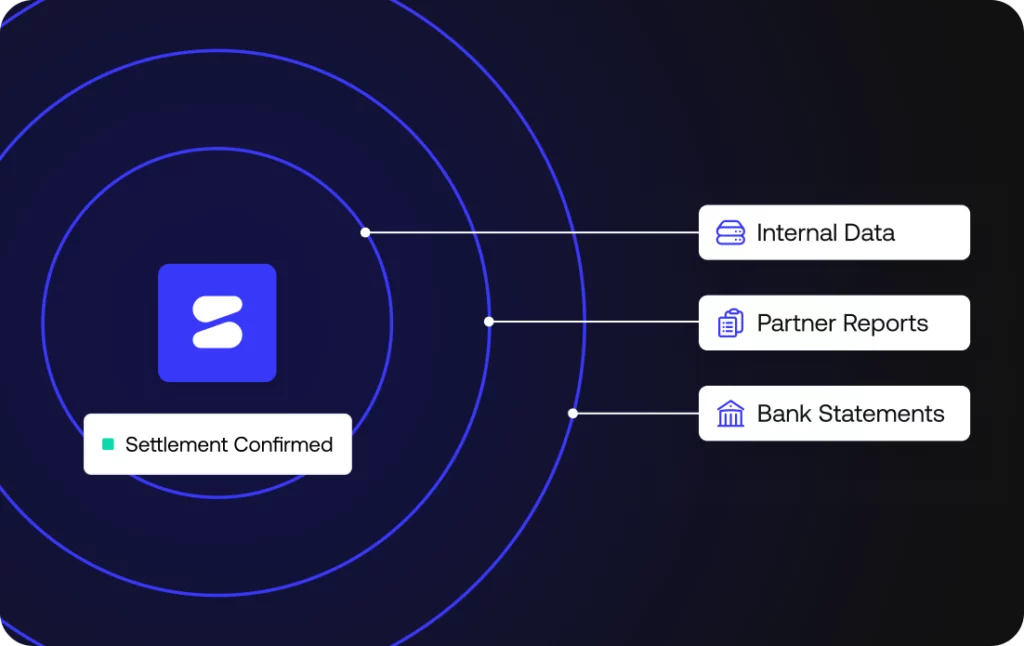
The control: You need to confirm that every dollar (or token) that should have moved actually moved accurately and on time. That means reconciling your internal operational data against partner settlement reports and bank statements across every payment source, every day. Not at month-end. Not in a spreadsheet.
How Simetrik solves this: Simetrik integrates your internal databases, partners’ operational and settlement reports, and bank statements to validate equivalent data points while maintaining full traceability throughout every stage of the transaction lifecycle. When you’re processing fiat-to-crypto conversions across multiple custodians and sponsor banks, this is how you prove the money arrived.
2. Fee Validation Against Every Contract and Network
Why this control matters: Proposed oversight for digital asset exchanges, dealers, and brokers increases the importance of proving how fees are charged, collected, and reported. Platforms should be able to validate trading fees, spreads, custody fees, or other charges against transaction-level records.
The control: You need to validate that the fees you’re being charged by processors, networks, and banking partners match what’s in your contracts and that the fees you’re collecting from customers are applied correctly across every transaction. Fee discrepancies at scale erode margins silently.
How Simetrik solves this: Simetrik integrates your partner fee agreements, settlement reports (incoming and outgoing), and internal databases to validate fees against rules and contracts, detect overcharges, and turn fee transparency into negotiation leverage. For crypto companies, where fee structures vary by network, token, and volume tier, this control can help protect margins and support measurable ROI.
3. Audit-Ready Reporting with Full Traceability
Why this control matters: Existing customer due diligence, suspicious activity reporting, and AML obligations already make verified, traceable data essential for in-scope entities. Future market-structure rules may add reporting expectations, but the exact requirements will depend on the final law and implementing regulations.
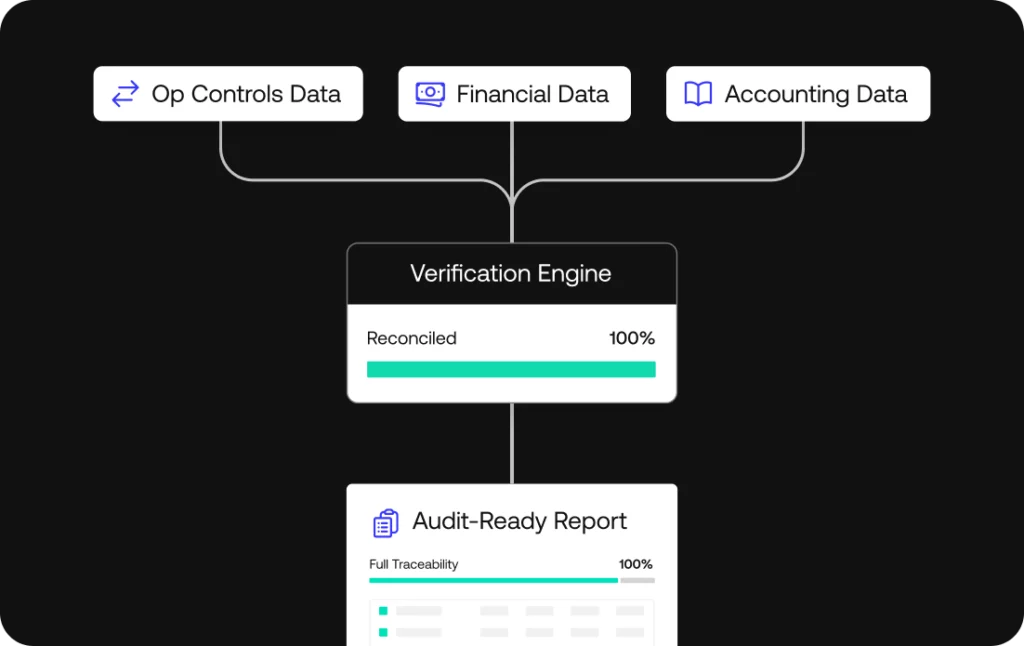
The control: Crypto companies subject to reporting requirements need to generate compliance reports based on reconciled data that traces back to the original source. Every match, exception, and resolution should be documented and audit-ready at all times.
How Simetrik solves this: Simetrik generates audit-ready reports for regulators and stakeholders based on verified data from your operational, financial, and accounting controls. Every report maintains full traceability back to the original data sources, reducing regulatory risk and cutting audit preparation time.
4. Continuous Accounting Controls
Why this control matters: As digital asset classifications and oversight continue to evolve, crypto companies cannot afford to discover accounting errors weeks after the close. Accounting rigor and traceable records remain essential regardless of the final bill text.
The control: You need to continuously automate revenue recognition, accruals, and provisions at transaction scale. Journal entries should be generated from reconciled and verified data, not from raw exports that someone manually cleaned up.
How Simetrik solves this: Simetrik automates operational accounting by generating journal entries from reconciled data, calculating provisions, and integrating with ERPs like SAP, Oracle, and NetSuite. The result: financial close accelerated by 1 to 2 weeks, with audit-ready documentation at every step.
5. Real-Time Oversight and Anomaly Detection
Why this control matters: The bill would introduce new definitions and oversight boundaries for digital asset activities. Whatever final classifications apply, platforms need visibility into reconciled transactions, exceptions, and control evidence.
The control: You need real-time dashboards that track KPIs across your entire operation, with intelligent alerts that flag anomalies before they become losses or regulatory findings. You can’t monitor what you can’t see, and you can’t report what you haven’t reconciled.
How Simetrik solves this: Simetrik provides customizable dashboards tracking real-time KPIs, intelligent alerts on anomalies, consolidated views of reconciled balances across sponsor banks, and drill-down from summary to transaction detail all based on reconciled and verified data.
The Bottom Line
The Clarity Act isn’t a surprise. The regulatory direction has been clear for years. Now that the Clarity Act is taking shape, crypto companies have a window to get ahead of it.
The companies that treat compliance as a strategic advantage will be the ones that earn institutional trust, close their books faster, and scale without adding headcount. That’s the difference between building controls reactively and building them on a platform designed for exactly this kind of complexity.
Simetrik already processes 2.5 billion daily records and reconciles over $500 billion in annual TPV for 160+ enterprise clients across 50+ countries, including some of the largest fintechs and digital asset platforms in the world. The controls described above aren’t theoretical. They’re live, in production, today.
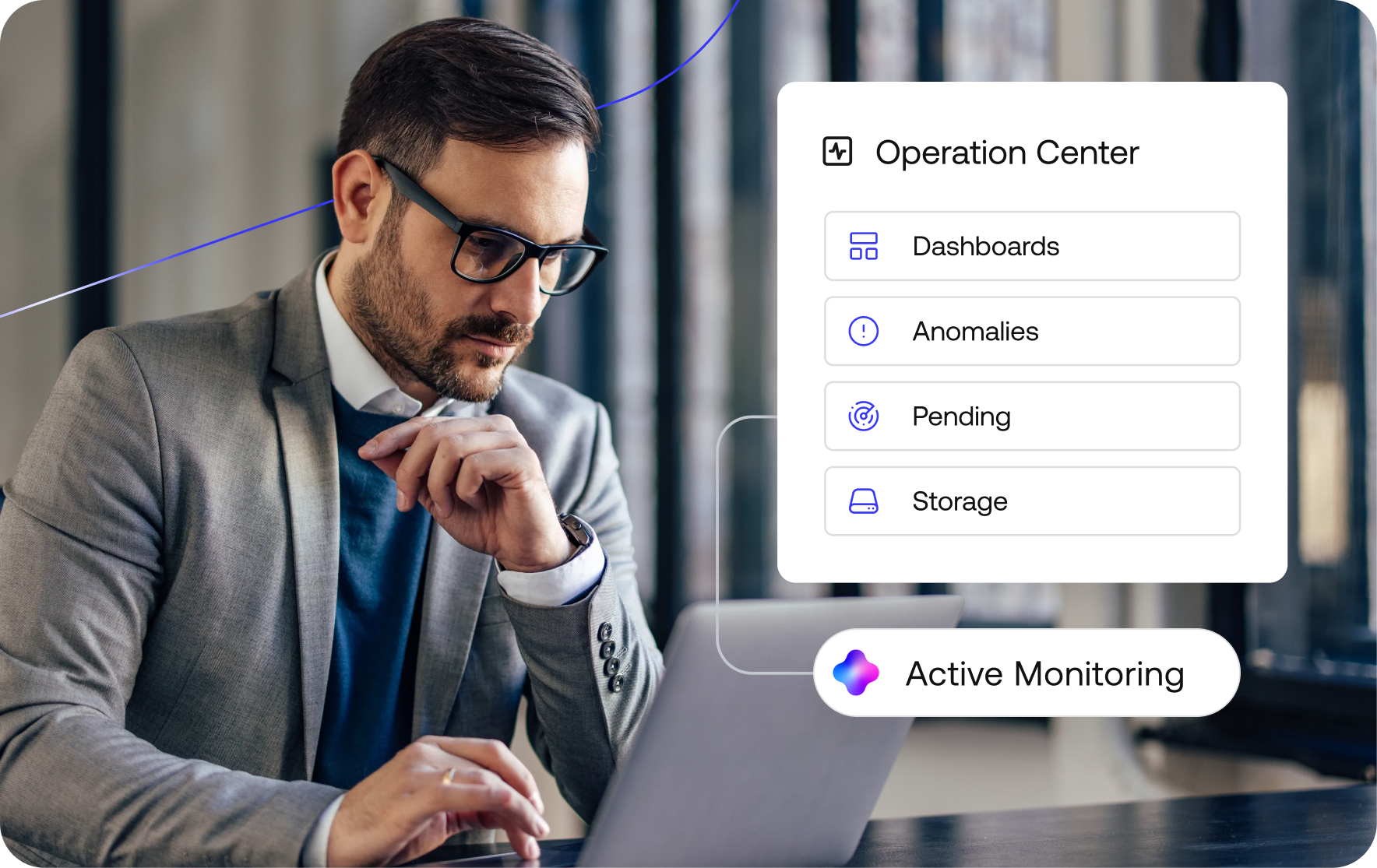
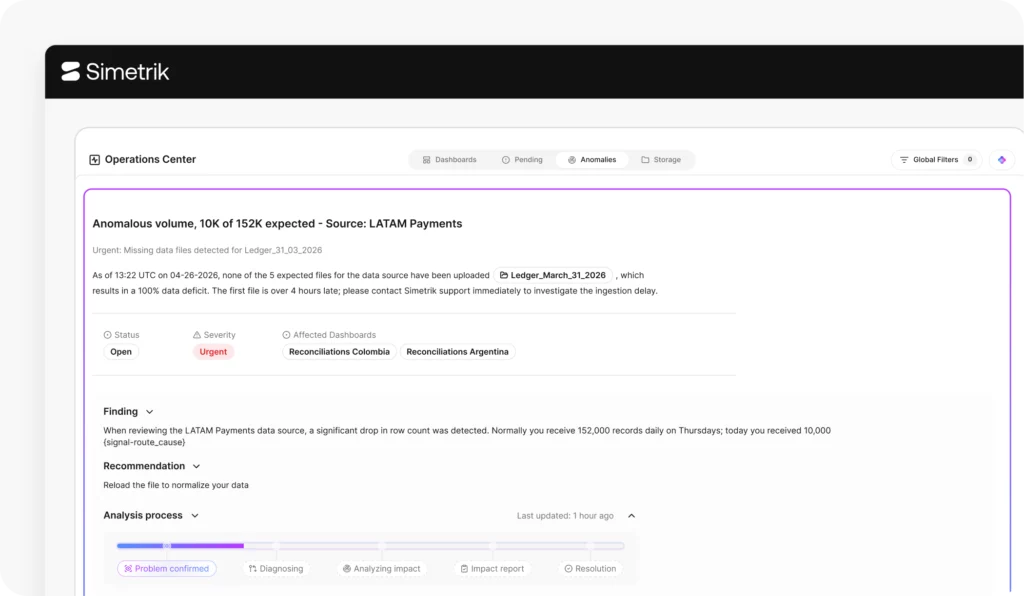
In our new version, the Operation Center arrives: the module that unifies the visualization, analysis, and resolution of your financial operations in one place.
DEPLOY DATE
June 16, 2026
7:00 p.m. GMT-5 — Global 8:00 p.m. GMT-6 — Mexico 9:00 p.m. GMT-3 — Brazil 9:00 p.m. GMT+5:30 — India
All features will be rolled out progressively.
OPERATION CENTER
Operate, detect, and resolve from one place
Dashboards, datasets, anomalies, and pending items unified in a single module. Go from observing to acting without switching tools.
Dashboards
Anomalies and pending items
Multiple dashboards organized by pages and various chart types. Switch views without losing the context of your operation. Build queries in seconds with the AI Copilot, directly in your datasets.
Incidents detected automatically with identified root cause. Manage and resolve pending items individually or in bulk with full traceability.
Record and certify with more flexibility
Generate journal entries directly from data sources, without prior reconciliation. And document in your control the differences between ERP and reconciled balance with auditable evidence.
More freedom to automate your journal entries
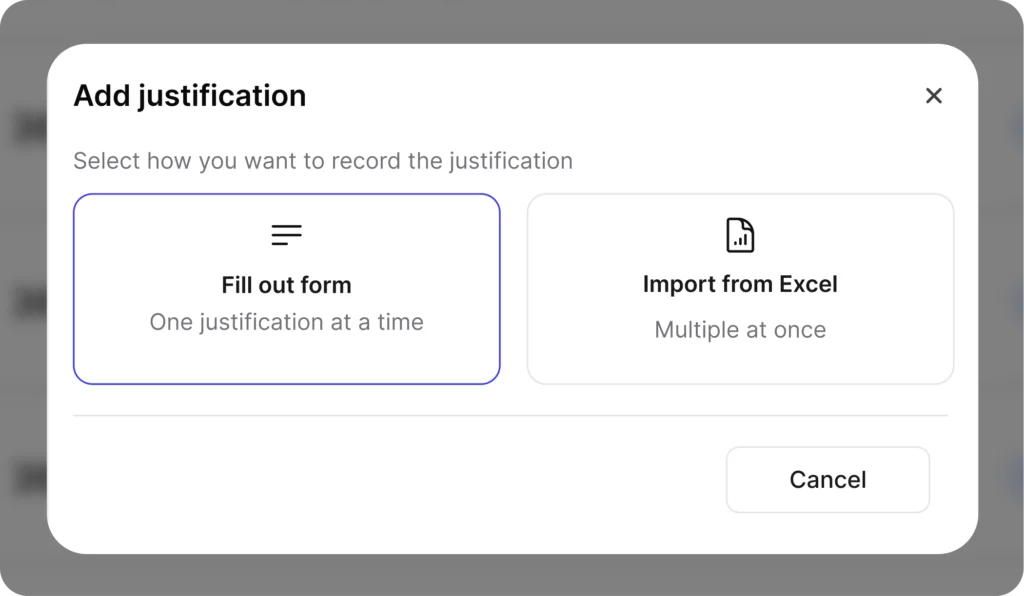
Full control over your closing differences
Automatically generate journal entries from your sources, without prior reconciliations. Journal entries are automatically reversed when records are deleted.
Centralize the justification of differences and monitor their evolution each period.
Turn off and reactivate without deleting your accounting automations
Turn off an accounting automation without deleting it. Keep its configuration for reference or as a base for new ones, and automatically release the associated resources for editing
Run reconciliations when your data is ready and manage columns safely
Define when your processes are triggered and delete columns without affecting existing configurations.
A+B Trigger
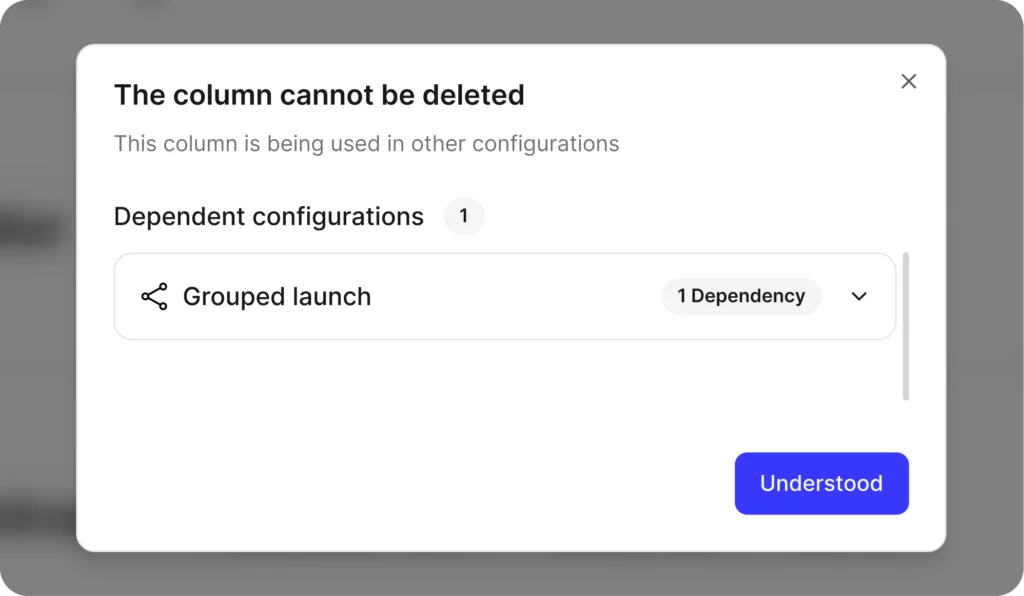
Column deletion
Run only when all required inputs are available. Set a maximum wait time to guarantee the daily close.
Delete columns with automatic dependency validation. The system blocks the action and indicates exactly which resources are using it.
The previous module-based navigation will no longer be available. From now on, smart navigation will be the only one available on the platform.
The Financial Operations Control Platform expands access for enterprise customers through consolidated procurement, billing, and AWS EDP commitments.
Bogotá, Colombia, 2026. Simetrik, The Financial Operations Control Platform, today announced the availability of its platform as a listing in the AWS Marketplace of Amazon Web Services (AWS). With this launch, AWS customers can now procure Simetrik through a streamlined buying experience, accelerating time-to-value for finance and operations teams that operate at enterprise scale.
What Simetrik on AWS Marketplace means for customers
Simetrik’s addition to the AWS Marketplace allows customers to quickly access its platform through a consolidated billing and procurement process, allowing customers to leverage AWS budgeting services for Simetrik software purchases. For organizations with Private Pricing Agreement (PPA) commitments, every dollar spent on Simetrik through AWS Marketplace counts toward their committed AWS spend, turning a control-platform investment into a strategic procurement decision.
Modern finance and operations teams face a structural problem: data never matches across processors, banks, networks, and ledgers. Variability, not volume alone, is what makes financial control hard at scale. Simetrik combines deterministic reconciliation controls with AI-assisted configuration and analysis across financial operations domains, helping teams identify discrepancies, maintain traceability, and scale governed workflows.
Today, more than 160 leading companies across 50+ countries trust Simetrik to process 2.5 billion daily records and reconcile $500B+ in annual TPV, including Mercado Libre, Rappi, Nubank, PayU, DLocal, Itaú, and Bancolombia.
Our mission is to empower finance teams with the control they need to operate with speed, accuracy, and confidence in an increasingly complex environment. We combine AI and cutting-edge technology to automate complex reconciliations, implement comprehensive financial controls, and provide a single source of truth. Today, more than 160 leading companies across 50+ countries trust Simetrik to process 2.5 billion daily records, cut losses, and accelerate growth.
Every fintech CFO has the same answer when you ask about reconciliation: “We’re covered.”
The dashboards are green. The month-end close completes on schedule. The board deck shows transactions processed, revenue recognized, and cash positions balanced. Everything looks healthy.
And then someone finds $2 million in losses that was there the entire time.
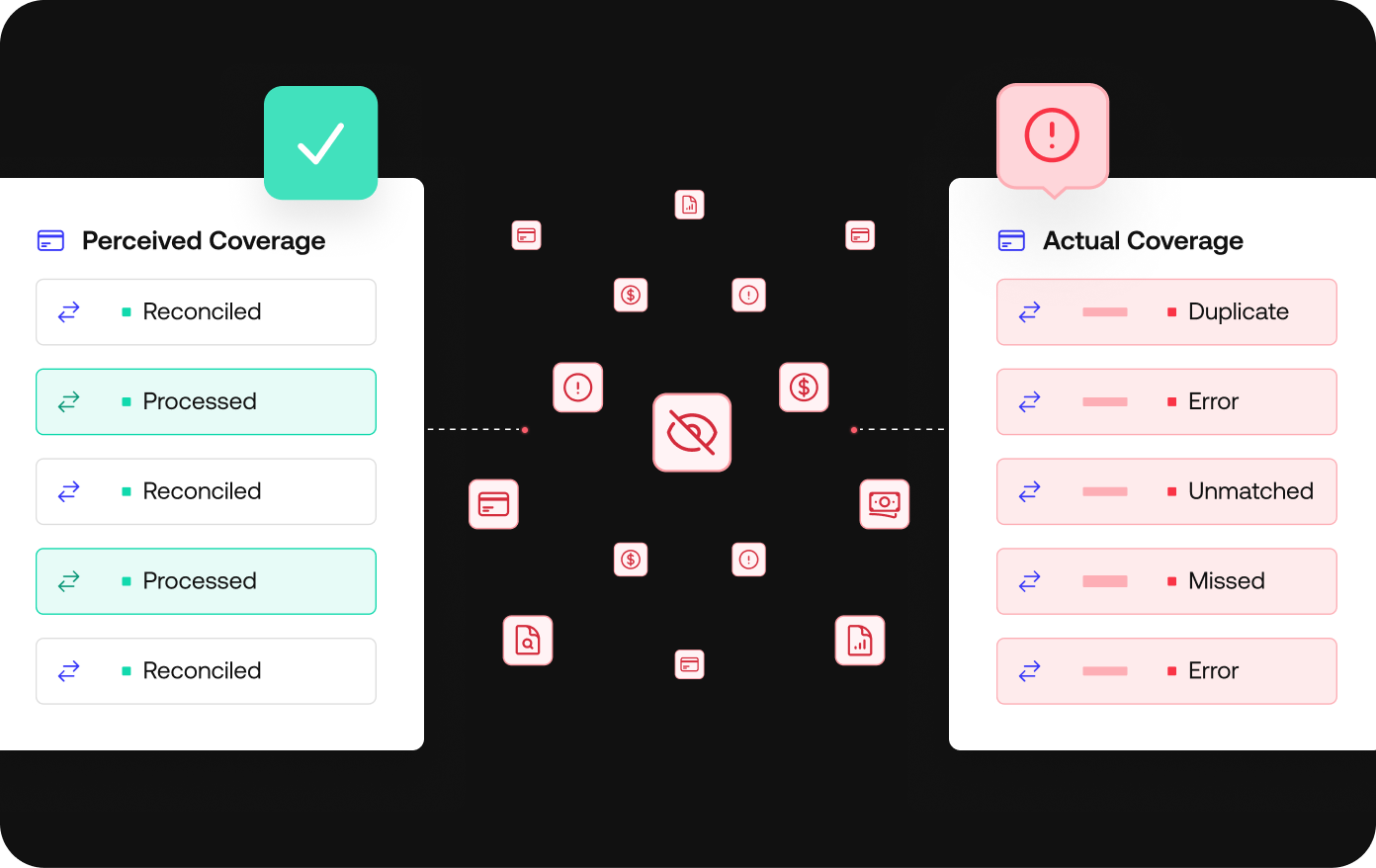
This is what we at Simetrik call the Confidence Gap, the distance between what finance leaders *believe* their reconciliation covers and what it *actually* covers. It is the most expensive blind spot in modern financial operations, and it is growing wider as payment complexity accelerates.
The Anatomy of an Invisible Problem
The Confidence Gap does not announce itself. There is no failed reconciliation run, no red flag in the dashboard, no alert from your payment processor. The numbers check out at the level you are looking at. The problem is that you are looking at the wrong level.
Consider a real case: a sophisticated payment processor operating across three markets, processing billions in annual volume. They had reconciliation processes. They had a finance team. They had dashboards. And buried inside their data were three separate sources of margin leakage totaling $2 million. None of which were visible to their existing controls.
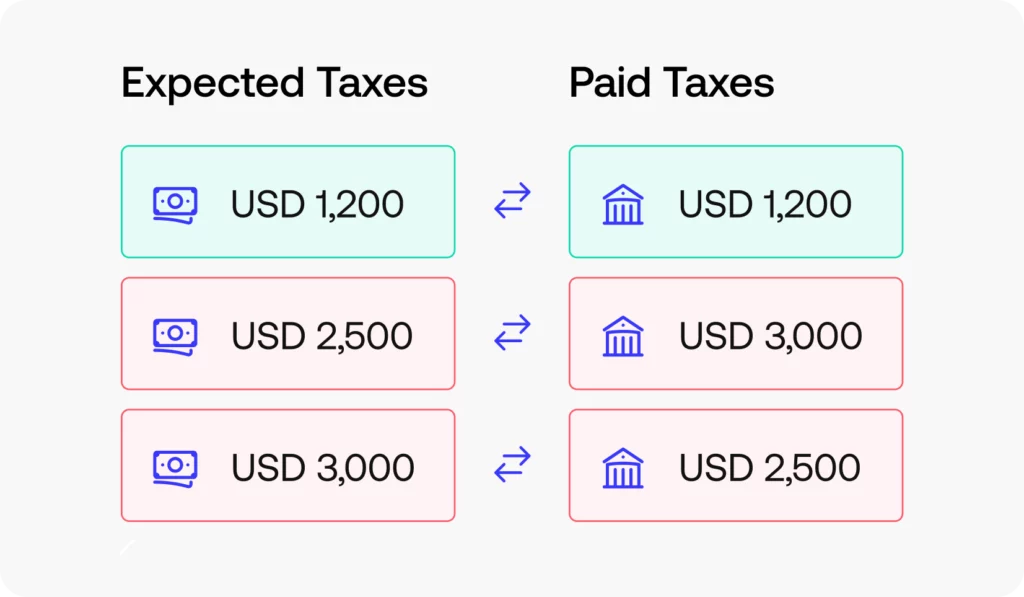
The first was a partner bank incorrectly withholding taxes on transactions. At the aggregate level, “taxes paid” checked out. At the transaction level, the wrong taxes were being applied to the wrong transactions. The second was a transaction code ambiguity, multiple acquirers used the same code for refunds and chargebacks, causing missed dispute deadlines and absorbed losses. The third was a pattern of duplicate debits on refunds spanning multiple countries, invisible without cross-entity pattern detection.
These were not edge cases. They were systemic, ongoing losses hiding behind reconciliation processes that looked perfectly functional.
Three Forces That Widen the Gap
The Confidence Gap is not caused by negligence. It is a structural consequence of three forces that compound as fintechs scale.
Volume masks discrepancies
When you process millions of transactions, aggregate numbers look healthy even when errors are accumulating underneath. A $500 tax misapplication on one transaction is noise. That same error compounding across thousands of transactions over months becomes a seven-figure problem, and it never triggers an alert because the totals still balance within acceptable thresholds.
Complexity outpaces process
Every new payment method, every new market, every new banking partner adds reconciliation complexity. Your team bolts on new processes to handle the new flows, but those processes were designed for yesterday’s architecture. The result is a growing patchwork of manual reviews, spreadsheet cross-references, and scripts that work until they silently stop.
Reconciliation is treated as hygiene, not infrastructure
It gets investment last, attention last, and talent last. Your best engineers are building product features, not reconciliation pipelines. Your best analysts are preparing board decks, not investigating transaction-level anomalies. Reconciliation gets treated as a back-office checkbox until a regulator, an auditor, or a $2 million loss forces it into the spotlight.
The Regulatory Signal You Cannot Ignore
If the business case alone does not close the gap, the regulatory environment should.
In late 2024, the FDIC proposed a new recordkeeping rule for custodial accounts. This was a direct response to the Synapse Financial Technologies collapse, which left over 100,000 consumers locked out of their money and exposed an estimated $65 million to $95 million shortfall between bank records and actual customer balances. The proposed rule pushes banks partnering with fintechs toward transaction-level traceability of beneficial ownership. A standard that makes aggregate reconciliation insufficient by design.
While the rule’s timeline has shifted under the current administration, the direction is clear: regulators are moving toward requiring the granularity that most fintech reconciliation architectures were never built to provide. Whether the FDIC rule takes effect this year or not, the expectation of transaction-level auditability is becoming the baseline. Companies that get ahead of it will have a competitive advantage; companies that wait will be scrambling.
Five Warning Signs You Have a Confidence Gap
Not every company has a $2 million problem. But most scaling companies have at least two of these five warning signs and if you recognize more than two, the gap is real.
Your reconciliation runs on a schedule, not on events
End-of-day or twice-a-week reconciliation creates windows where errors compound undetected. Event-triggered reconciliation catches a $500 error on day one. Batch reconciliation discovers a $500,000 problem six months later.
You reconcile in aggregate, not at the transaction level
The $470,000 tax issue described above was invisible at the aggregate level. “Taxes paid” checked out. “Correct taxes paid on correct transactions” did not. If your reconciliation summarizes before it compares, it is designed to miss the errors that matter.
Your reconciliation is siloed by partner or market
The duplicate-debit pattern spanned three countries and multiple acquirers. No single partner’s data showed an anomaly. Only a cross-entity view comparing behavior patterns across all acquirers simultaneously could surface it. If your reconciliation runs in parallel silos that never intersect, cross-entity patterns stay invisible.
Finance cannot configure a new reconciliation flow without engineering
In the case study above, the company went from six weeks to two weeks to onboard a new payment method once finance could configure flows independently. When reconciliation depends on engineering backlogs, your speed to market is bottlenecked.
A regulatory audit would take you weeks, not hours
If producing a complete transaction-level audit trail is a project rather than a query, your infrastructure lacks the granularity you think it has. As regulators push toward real-time traceability, “we can get it to you by next week” is not going to be an acceptable answer.
Closing the Gap
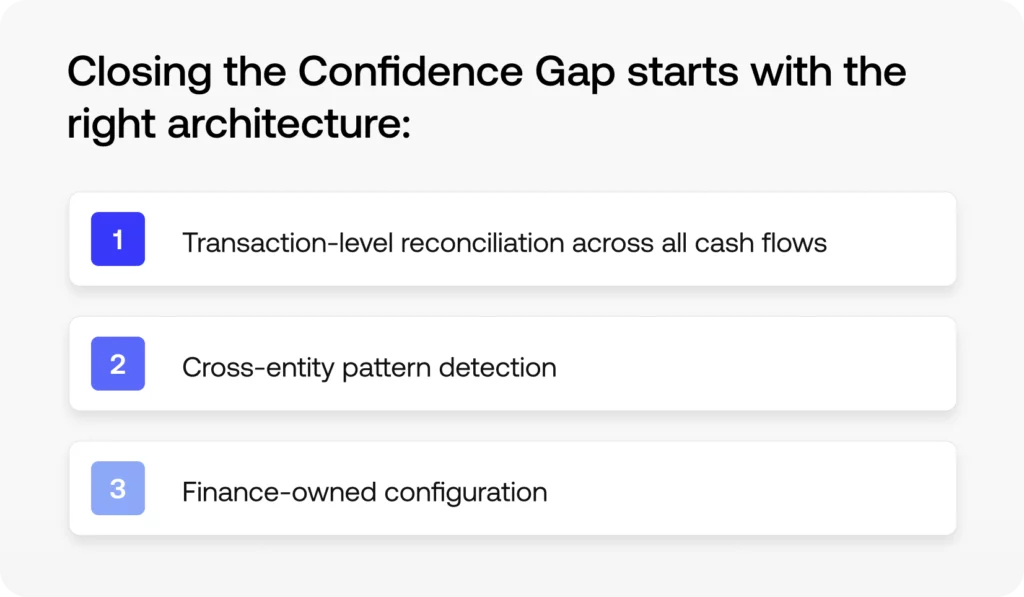
The companies that close the Confidence Gap share three architectural characteristics;
Transaction-level reconciliation across all cash flows
Not summary batches, not aggregate totals, but every individual transaction matched from payment processor to core ledger, continuously. Simetrik automates this across all inbound and outbound payment flows, reconciling at the transaction level and flagging discrepancies within hours, not weeks. This is how the $470,000 tax phantom was found: by comparing individual transactions against banking records instead of trusting aggregate totals.
Cross-entity pattern detection
Discrepancies that span multiple partners, markets, or acquirers require a unified view of all settlement data. Simetrik’s platform processes 2.5 billion records daily across 50+ countries, enabling the kind of cross-entity anomaly detection that caught the duplicate-debit pattern across three markets. Manual processes and siloed reconciliation tools are structurally incapable of surfacing these patterns.
Finance-owned configuration
When finance teams can build and modify reconciliation flows without waiting for engineering, two things happen: new payment methods get reconciled from day one (instead of six weeks later), and the people closest to the business logic are the ones designing the controls. Simetrik’s no-code platform puts reconciliation configuration in the hands of finance and ops teams, reducing dependency on engineering.
Do you have gaps?
The Synapse collapse proved that a company can process billions in volume, serve millions of customers, and still lose track of tens of millions of dollars because of a visibility failure. Their reconciliation architecture was not designed for the complexity they had grown into.
The $2 million case study proves that even sophisticated processors with real reconciliation processes can have systemic margin leaks hiding in plain sight.
The question is not whether you have a Confidence Gap. The question is whether you will close it before it costs you more than you are comfortable discovering.
Are you ready to see what your current reconciliation is missing? Schedule a 30-minute personalized demo with Simetrik. We will use a secure sandbox environment with either dummy data or your actual payment data to show you live, automated discrepancy detection and the transaction-level audit trails that close the gap.
We’re excited to share that Simetrik has been selected for Mastercard Start Path, the global startup engagement program that has supported over 500 companies from more than 60 countries to accelerate growth and innovation in the financial ecosystem.
This is a meaningful milestone for us, but more importantly, it’s a meaningful milestone for the issuers, acquirers, fintechs, and financial institutions we serve every day. Here’s what it means in practice.
Closing the gap between payments and accounting
Digital payments have scaled fast. The back office hasn’t kept up. Finance teams at banks, payment processors, and fintechs are still reconciling manually, chasing exceptions, and building controls they shouldn’t have to build from scratch.
Simetrik exists to close that gap. Our AI-native platform gives every participant in the payments chain complete visibility and traceability across every transaction continuously, not just at month-end.
The Mastercard Start Path recognized this approach. Through the Corporate Solutions track, we’ll have the opportunity to collaborate directly with Mastercard to bring automated reconciliation and financial controls to high-volume, high-complexity payment ecosystems around the world.
“Digital payments scaled fast. The back office didn’t. Finance teams at the world’s largest banks and payment processors are still reconciling manually, chasing exceptions, and building controls they should never have had to build themselves. Simetrik exists to close that gap. Our vision is to be the AI-native platform for global financial operations, giving every participant in the payments chain, from fintechs and banks to acquirers and issuers, full confidence in every transaction from start to finish.”
— Santiago Gómez, Co-Founder & COO, Simetrik
Four exciting benefits for our customers and partners
1. Go live faster with pre-built templates
If you’re processing issuing or acquiring flows, you won’t need to start from scratch. Simetrik’s pre-built templates for workflows mean your finance and operations teams can build and modify reconciliation processes without engineering support. This can deploy transaction-level controls in weeks, not months. No custom code. No long integration timelines.
2. Third-party validation for regulated environments
For issuers, acquirers, and other regulated entities, vendor selection isn’t just about capability. It’s about trust. Simetrik aligns with the governance, security, and operational standards that global card networks expect. At a moment when regulators are raising the bar on transaction-level evidence, that independent validation matters for your audit trail and financial control framework.
3. Pre-validated integrations for your payment infrastructure
Integration headaches are one of the biggest barriers to adopting new financial operations tools. Simetrik’s connectors meet the connectivity and data-format standards that global financial institutions require. That means the platform works with your existing payment infrastructure without custom development.
4. A direct channel into Mastercard’s ecosystem
Mastercard Start Path opens a direct connection for Simetrik to reach Mastercard’s corporate clients and partners. For our customers, that creates opportunities for joint pilots and co-solutions across issuing, acquiring, and cross-border payment operations, shortening the path from evaluation to production.
What’s next
This opportunity with Mastercard can advance what we’ve been building since day one: a single platform that gives finance and operations teams full confidence in every transaction, across every partner, in every market they operate in.
If you’re already using Simetrik, you’ll benefit from deeper integrations and faster template rollouts. If you’re evaluating us, this is a good time to schedule a personalized demo and see how we can help you take control of your financial operations.
About Mastercard Start Path
Mastercard Start Path is a global startup engagement program that partners with later-stage startups and fintech innovators to accelerate growth. Since inception, the program has supported over 500 companies from 60 countries, providing access to Mastercard’s technology, expertise, and global network. Learn more at mastercard.com/startpath.
For years, your fintech has thrived on a simple formula: build a sleek front-end, acquire users rapidly, and let a traditional sponsor bank handle the heavy regulatory lifting behind the scenes. It’s a model that allows startups to move fast and break things without actually breaking federal banking laws.
As transaction volumes scale, those “training wheels” start to look like expensive roadblocks.
Thanks to the passage of the 2025 GENIUS Act and a wave of pro-innovation rulings under OCC Comptroller Jonathan V. Gould, the window for federal charters is wide open. Following the December 2025 conditional approvals for giants like Ripple, Circle, Paxos, and Fidelity, a flood of small-to-medium fintechs and digital asset firms are now eyeing the OCC National Trust Charter.
Securing an OCC Charter is the ultimate graduation for a scaling fintech. It cuts out the sponsor bank middleman and preempts a patchwork of 50 different state licenses. However, federal examiners do not grade on a curve. If your back office still runs on spreadsheets and manual Python scripts, your application is dead on arrival. An OCC charter is the gold standard of financial regulation. Earning one signals to Wall Street, enterprise partners, and retail consumers that your institution is heavily capitalized, strictly regulated, and built to survive economic downturns.
Here is what it takes to get your operations ready for the federal standard.
The Reality Check: Startup Agility vs. Bank-Grade Compliance
Right now, your finance team probably relies on Excel, Google Sheets, or homegrown Python scripts to match transactions, catch invisible revenue leakage, and run the month-end close. When discrepancies occur, your team manually hunts them down across multiple processor portals.
This is the “good enough” trap. It works when you have 10,000 users, but it breaks when you scale.
The OCC demands “bank-grade safety and soundness.” This means examiners have zero tolerance for operational gaps, delayed settlement tracking, or manual reconciliation errors. You cannot manage billions in fiduciary assets, issue stablecoins, or run a federally regulated payments program using VLOOKUPs. When regulators come knocking, spreadsheets won’t hold up to scrutiny. A proven, auditable system gives you the documentation and traceability to face any regulatory review with confidence.
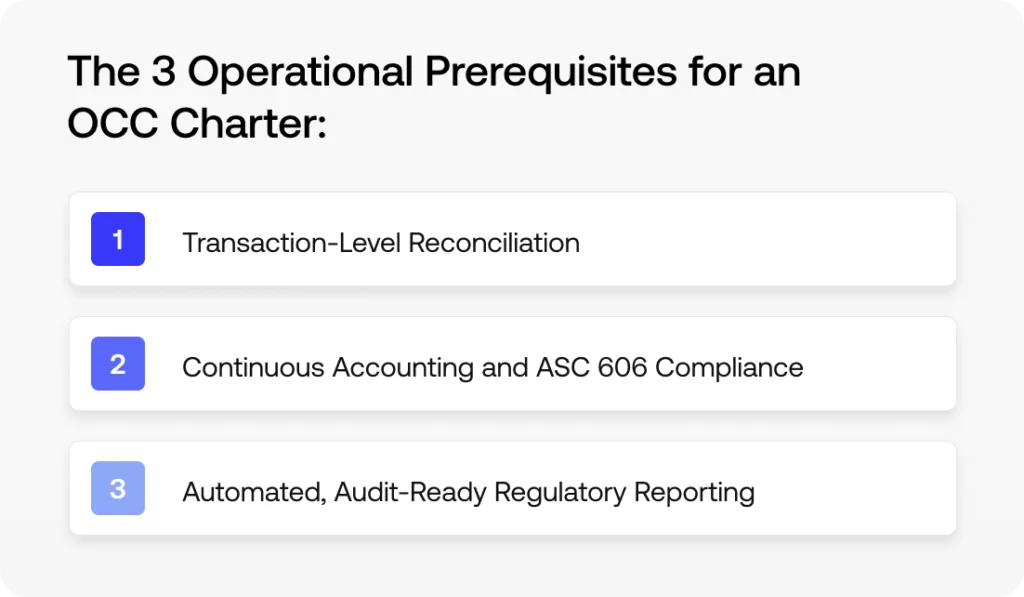
The Three Operational Prerequisites for an OCC Charter
To pass an OCC exam, you must prove that your financial controls are automated, continuous, and foolproof. Here are the three operational pillars you must have in place:
Prerequisite 1: Transaction-Level Reconciliation
Traditional financial close tools are balance-level focused. They are not built to handle the complexity of matching 24/7 crypto trades, volatile network gas fees, and card network chargebacks against fiat ACH and wire rails.
The Standard: You need continuous, automated, transaction-level reconciliation.
How Simetrik Solves It: Simetrik aligns operations data for all product operations, such as payment processing, ATMs, and other digital products, with accounting records daily, tracking every single dollar from the payment processor to the core ledger. We automate discrepancy detection within 24 hours, preventing the 5 to 15 basis points of invisible margin leakage that usually slips past manual reviews.
Prerequisite 2: Continuous Accounting and ASC 606 Compliance
If your month-end close takes 8 to 12 days because your team is bogged down by manual journal entries and spreadsheet-based revenue recognition, regulators (and investors) will see a massive red flag.
The Standard: A continuous, highly automated close process that is perpetually audit-ready.
How Simetrik Solves It: Simetrik automates revenue recognition directly from transaction-level payment data, ensuring strict ASC 606 compliance. By systematically generating journal entries for revenues, fees, and provisions, we reduce manual journal entries by 80%+. The result? A 2-3 day close with zero posting errors.
Compiling FinCEN, BSA/AML, and SOC 2 reports manually takes weeks of engineering and compliance resources, leaving massive room for human error. Under the OCC, these reporting requirements become heavier and more frequent.
The Standard: Complete transaction-level audit trails that can be generated on demand for federal examiners.
How Simetrik Solves It: We transform compliance from a manual burden into automated assurance. Simetrik generates FinCEN, AML, and other required regulatory reports directly from your transaction data, maintaining SOC 2-ready controls while reducing your overall compliance costs by up to 60%.
Stop Acting Like a Tech Company, Start Operating Like a Bank
You need Unified Oversight. Executives must have real-time KPIs across all product operations, from cash positions across funding sources to proactive anomaly alerts, with the ability to drill down from a summary dashboard straight to the transaction level. When the OCC (or your board) asks a question about unit economics or funds flow integrity, you must be able to answer it with instant, verified data.Are you preparing your operations for the next stage of scale?
Schedule a 30-minute personalized demo with Simetrik.
We’ll use a secure sandbox environment with either dummy data or your actual payment data to show you live, automated discrepancy detection and the regulatory-grade audit trails required for federal compliance.
When companies scale quickly, the first cracks often appear in back-office processes. Reconciliation is usually the most visible and the most painful.
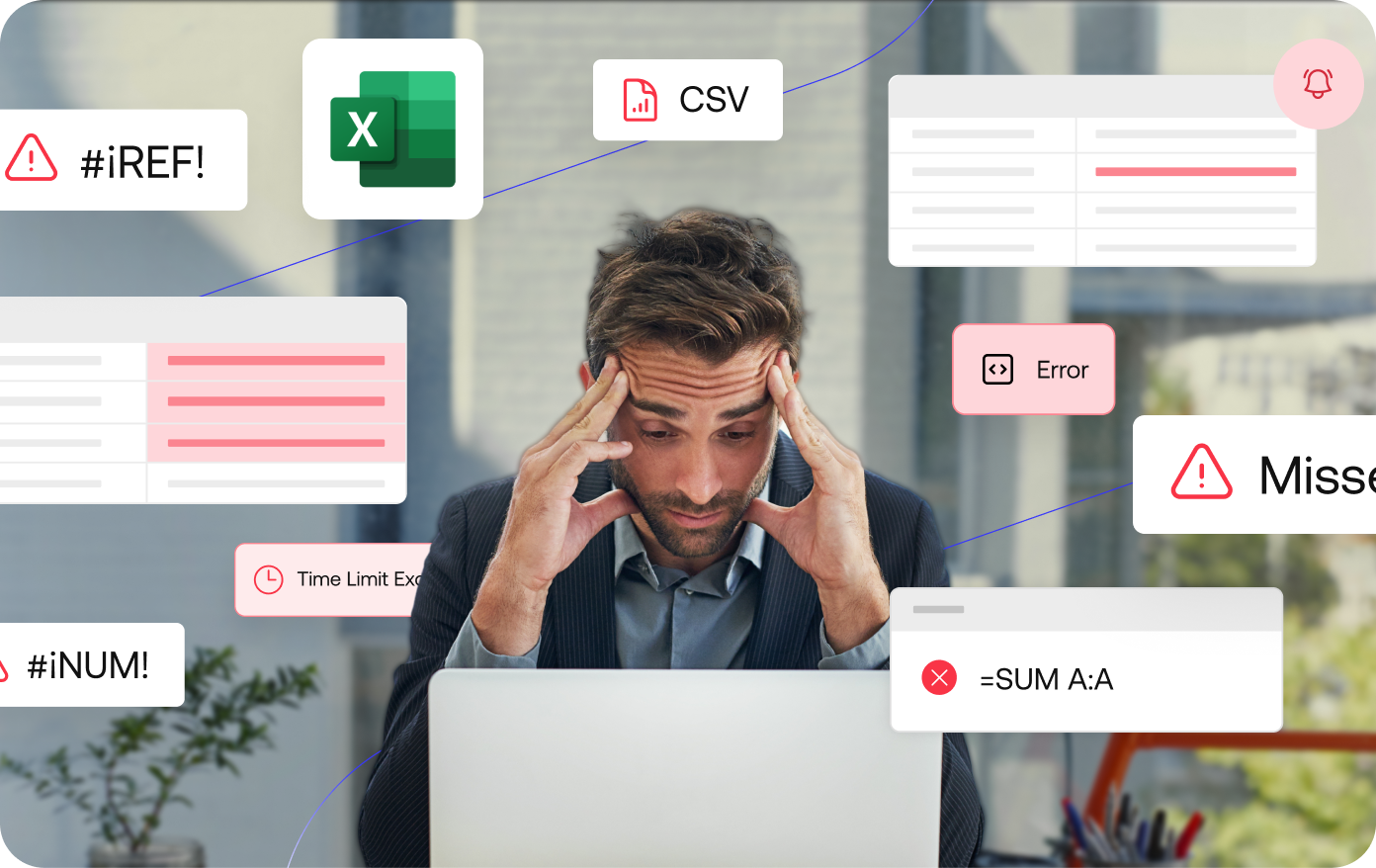
Teams start each morning inside spreadsheets, pulling CSVs from processors, painstakingly matching transactions, and hoping the numbers line up. Manual workarounds may be sufficient at a small scale, but they turn into structural risk as volumes and partners multiply.
For a fast-growing fintech, reconciliation at scale means comparing transaction-level records across a growing number of processors, banks, ledgers, and partners without losing control of exceptions.
The operating model is straightforward: centralize the source data, normalize it, apply deterministic matching rules, and send the remaining exceptions to analysts with the context they need to act.
This is a familiar story: multiple bank and processor accounts, dozens of payment stakeholders, hundreds of thousands of daily entries, and activity spread across many time zones all contribute to a level of complexity that is hard to rein in.
At scale, reconciliation must work for everyone. Finance leadership needs speed and reliability, while operations wants transparency and control.
Both teams need one source of truth. This article explains the problems behind manual reconciliation and how a controlled, automation-first approach can turn daily firefighting into a durable operating model.
The cost of spreadsheet-driven reconciliation
Spreadsheets are flexible and fast at the start. At scale, however, they create hidden costs that compound daily.
Instead of one controlled view of transaction and financial data, spreadsheets provide snapshots that diverge as teams copy, filter, and rework them. It becomes difficult to pinpoint what is reconciled, what is pending, and where material risk is concentrated. Context lives in people’s heads and scattered tabs.
In April 2025, the FDIC announced a $150 million civil penalty and a restitution plan of at least $1.225 billion against Discover Bank. A parallel Federal Reserve action imposed another $100 million penalty on Discover Financial Services and DFS Services.
Software would not have resolved the underlying conduct on its own. The case shows why teams need source-level records, controlled classification logic, reviewable changes, and evidence they can reconstruct when a fee or rule is challenged.
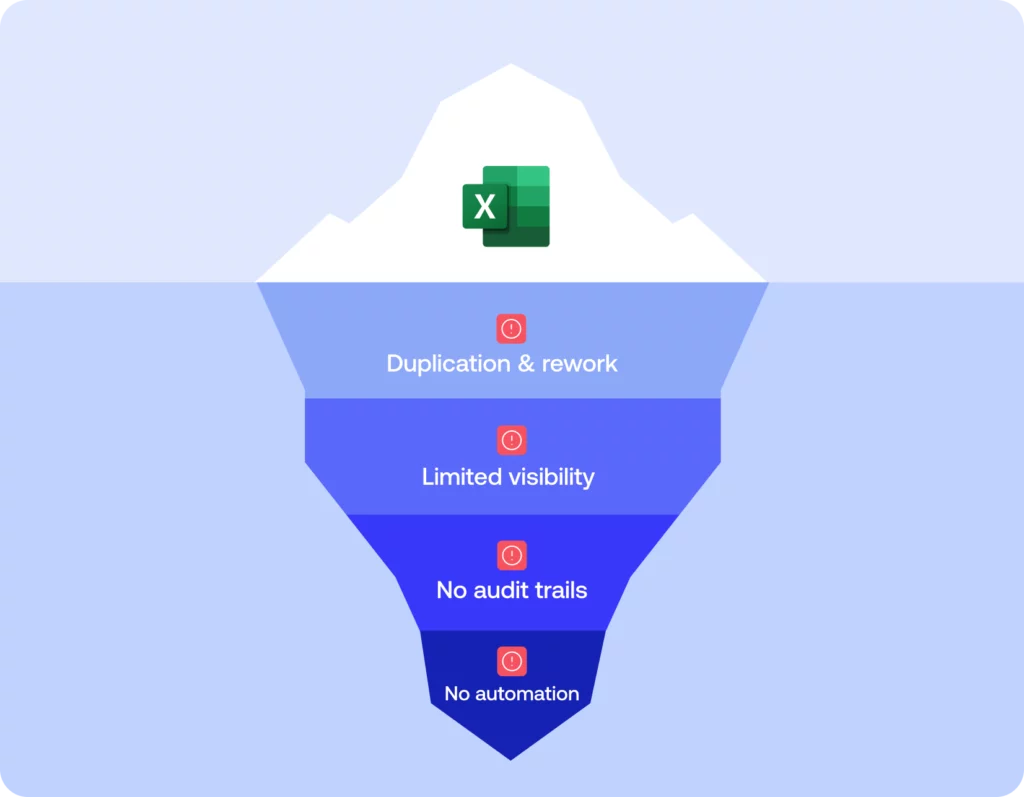
The cost of spreadsheet-driven reconciliation is due to several factors:
Duplication and rework that wastes hours and adds risk
Limited visibility that stunts leadership’s ability to make decisions
Lack of clear, immutable audit trails needed for compliance
Lack of automation, with experienced analysts reduced to data movers
These are not simply inconveniences. They are control failures waiting to surface. And the higher the transaction volumes, the worse these failures will be.
Why volume breaks spreadsheets and how to fix it
The largest PSPs and marketplaces process millions of transactions a day. At that scale, two things matter most. First, you must reconcile at the transaction level, not only by balance. Second, you must do it without forcing humans to wait on a screen.
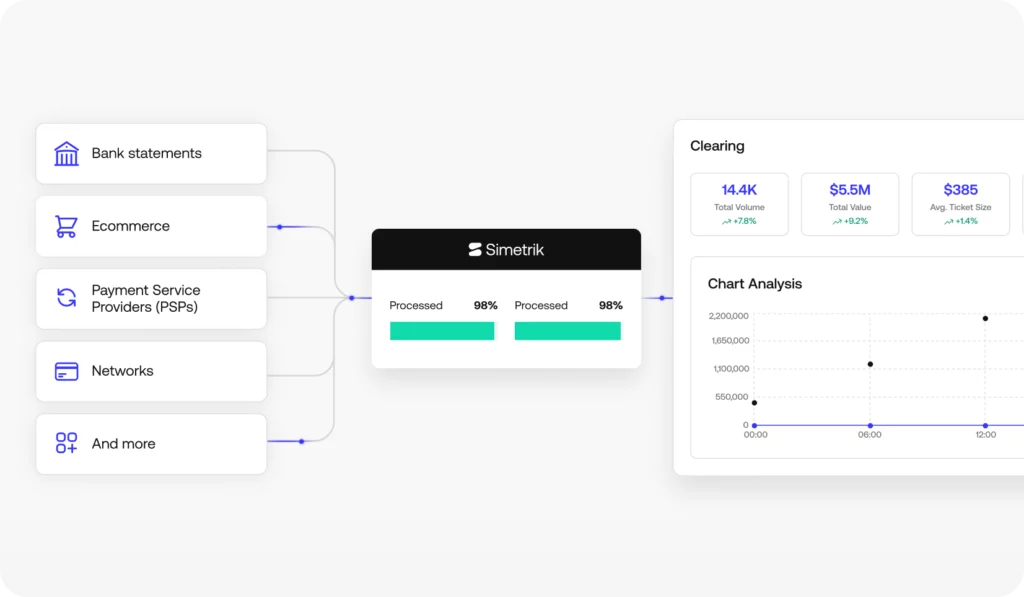
A scalable workflow ingests compatible data from processors, banks, and internal systems, then normalizes files and APIs into comparable structures. Configured rules handle repeatable matching while analysts work from an exception queue instead of reviewing the full dataset.
A useful scale test compares the same control at ten thousand and ten million rows. Runtime should remain predictable, material open items should stay visible, and analysts should not have to wait on the full dataset or build intermediate spreadsheets to make the process work.
What modern reconciliation should deliver by default
A modern reconciliation platform should provide financial control from transaction record ingestion to traceable reporting, with visible rules, exceptions, owners, and evidence.
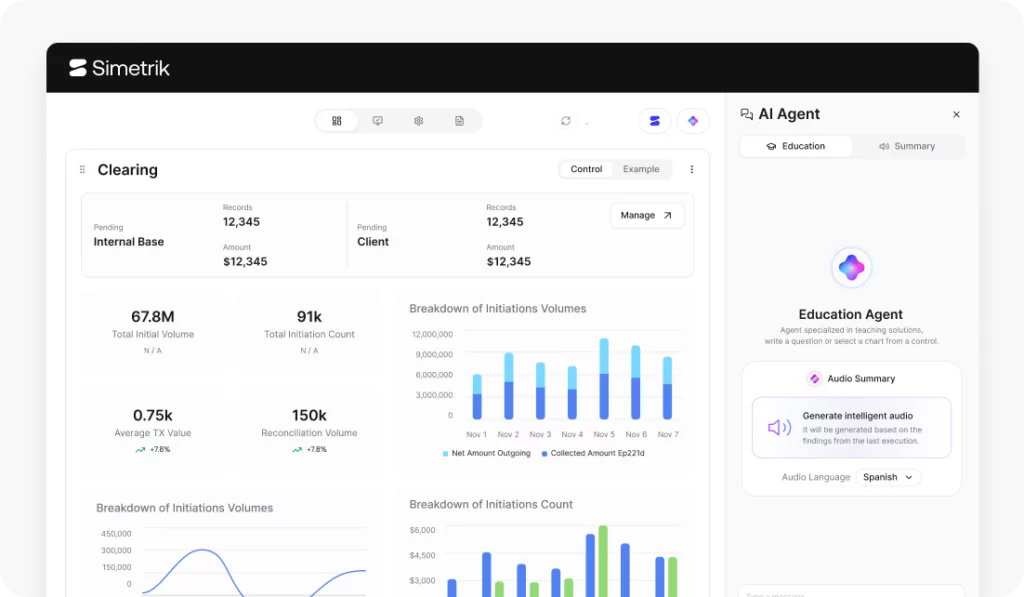
In practice, teams need one governed view of accounts, partners, processors, completed controls, pending exceptions, fees, and financial exposure. The dashboard should show both counts and values, because a small number of unresolved transactions can still be material.
A scalable model uses deterministic matching rules for control and AI to assist mapping, transformations, rule suggestions, and exception analysis. Finance and operations retain responsibility for the configuration, approvals, and material decisions.
When considering a modern reconciliation platform, check for these critical features:
Configurable matching. Prioritized rules, tolerances, and matching sequences that compare prepared transaction data while retaining the rule behind each result.
Scalable processing. Processing designed for growing data volumes, source counts, matching sequences, and recurring controls.
Granular access control. Configurable profiles that give reconcilers, engineers, finance leaders, and other stakeholders appropriate access and visibility. Actions and changes remain traceable within the supported workflow.
Collaboration across teams. Configured exception and oversight workflows can bring the right teams into the investigation while keeping evidence and status tied to the underlying record.
A traceable audit trail. Source lineage, rule versions, actions, notes, approvals, timestamps, and user attribution that allow a reviewer to reconstruct the result.
Controlled reporting and downstream workflows. Dashboards, datasets, exports, and compatible distribution workflows built from reconciled data and documented controls.
Together, these capabilities reduce repetitive work and make control evidence easier to review. They also reduce the engineering dependency created when every new partner, field, or rule requires a custom spreadsheet or code change.
How Simetrik aligns with your operational reality
Simetrik is a financial reconciliation and control platform for teams managing high-volume operations. It combines governed data preparation, configured matching rules, exception workflows, and traceable outputs. AI assists mapping, transformations, rule suggestions, and analysis while the deterministic engine executes the control logic.
Reconciled data can feed dashboards, reports, and compatible downstream workflows. The same governed output supports operations and finance without another round of spreadsheet assembly.
From data movers to investigators
By adopting an AI reconciliation platform, you allow analysts to take on a more impactful, strategic role. They can see discrepancies and exceptions in their dashboard, along with all the context they need to investigate and resolve the issue.
With Simetrik, exception views can include the fields needed for investigation: counterparty, flow type, currency, amount, references, prior attempts, and related items. Configured conditions can route ownership and notify support or payments teams when their input is needed.
Analysts spend their day resolving, not assembling. They close items, add root cause codes, and propose rule changes when patterns emerge. Managers see throughput, backlog age, and the value at risk by team and partner. Leadership gets a clear view of operational health and financial exposure, not a stack of spreadsheets.
Reporting that’s ready to share and act on
Many teams still struggle with reporting at the end of a period. Missing evidence, manual data collection, and incomplete source information delay review and force people to rebuild the same analysis.
Internal protocols and external reporting requirements add more preparation. Teams need documentation that reflects their own controls and can be traced back to the underlying records.
AI Copilot Datasets can help users create reusable queries or datasets from natural-language instructions, such as identifying which partners drive the most exceptions or which accounts close late. Teams review those outputs and use them in dashboards or reporting workflows configured for their own requirements.
Dashboards and reports can remain drillable to the underlying transactions. Finance gets the context it needs while operations avoids rebuilding the same pivot table at every period end.
Integrations that keep systems aligned
Fast-growing companies often implement accounting systems on a separate track from operations. Reconciliation then becomes a bridge between external movement and internal books. That bridge needs to be stable.
Through compatible integration methods, Simetrik can ingest financial and operational data from banks, processors, ledgers, data warehouses, and internal systems. Cleared positions or exception summaries can then move into supported downstream workflows.
If an ERP rollout is still underway, structured exports can bridge the current process while the team establishes more consistent data and traceability.
What the first 90 days look like
Teams often ask how to move from spreadsheets to a controlled operating model without disrupting the close. The following 90-day sequence is an evaluation framework, not a universal implementation promise.
Period
Operating focus
Evidence to review
Weeks 1–4
Connect the highest-volume processors and bank accounts. Recreate the current matching logic and begin working exceptions in Simetrik while spreadsheets remain a comparison point.
Source completeness, first match results, aged items, and an executive dashboard for the in-scope workflow.
Weeks 5–8
Retire spreadsheet steps for the in-scope accounts. Add rule stages, configured ownership, notifications, notes, and reason codes.
Manual-touch rate, backlog age, ownership, and monthly reporting from the controlled workflow.
Weeks 9–12
Expand to more accounts and partners. Tighten access profiles, add approvals for sensitive actions, and connect compatible downstream workflows.
Runtime, coverage, remaining gaps, user access, exports, and month-end readiness.
The first month tests source readiness, matching coverage, and ownership. Later phases should prove that the workflow can expand without losing runtime visibility, traceability, or control.
Finding ROI: seeing fast outcomes on Simetrik
Use the first few reconciliation cycles to establish a baseline. Compare runtime, match coverage, unmatched value, backlog age, manual touches, and reporting effort before expanding the workflow.
The ROI case should be measured through outcomes such as:
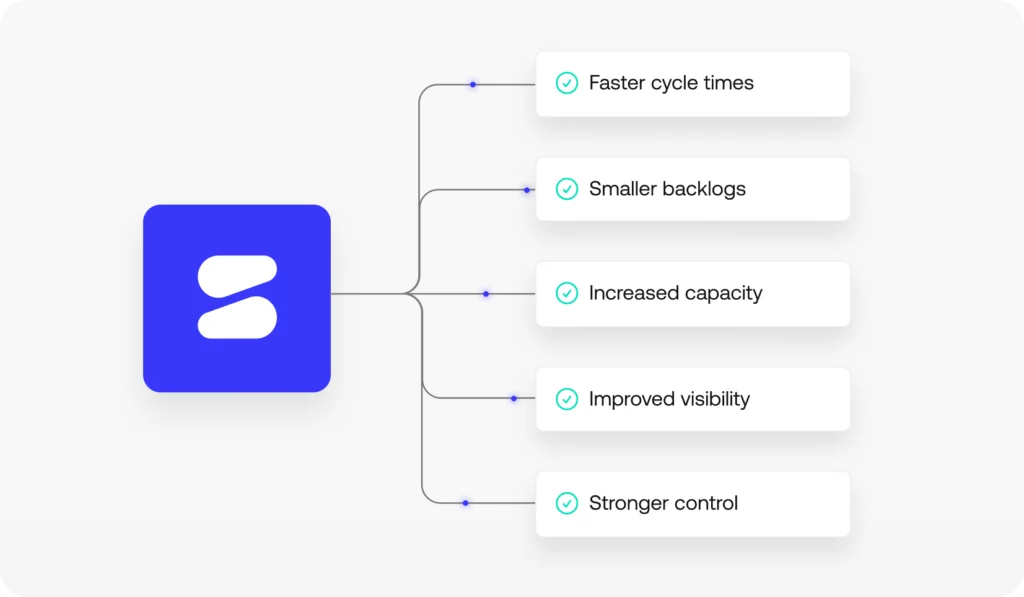
Faster cycle times. Measure the time from source arrival to a documented reconciliation result, including time spent resolving material exceptions.
Smaller backlogs. Track the count, value, age, and owner of unresolved items instead of relying on rows copied between files.
Increased capacity. Measure how much analyst time moves from collecting and matching data to investigating exceptions and fixing recurring causes.
Improved visibility. Give leaders a view of financial exposure by value, age, partner, and flow, with traceability for exceptions and adjustments.
Stronger control. Review whether actions, rule changes, approvals, and evidence can be reconstructed without assembling a separate audit file.
A credible business case connects these measures to the cost of engineering changes, manual effort, delayed investigation, and fragmented reporting.
Simetrik brings data preparation, deterministic matching, exception management, and traceability into one controlled workflow. To evaluate the approach with your own high-volume reconciliation, request a demo.
Payments increasingly move in near real time across banks, payment service providers, card networks, platforms, and internal systems. Each participant can record a different amount, timestamp, fee, or settlement status, making liquidity visibility harder to maintain.
This complexity greatly complicates the role of treasury and finance teams. Variance among currencies, settlement times, and data management protocols makes it hard to track liquidity and accurately apply cash at scale, often leading to millions of unaccounted-for dollars a year.
How can the office of the CFO tackle liquidity and forecasting challenges when money moves faster than it ever has? Keep reading for the answer – and a look into the emerging world of AI reconciliation.
The short answer: reconcile transaction, settlement, bank, and internal records frequently enough to identify what has cleared, what is pending, and where exceptions remain. Reconciliation improves the data used for liquidity decisions, but it complements rather than replaces a treasury management system, cash forecasting, or funding execution.
What’s so hard about liquidity management?
Treasury and finance teams used to be able to rely on batch settlement data to understand their cash positions. With the proliferation of flexible payment methods and new payment services, complexity grew.
The addition of real-time payment (RTP) networks brings even more nuance and risk to the market. These new payment rails give businesses faster ways to handle payroll, pay out merchants, and manage AR/AP – they also tend to push internal reconciliation and finance teams to the limit.
The challenges to managing liquidity effectively today include:
Funds come and go many times throughout the day. Without a continuous tracking system, finance teams can’t be sure enough cash is available at any given point.
Settlement times vary and don’t always coincide with transaction time stamps. Bank balances may be off by thousands of dollars, leading to poor funding decisions, unplanned fees, and unnecessary panic.
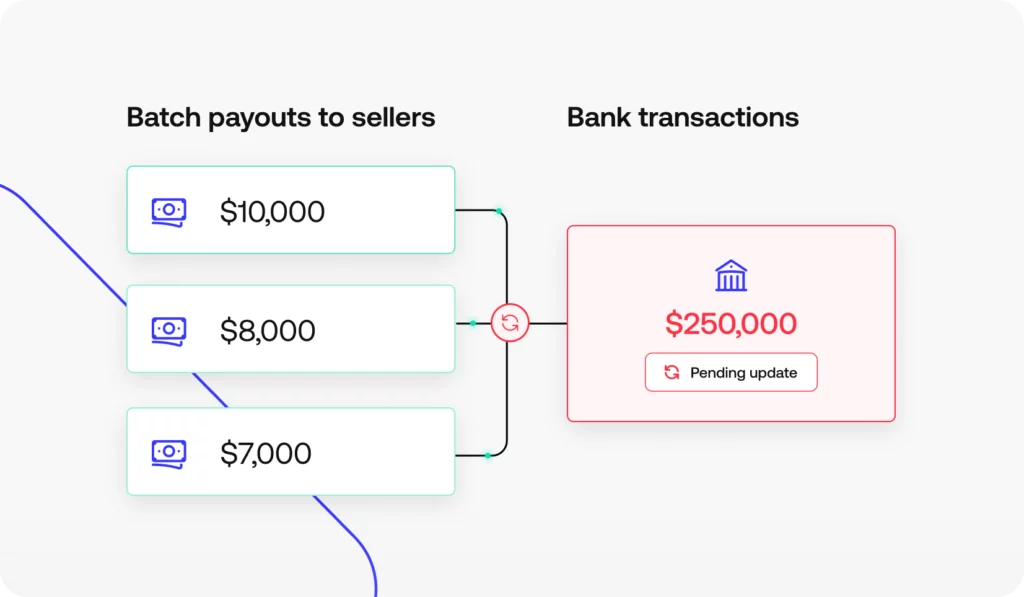
Batch payments don’t map back to individual transactions. This adds hours of manual reconciliation to ensure cash and fees are applied correctly.
Discrepancies and errors slow reconciliation and make it hard to calculate cash on hand.
Move too cautiously, and the opportunity cost is steep. Cash sits idle in accounts instead of being deployed to fund growth or reduce short-term borrowing. Move too aggressively, and you risk the opposite problem.
Underfunded RTP accounts, for example, can break funding agreements with sponsor banks – the very relationships that make instant payments possible. Without timely reconciliation, teams may not realize how quickly real-time payouts are draining balances until transactions start failing.
Cross-border settlements introduce another layer of complexity. Funds often pass through multiple correspondent banks and FX providers before reaching their destination. When timing or conversion delays aren’t captured immediately, treasury teams can mistake in-transit balances for available cash, exposing the business to liquidity gaps and currency risk.
Merchant payouts add risk, too, as marketplaces and retailers often pay merchants ahead of card network settlement. Without clear visibility into pending inflows, finance teams may overextend working capital, effectively funding payouts with money that hasn’t yet arrived.
To accurately monitor liquidity and maintain a clear line of sight into balances, AR, and AP across your entire payments ecosystem, look no further than reconciliation.
The role of reconciliation in understanding liquidity
Reconciliation helps finance teams manage liquidity and cash flows by maintaining accuracy and financial integrity at every step of every transaction.
At the most granular level, the reconciliation process validates and matches transaction records across all parties. At a higher level, it ensures operational balances accurately reflect the reality of the company’s cash position.
Once reconciled, the data can be used to make all kinds of decisions about liquidity: whether to acquire more funding, what payment terms to offer or accept, how to allocate working capital, and many more.
But while AI and automation have transformed other key enterprise workflows, too many companies have yet to invest in modern reconciliation solutions that can handle the volume and complexity associated with real-time, global payments today.
The problem with legacy financial platforms
Many finance teams still rely on manual entries, spreadsheets, and brittle systems that can’t paint a real-time picture of cash flows and liquidity. Even with a strong treasury management system (TMS), the gap between balances shown in banking systems or financial analytics tools vs the reality of minute-by-minute transactional data leads to substantial discrepancies and excess costs.
Legacy, manual solutions aren’t just slower, they suffer from poor interoperability – too many disparate data formats, currencies, and protocols muddy visibility and hinder finance teams’ ability to use reconciled data for critical decision-making around liquidity.
Fragmented tech stacks also force engineering to spend time on costly integrations and workarounds, rather than working on initiatives that will eventually drive revenue. The bottom line? It’s expensive to stick to the status quo.
How transaction reconciliation improves liquidity visibility
AI-assisted reconciliation helps finance teams improve the accuracy and timeliness of data used for working-capital and funding decisions. Modern platforms apply deterministic matching rules at scale, surface exceptions, and produce traceable dashboards and reports for treasury and finance teams.
These newer, AI-enhanced systems are designed to handle exactly the kind of high-volume, complicated transaction data that enterprise finance teams struggle with. Incoming and outgoing payment records can be validated and matched across PSPs, real-time payment rails, card networks, banks, and internal systems, with exceptions routed for review.
Unlike legacy and manual solutions, AI reconciliation centralizes all of your transaction and finance operations data into a single source of truth, standardizing records and identifying gaps so operational balance views can be refreshed as new data arrives. This gives teams a more reliable view of cleared, pending, and unmatched activity that can inform prefunding decisions on real-time payment rails.
Treasury and finance decision-makers can log into their TMS, business intelligence tools, ERP, or any other connected system and work from the same reconciled dataset, reducing uncertainty in liquidity analysis.
Strengthen liquidity with complete visibility and control on Simetrik
Simetrik is an AI-assisted reconciliation platform for complex finance operations where liquidity decisions depend on timely, traceable transaction data.
The platform ingests transaction data from any source and system, standardizing it and applying configurable, deterministic matching logic. Reconciled outputs and exception data can then feed connected ERPs, treasury systems, and business intelligence tools.
This level of automation and efficiency lets your finance team spend less time on repetitive matching and more time reviewing exceptions and supporting forecasting. Depending on the workflows and data sources configured, teams can use Simetrik to:
Compare operational balances with transaction and settlement data
Include prepayments and credits in reconciled balance views
Batch payouts and bulk payments from PSPs are automatically disambiguated
Surface aging receivables for follow-up in connected workflows
Fraud and risk models are improved with trusted, reconciled data
Detect errors and route discrepancies for governed resolution
Feed reconciled data into the TMS and ERP for liquidity analysis
Simetrik helps finance and treasury teams transform their operations while maintaining global governance and control. To learn more about how our AI reconciliation platform improves liquidity and drives profitable decision-making, explore our solutions or get in touch with us to schedule a demo.