If you work in card payments, you know the feeling. A network file lands at 3:07 a.m., a processor export arrives at 3:12 a.m., and by 9:00 a.m. the operations team is trying to explain why a handful of transactions do not line up. Meanwhile, compliance wants sub-merchant chargeback trends and engineering is preparing another rule change and redeploy.
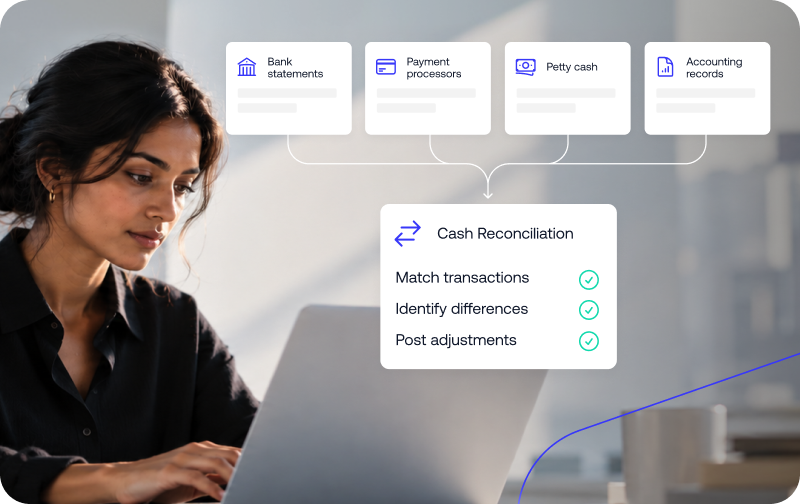
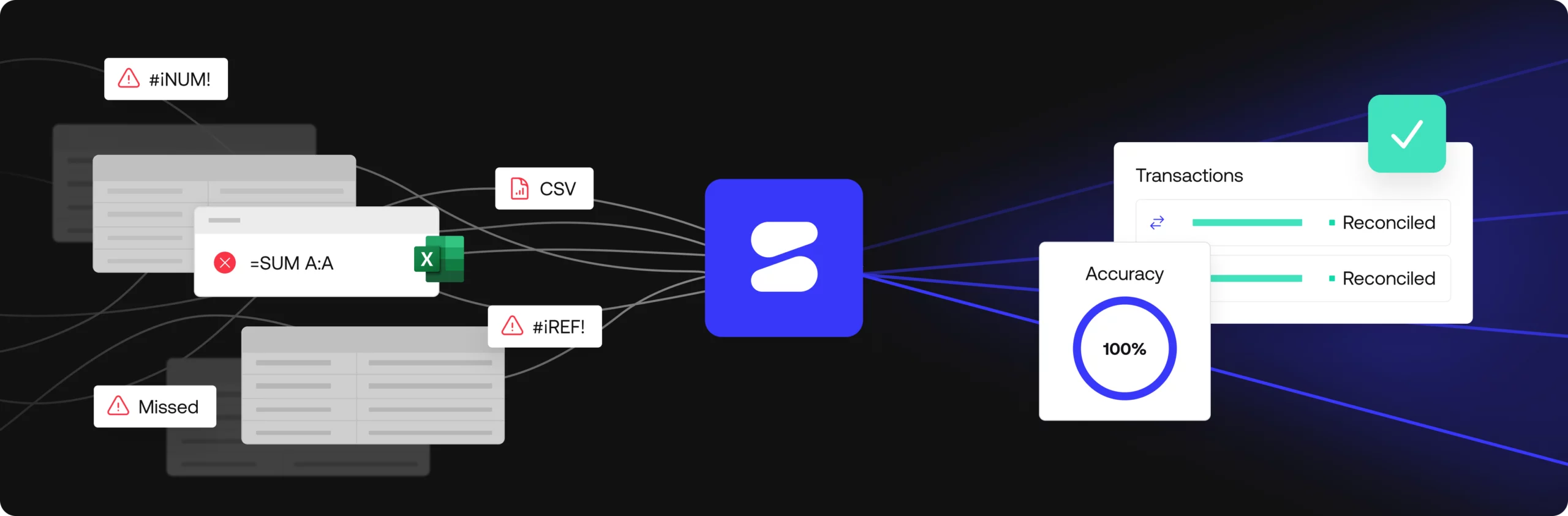
Payments reconciliation is the process of comparing transaction records across processors, card networks, banks, and internal systems to confirm that amounts, references, fees, refunds, and settlements agree. Automation brings those records into one controlled workflow, applies matching rules, and routes exceptions for review.
This matters most in high-volume payment operations, where the same transaction can arrive with different identifiers, dates, formats, or statuses. A processor file may land overnight, but operations still needs to explain why a subset of records does not line up the next morning.
This guide explains how to automate payments reconciliation from data ingestion and normalization through matching, exception analysis, alerts, and traceable reporting. The working example compares processor records with network settlement data, but the same pattern applies when several processors need to be reconciled against one ledger or settlement view.
Why payments reconciliation breaks at scale
- Fragmented data: Networks, processors, gateways, banks, internal ledgers, ERPs, settlement files, and dispute feeds each have their own identifiers, formats, timing, and lifecycle.
- Frequent change: Networks revise specifications, partners add columns, merchants expand cross-border, and teams launch new payment products. A code-only workflow can struggle to keep pace.
- Engineering bottlenecks: When matching logic lives entirely in code, a small adjustment can require a ticket, a pull request, testing, a redeploy, and cross-team coordination.
- Limited visibility: Finance and operations may know the totals but still need to trace root causes, fee variances, or sub-merchant chargeback trends through SQL, email threads, and several systems.
Five building blocks of automated payments reconciliation
1. Ingest source data
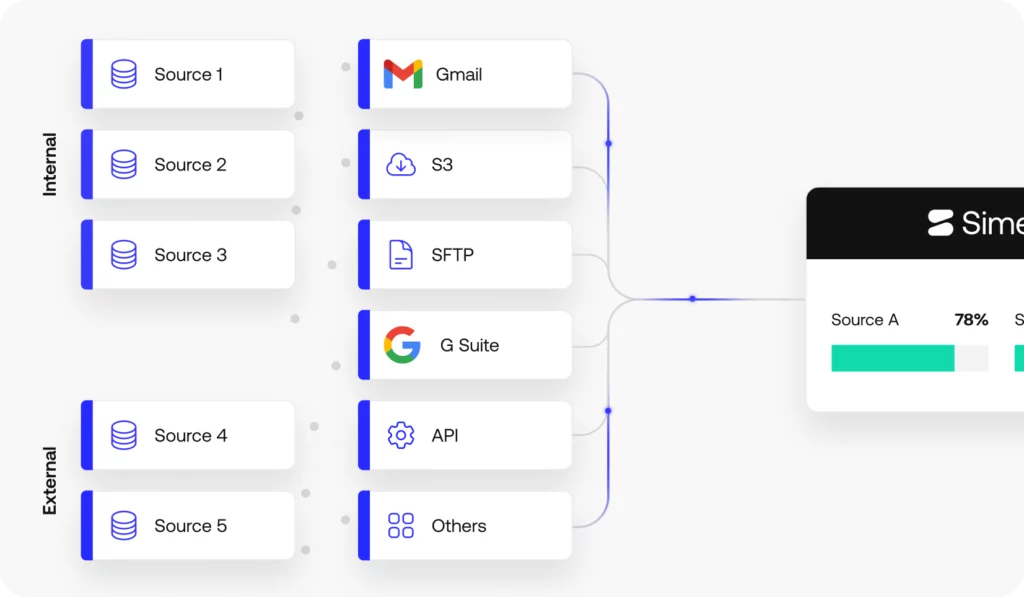
Start with the records that describe each stage of the payment lifecycle: processor exports, network settlement packages, bank statements, dispute feeds, and internal ledger data. Preserve the source context and original structure so every output can be traced back to the record that produced it.
Simetrik can ingest financial and operational data through compatible methods such as SFTP, email, APIs, or secure access workflows.
When a PDF or flat file contains 30 tables, the tabular sections can remain distinct Sources while retaining the original structure for audit. The objective is a governed input layer without brittle preprocessing scripts or staging jobs.
2. Normalize records across sources
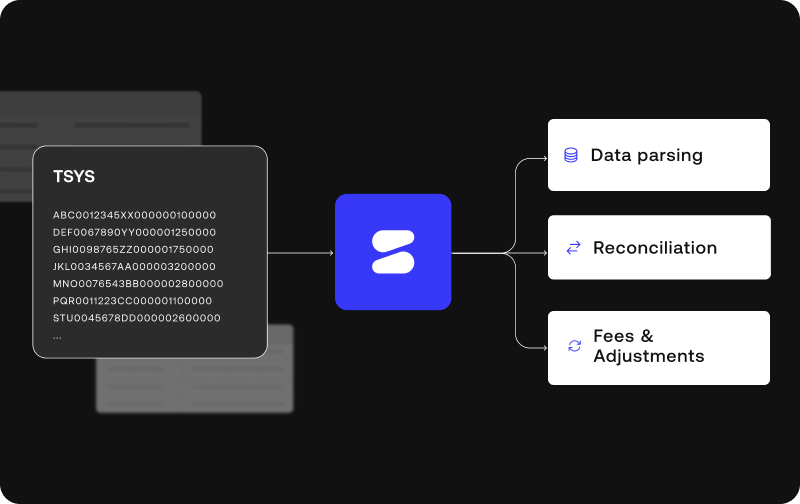
Different systems use different column names, date formats, signs, currencies, and reference fields. A processor may add Ref2 beside Ref1 or insert a new field without changing the underlying transaction. Normalization makes those records comparable before matching begins.
Source Unions map compatible partner files into a consolidated schema. If Visa changes a column name or a processor inserts a field, the team can update the mapping while preserving historical context.
Dozens or hundreds of compatible partner sources can feed a canonical view for comparison with an internal ledger or network settlement data. AI-assisted mapping can suggest relationships between columns, while the team reviews the configuration and its downstream dependencies.
Reconciliation should not break because someone added Ref2 next to Ref1. Normalization is an operational capability, not a one-off cleanup project.
3. Apply configurable matching rules
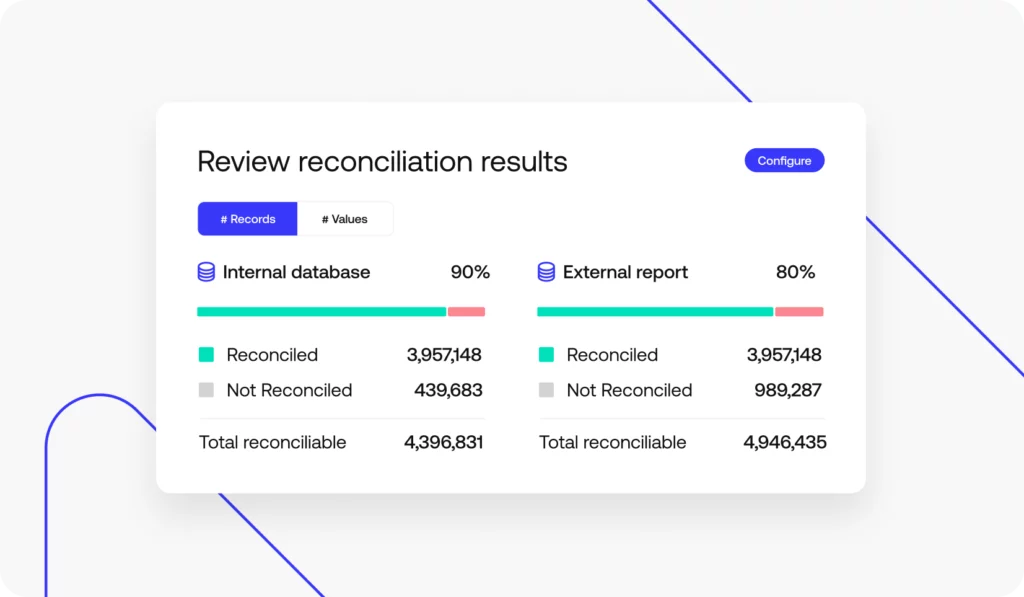
Start strict with amount, currency, multiple references, payment method, and an approved settlement-date tolerance such as T+1. Then add priority-based fallback logic for a secondary reference parsed from a longer string, known timing differences, minor rounding, or processor-specific behavior.
Some customer configurations use Rule Sets in the triple digits to cover the long tail. Each match remains tied to the Rule Set that produced it.
Simetrik applies configured rules deterministically: the same data and configuration produce the same control result. AI can assist with suggestions, but the team remains responsible for validating the logic.
Operations should not need an engineering ticket for every documented rule change. Moving that configuration out of a code-only workflow avoids a pull request and redeploy while preserving ownership, history, and review.
4. Analyze matches and exceptions
Each run should separate matched records from exceptions and make the remaining work easy to investigate. Useful views include:
- Match rate and unmatched value for the current run.
- Exceptions by processor, payment method, merchant, or geography.
- The rule set that matched each record.
- Fee, foreign exchange, and settlement variances.
- Chargeback activity linked to the underlying transaction.
Simetrik’s Operations Center can bring reconciliation results, anomalies, and pending items into one environment so teams can investigate and document exceptions with their supporting context.
Reconciliation is not only about making two files equal. Teams need to move from transaction-level evidence to executive summaries, then back to the exact row and Rule Set that explains a result.
5. Monitor controls and completeness
Configured alarms can flag an expected file that did not arrive, a row-volume change, a falling match rate, a chargeback spike, a fee variance, or a growing exception backlog. Thresholds should reflect materiality: three unreconciled transactions totaling $250,000 may deserve attention before 300 records totaling $12.60. Track amounts, not only counts.
Simetrik can monitor configured conditions, alert teams to signals that need attention, and bring related work into its unified oversight and alerts layer.
How to automate a processor-to-network reconciliation
A processor-to-network reconciliation usually follows six controlled steps.
Step 1: Collect the records
- Acquirer or processor transaction exports, delivered through the agreed workflow.
- Visa or Mastercard network settlement packages, kept distinct when their lifecycle requires it.
- Optional bank statement, refund, dispute, or chargeback data.
Set a clear owner and expected delivery cadence for each source. A reconciliation cannot be complete if one of its required inputs is missing.
Step 2: Normalize the source data
- Map processor fields into a common structure for dates, amounts, currencies, statuses, and multiple references such as Ref1, Ref2, and Ref3.
- Keep network records separate when their structure or lifecycle requires a different preparation path.
Step 3: Enrich the fields needed for matching
Add calculated or standardized fields only when they help compare the records. Examples include normalized timestamps, fee-per-transaction calculations, foreign exchange conversions, or a fallback reference extracted from a longer entry string. Document every transformation so it can be reviewed later.
Step 4: Define matching logic
- Strict rule: Match amount, currency, primary reference, payment method, and an approved settlement-date tolerance.
- Fallback rule: Use a secondary reference or a wider timing tolerance for known operational differences.
- Edge-case rule: Apply specific logic for gateway quirks, cross-border FX rounding, partial captures, refunds, or other understood lifecycle differences.
Run rule sets in priority order and retain the rule that matched each pair. That record makes later review much easier.
Step 5: Review exceptions
- Group unmatched records by cause, source, value, and age, then expose the exact failure reason, such as a missing reference, amount variance, or settlement drift beyond tolerance.
- Assign an owner, evidence, and next action to material exceptions.
Step 6: Act and distribute results
- Trigger configured alerts when a control crosses its threshold.
- Export or distribute daily summaries, settlement confirmations, fee breakdowns, and other reconciled data through compatible reporting workflows.
- Retain the original sources, transformations, rules, user actions, and timestamps needed to reconstruct the result.
How chargebacks fit into payments reconciliation
A chargeback should connect back to the original payment, the processor or network notification, any financial debit or fee, the settlement result, and the internal ledger.
When those records live in separate systems, teams can miss duplicate debits, unmatched fees, a recovery that never appears in settlement, or a chargeback deduction with no underlying transaction match.
- Validate that each dispute is linked to a valid transaction and the expected financial movement.
- Track both counts and amounts by sub-merchant, brand, country, BIN, processor, and the other operational dimensions that matter to the team. A small count can still represent a material financial exposure.
Simetrik can compare compatible sources, follow exceptions, and verify the financial impact of a result. Its claims and chargebacks workflow focuses on transaction-level control across that lifecycle.
Performance and scale: what enterprise buyers should test
A natural evaluation question is: what happens when a million transactions run through dozens of Rule Sets? The answer has to cover more than raw throughput. Buyers should test whether runtime stays predictable as volumes grow, sources change, and new edge cases are added.
Simetrik customer environments can reach hundreds of millions of records per day across multiple reconciliations, with execution measured in minutes. Matching is parallelized, transformations compile efficiently, and Source Unions reduce the rework created by one-off pipelines.
The practical test is whether teams can add Rule Sets for gateway quirks, settlement drift, FX rounding, partial captures, and refunds without pushing a nightly run into the next business day. Track daily volume, Rule Set count, end-to-end runtime, peak-load behavior, and the cost of adding each new exception pattern.
Metrics for automated payments reconciliation
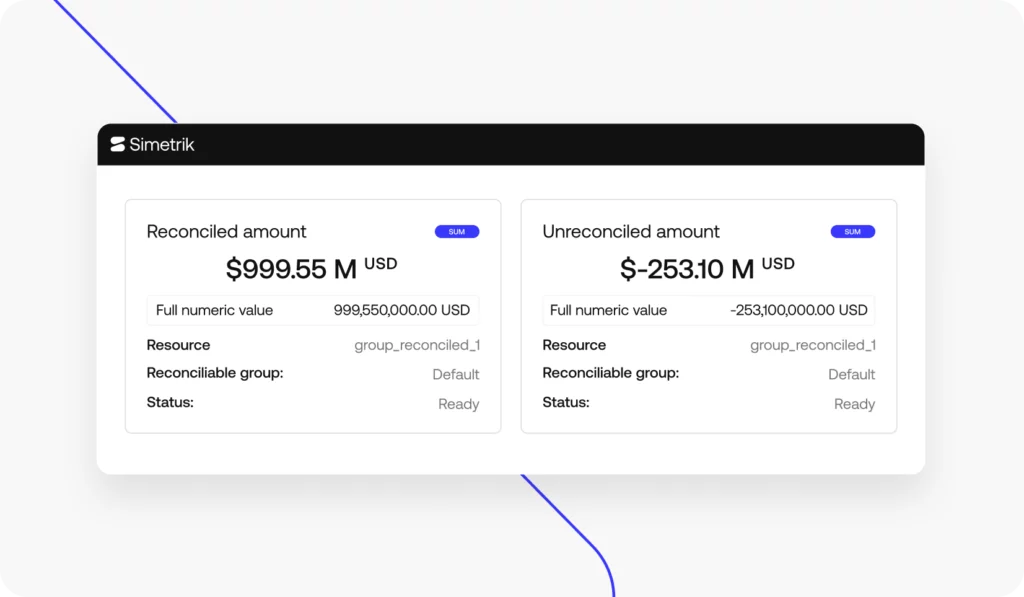
A useful dashboard should show whether the process is complete, accurate, timely, and explainable. Track:
- Match rate and value coverage: The share and value of records matched by the configured rules.
- Unmatched count and value: The volume and financial materiality of the remaining exceptions.
- Exception aging: How long unmatched items remain unresolved.
- Time to resolution: The elapsed time from detection to a documented outcome.
- Fee and FX variance: Differences between expected and recorded deductions or conversions.
- Source completeness: Whether every required file or dataset arrived for the run.
- Manual intervention rate: The share of records that required judgment or adjustment.
Targets should reflect materiality, source quality, and the risks of the workflow. In mature implementations, teams using this approach have reported daily match rates above 99.95%, with the remaining exceptions explainable and trending down. Treat that as a benchmark to validate against your own data, not as a universal guarantee.
Build vs. buy: what to evaluate
An internal solution can fit a narrow, stable workflow with a strong technical owner. The honest comparison begins when sources, entities, rules, and exceptions keep changing. Evaluate time to adapt, engineering dependency, long-tail coverage, auditability, and opportunity cost, not only the first version of the matcher.
| Criterion | Build in-house | Use a platform |
|---|---|---|
| Change frequency | You own development, testing, releases, and maintenance. | Evaluate configurable rules, approvals, and versioning. |
| Source growth | You build and maintain ingestion and transformations for each source. | Verify compatible ingestion and normalization methods. |
| Exception ownership | You design queues, service levels, and escalation paths. | Evaluate assignment, evidence, and traceability in one workflow. |
| Auditability | You implement history, permissions, and row-level evidence. | Verify lineage, action logs, and reproducible results. |
| Economics | Count infrastructure, support, and key-person risk. | Count implementation, subscription, and vendor dependency. |
Long-tail coverage is where the economics often change. In the in-house programs observed by Simetrik, initial automation has reached roughly 60% coverage before edge cases began consuming disproportionate engineering time.
The relevant comparison is not only license cost versus infrastructure. It also includes sprint time, support, key-person risk, audit controls, and the opportunity cost of taking engineers away from customer-facing or risk work.
Neither option is automatically better. A platform becomes more compelling when change is frequent, exception logic expands, and operations needs direct control without giving up auditability. That is the point at which Simetrik’s configurable rules, Source Unions, controls, and transaction-level traceability address more than the matching step.
A practical pilot plan
A six-week pilot can provide a useful evaluation window when the sources, owners, and scope are ready. This is an outline for testing coverage, control, and runtime against a known baseline, not a universal implementation promise.
- Week 0–1, connections: Set up compatible delivery for processor, network, and optional bank or chargeback data. Confirm owners and expected arrival times.
- Week 1–2, normalization: Build the Source Union or equivalent canonical views. Add the three to five enrichment fields needed for fees, FX, timestamps, or parsed references.
- Week 2–3, first reconciliation: Configure three to five prioritized Rule Sets and test them against historical data, including known exceptions.
- Week 3–4, exceptions and dashboards: Create root-cause views, define owners and evidence, add chargeback or sub-merchant views where relevant, and configure alerts.
- Week 4–5, iteration: Add long-tail Rule Sets for documented edge cases and validate the reports or exports the receiving teams require.
- Week 6, review: Compare runtime, match rate, unmatched value, exception aging, and manual effort with the baseline before expanding to more processors, networks, or bank settlement workflows.
Make reconciliation predictable
Reconciliation will never be glamorous, but it should be predictable, explainable, and fast. A partner changing a column on Thursday should be a controlled mapping update, not a post-mortem.
Automated payments reconciliation works when complete source data, documented transformations, deterministic rules, visible exceptions, and an audit trail make every result reconstructable while human review remains where judgment is required.
Simetrik brings data preparation, deterministic matching, exception management, and traceability into one transaction-level reconciliation workflow. To test it with your own processor, network, bank, or chargeback data, request a demo.