Category: Control & Reconciliation

Simetrik Alternatives: Comparing build, spreadsheets, and AI tools

If you’re evaluating alternatives to Simetrik, you already know what a reconciliation platform does. You’re likely weighing whether to build your own engine, stick to spreadsheets, or adopt newer AI tools promising “fully automated” exception resolution.

What does Simetrik do? Simetrik is a dedicated financial operations control platform that standardizes data, executes deterministic reconciliation rules, surfaces exceptions, and preserves an audit trail. Its AI layer assists configuration and analysis; it does not replace the governed matching engine or human accountability.

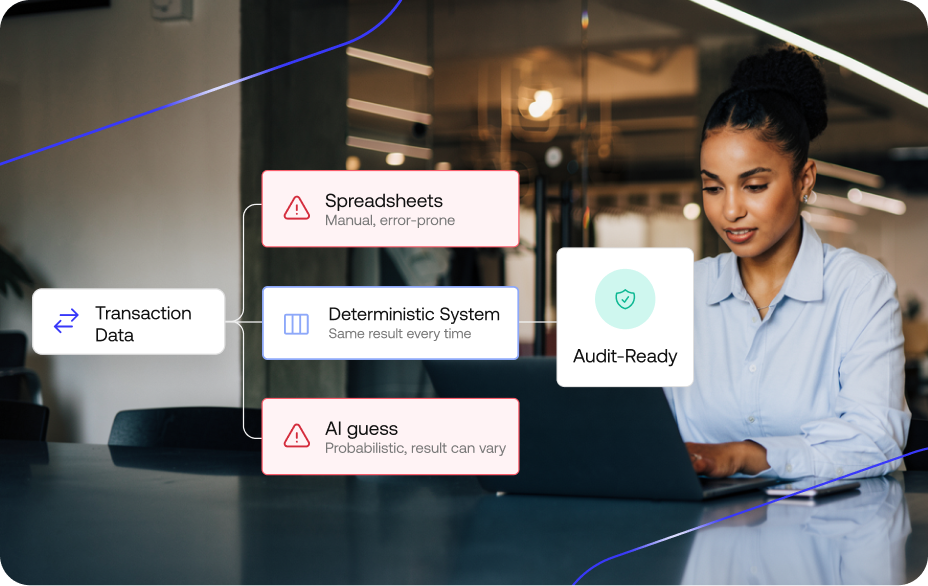
Here is the line every CFO needs to draw: A financial control must produce the exact same result every single time. While some newer AI tools promise to let autonomous agents close exceptions without human oversight, a probabilistic guess isn’t an accounting control, it’s an audit risk. 

This guide breaks down where in-house builds, spreadsheets, and AI tools hold up, where they fail under audit scrutiny, and how to choose an architecture built for long-term compliance.

Comparing financial reconciliation alternatives at a glance
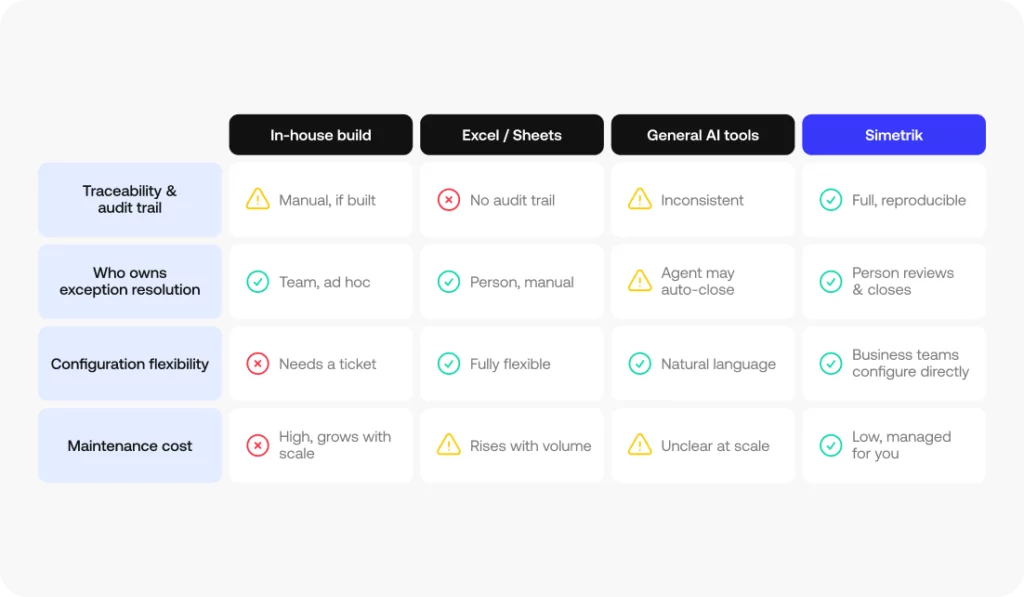
Comparison of in-house builds, spreadsheets, general AI tools, and Simetrik

Alternative 1: Building a financial reconciliation tool in-house

For a lot of teams, the first real alternative to buying a platform isn’t another vendor. It’s the engineering team down the hall. If you already have developers who understand the payment flow, building a reconciliation tool internally can look like the obvious move: no procurement cycle, no new vendor relationship, full control over the roadmap.

What an in-house financial reconciliation build usually includes

A typical in-house reconciliation build covers a predictable set of pieces: 

  • Ingestion from bank files
  • Processor APIs, or internal databases
  • An ETL layer or custom scripts to clean and standardize that data
  • Matching logic written specifically for your transaction types
  • Accounting rules encoded directly into the system or a connected tool
  • A way to generate files or journal entries for the ERP
  • Some version of monitoring, versioning, and an audit trail. 

Not every build includes all of this from day one. Most start with ingestion and matching, then add the rest as gaps show up.

When a custom-built reconciliation system is the right call

Building internally is a legitimate decision, not a fallback you settle for. It makes sense when the case is genuinely simple: one or two data sources, stable transaction logic, low volume, and a technical team that already understands the flow end to end. In that situation, a custom build gives you something a vendor platform can’t: complete control over the release schedule and the exact logic, with no external dependency on someone else’s product roadmap.

Where in-house reconciliation software breaks down as transaction volume grows

The trouble tends to start later, not at launch. Every rule change needs an engineering ticket and a QA cycle, so finance ends up waiting on IT for things that should take minutes. The system’s continuity depends on the two or three people who understand how it actually works, and if they leave, the institutional knowledge goes with them.

Visibility stays limited for the finance team that has to use the output, because most in-house builds get optimized for the data pipeline, not for the person reviewing exceptions. Permissions, versioning, traceability, and alerting all have to be built by hand on top of the matching logic itself, which turns into its own project. And technical debt piles up quietly until the day you add a new entity, a new currency, or a new data source, and realize the system was never built to flex that way.

Alternative 2: Using general AI tools for financial reconciliation

Where AI Copilots and Chatbots Fit in a Reconciliation Workflow

General-purpose AI tools genuinely help with parts of this work. They’re good at interpreting messy files, suggesting field mappings, drafting or explaining formulas, and letting someone describe a rule in plain language instead of writing it from scratch. Used this way, they’re leverage: they take work off someone’s plate without taking over the decision.

Why financial reconciliation needs a reproducible control, not a probabilistic answer

Here’s where it gets more complicated. A chatbot or AI agent that decides, on its own, whether a transaction matches or how an exception gets closed is solving the wrong problem in an appealing way. A financial control needs to produce the same result from the same inputs every time. That’s what makes it something an auditor can rely on.

AI agents don’t actually reason, they output what is most statistically probable based on context. Where a deterministic system knows without a doubt that $1 + 1 = 2$, a probabilistic AI evaluates what usually follows “$1 + 1$.” That makes it prone to repeating common errors, and when context is missing, the margin for error spikes.

An output that changes on the same data isn’t a financial control; it’s a guess with good manners. True controls require absolute predictability. AI should assist with patterns and rules, but a deterministic engine must execute the logic, and a human must make the final call.

Alternative 3: Reconciling payments and transactions in Excel or Google Sheets

Why Excel and Google Sheets were the default starting point for reconciliation

Almost every finance team starts here, and there’s nothing wrong with that. Exporting statements from a bank or processor and cross-checking them in a spreadsheet, using VLOOKUPs, pivot tables, the occasional macro, is how most reconciliation processes begin before anyone formalizes them. At low volume, with a handful of sources, it works fine. It’s cheap, flexible, and everyone on the team already knows how to use it.

Where manual spreadsheet reconciliation stops scaling

The limits show up gradually, then all at once. Spreadsheets are intensive in time: every new statement means another round of exporting, formatting, and cross-checking by hand. They’re error-prone in ways that are hard to catch, because a broken formula or a mis-copied row doesn’t announce itself. There’s no real-time visibility into where the reconciliation stands, and no reliable record of who changed what, when, or why, which becomes a real problem the first time an auditor asks.

None of this makes spreadsheets a bad choice early on. It just means the same tool that worked fine at 500 transactions a month starts working against you at 50,000. 

A framework for evaluating reconciliation software alternatives

Whatever you’re comparing, an internal build, a spreadsheet, an AI tool, or a vendor platform, the same four questions tend to separate what actually works from what just looks good in a demo.
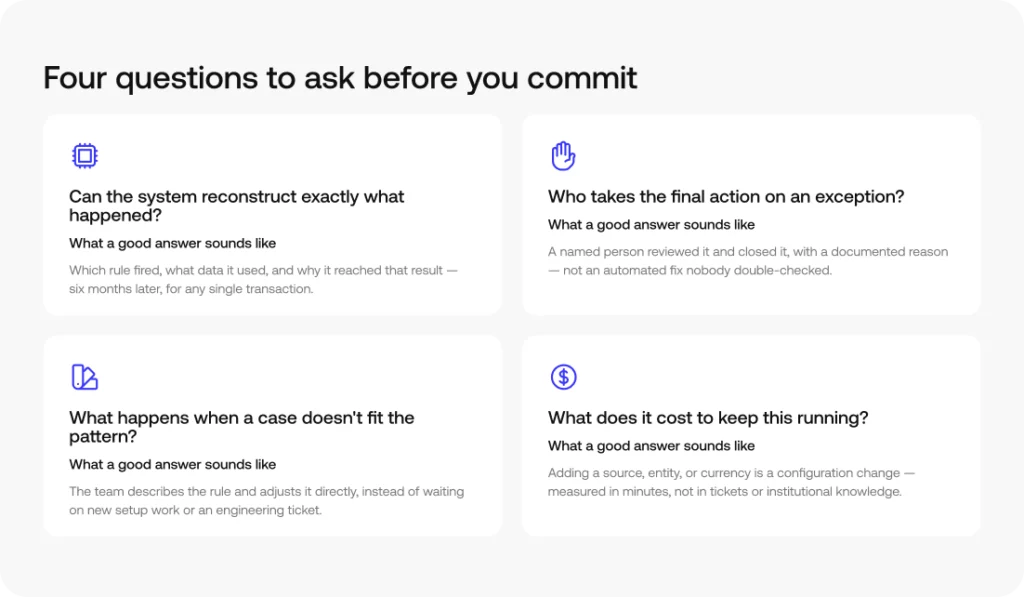
Four questions for evaluating financial reconciliation alternatives

Questions to ask about traceability and audit trail

Can the system reconstruct exactly what happened for any given match or exception? Not just that it matched, but which rule fired, what data it used, and why it reached that result. If you can’t answer that six months later, you don’t have a control. You have an output.

Questions to ask about who owns exception resolution

When something doesn’t reconcile, who takes the final action, and can that action be explained afterward? The honest answer matters more than whether the system “resolved” something on its own. A flagged exception that a person reviewed and closed is more defensible than an automated fix nobody double-checked.

Questions to ask about configuration flexibility

What happens the first time a case doesn’t fit the standard pattern? Does the team wait on a new setup, or can they describe the rule and adjust it directly? Some platforms lean on natural-language interaction for exactly this. Simetrik Agent, for instance, lets a team describe a workflow instead of relying only on a fixed template. A tool that adapts to the edge case is worth more than one that only handles the common one.

Questions to ask about maintenance cost and scalability

Does your current infrastructure actually support your expected growth and compliance requirements across the short, medium, and long term? More specifically, what does it cost, in time, engineering tickets, and lost institutional knowledge, to keep it running as sources, currencies, entities, or rules change?

This question applies just as much to a spreadsheet model or an internal build as it does to any vendor platform, and it’s usually the one that gets skipped until it’s too late.

When a dedicated reconciliation control platform is worth the switch

There’s a point where each of the alternatives above stops being enough, and it’s rarely a single event. It’s an accumulation: new data sources show up, entities and currencies multiply, and exception volume starts growing faster than the team reviewing it. At the same time, constant variability in statements and documents forces teams to reconfigure their manual setups or re-engineer their code with every slight format change. Control requirements from finance, audit, or a regulator start asking for things the current setup was never built to provide.

That’s the point where a platform built specifically for transaction-level control starts to earn its cost. Simetrik connects the pieces that a build or a spreadsheet usually keep separate: data preparation, matching, exception handling, and the path into accounting, under one system that business teams can configure directly, without opening an engineering ticket for every change.

The core that executes the matching logic is deterministic, so the result stays reproducible. The AI layer around it assists with configuration, pattern detection, and natural-language interaction, without taking over the final decision. 

See how Simetrik’s control platform fits into a reconciliation operation that has already outgrown a spreadsheet or an internal build.

How Simetrik handles reconciliation, from matching to audit trail

The architecture behind Simetrik’s deterministic matching engine

Simetrik ingests transaction data from banks, processors, and internal systems, prepares it into a consistent structure, and applies configured rules to match records against each other. The engine that executes those rules is deterministic: the same data and the same configuration produce a consistent result. Around that core sits an AI layer that assists the process. It can suggest matching logic, identify fields, help build transformations, and support conversational configuration through Simetrik Agent, but it doesn’t replace the rule that actually executes. That split matters because a financial control has to be reproducible: a result a team can trace back to a specific rule is one they can defend to an auditor, and a result that came from a model’s best guess isn’t.

How Simetrik detects and resolves reconciliation exceptions

When a transaction doesn’t match cleanly, Simetrik flags it and routes it with context: which rule ran, what data it compared, and why it didn’t clear. A finance team reviews that exception and takes the resolving action from there. Automating the detection, the context, and the routing while leaving the final decision to a person is a deliberate design choice, not a shortcut. A financial exception closed without a documented, reviewable reason is a bigger risk than one that took a person a little longer to confirm.

Simetrik’s audit trail and security certifications

Simetrik’s security program includes ISO/IEC 27001, ISO/IEC 27701, ISO/IEC 27018, SOC 1 Type 2, SOC 2 Type 2, SOC 3, and PCI DSS. Matches, exceptions, and rule applications can be traced back to the configuration that produced them, and the workflows that connect reconciliation to accounting carry that same traceability into journal entries and the reports a team may need for an audit. Certifications are a floor, not the differentiator. What matters more day to day is whether a team can reconstruct exactly what happened, for a given transaction, months after the fact.

Frequently asked questions about Simetrik alternatives

Is Excel or Google Sheets a viable long-term alternative to reconciliation software?

No. Excel and Google Sheets are a viable starting point, not a long-term answer, once volume or complexity outgrows what a team can check by hand. Spreadsheets lack traceability, real-time visibility, and a record of who changed what, which becomes the actual cost as transaction volume rises.

Can general AI tools, like a chatbot or AI agent, replace a reconciliation platform?

General AI tools excel at auxiliary tasks like interpreting messy files, suggesting field mappings, or drafting formulas, but they shouldn’t execute control decisions autonomously. Reconciliation outputs directly drive executive decision-making, tax filings, and financial reporting. Because general AI operates on probability rather than deterministic rules, a non-reproducible answer directly undermines data confidence and credibility. Replacing strict controls with statistical guesses can expose a team to misinformed decisions, audit findings, and regulatory risk, defeating the purpose of a financial control.

Does a reconciliation platform need to execute the fix automatically, or is flagging enough?

A modern platform should support deterministic auto-matching, governed human intervention for complex exceptions, and assisted remediation workflows. What matters is applying the right level of control to each case. Known patterns can be resolved through configured rules, while sensitive edge cases are routed with full context for review and approval. A unified audit trail preserves efficiency without sacrificing reproducibility.

When does it make sense to move from a spreadsheet or internal tool to a dedicated platform?

The switch becomes necessary when you hit limits on both scalability and reliability. Scalability breaks down as growing data, entities, and currencies require unsustainable headcount or dev tickets. Reliability breaks down because spreadsheets can’t track user actions or prove data integrity. When a spreadsheet claims an operation is “90% reconciled,” it can’t answer: Who verified this? Under what rules? Has it been modified? When you can no longer prove how your numbers were reached, the audit risk far outweighs the cost of a dedicated platform.

Does configuration flexibility matter more than a library of pre-built templates?

What matters is whether an approach can adapt to a workflow that falls outside standard patterns without stalling on new setup work, through natural-language interaction, assisted rule-building, or both. A large template library speeds up standard cases. Genuine configuration flexibility is what handles the case that doesn’t fit one.

Should certifications or pricing structure decide which reconciliation option is right for you?

They’re worth checking, but they answer a narrower question than the one that actually matters: can this approach reconstruct what happened, who owns the fix, and what it costs to maintain as your operation changes. Certifications and pricing models are inputs to that decision, not a substitute for it.

Does Simetrik use AI for reconciliation matching?

Yes. Simetrik pairs a deterministic core that executes configured matching rules with an AI layer that assists configuration, suggesting matching logic, identifying fields, and supporting natural-language interaction through Simetrik Agent.

Does Simetrik resolve reconciliation exceptions automatically?

Simetrik detects discrepancies as data is processed and routes them with context so a finance team can review and take the resolving action. That’s a deliberate design choice, not a limitation: a result a person can trace, explain, and defend to an auditor is worth more than one an automated process applied without review.
From gray zone to regulated: 5 financial controls to prepare for the CLARITY Act

As of August 25, 2026, the Digital Asset Market CLARITY Act (H.R. 3633) has not been enacted. The bill passed the House in 2025 and the Senate Banking Committee advanced an amended version by a 15–9 vote on May 14, 2026. It remains proposed legislation while the Senate considers the bill.

The bill would establish a federal market structure for digital assets and clarify oversight roles. Because the final text and effective dates may still change, crypto companies should treat the five controls below as operational readiness measures, not as a definitive compliance checklist.

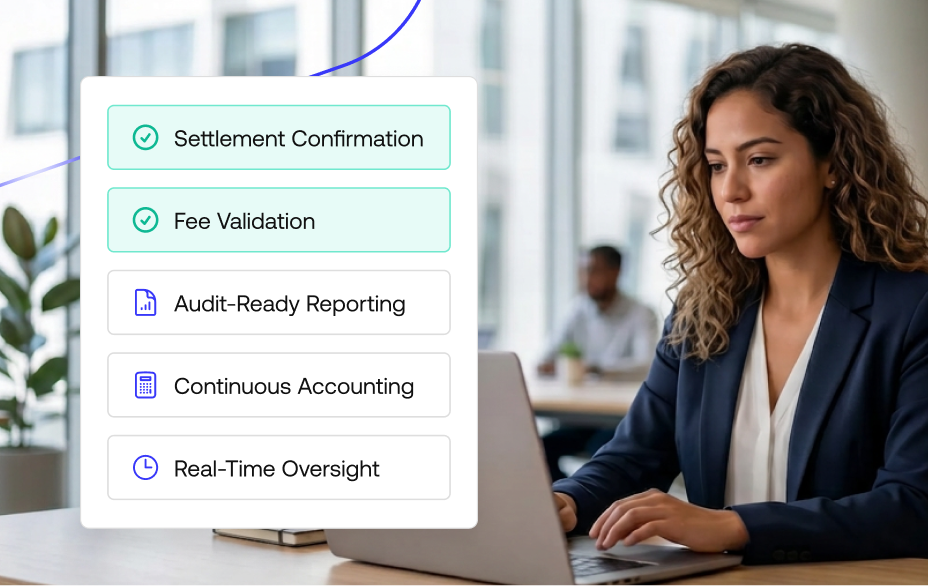
Companies that strengthen these controls now can be better prepared for audits, institutional due diligence, and future scale. Here are the five financial controls you need to have in place and why each one matters more than ever under the new regulatory reality.

1. Settlement Confirmation Across Every Payment Rail

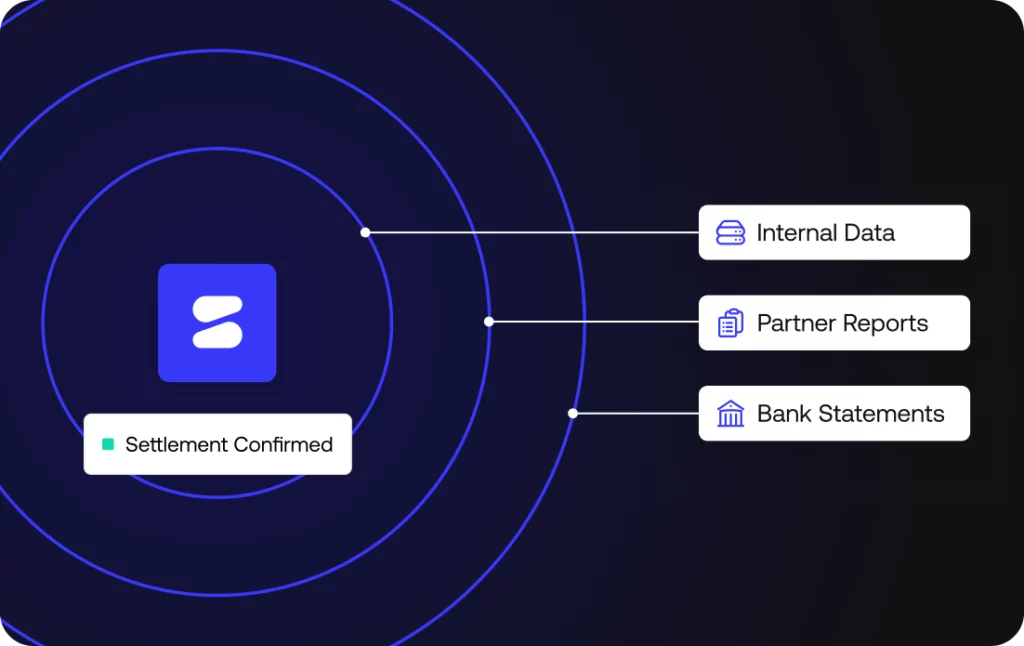
Settlement confirmation across internal data, partner reports, and bank statements

Why this control matters: A more defined digital asset market structure could increase institutional participation. More counterparties and settlement methods create more points where records can diverge between intent and execution.

The control: You need to confirm that every dollar (or token) that should have moved actually moved accurately and on time. That means reconciling your internal operational data against partner settlement reports and bank statements across every payment source, every day. Not at month-end. Not in a spreadsheet.

How Simetrik solves this: Simetrik integrates your internal databases, partners’ operational and settlement reports, and bank statements to validate equivalent data points while maintaining full traceability throughout every stage of the transaction lifecycle. When you’re processing fiat-to-crypto conversions across multiple custodians and sponsor banks, this is how you prove the money arrived.

2. Fee Validation Against Every Contract and Network

Why this control matters: Proposed oversight for digital asset exchanges, dealers, and brokers increases the importance of proving how fees are charged, collected, and reported. Platforms should be able to validate trading fees, spreads, custody fees, or other charges against transaction-level records.

The control: You need to validate that the fees you’re being charged by processors, networks, and banking partners match what’s in your contracts and that the fees you’re collecting from customers are applied correctly across every transaction. Fee discrepancies at scale erode margins silently.

How Simetrik solves this:  Simetrik integrates your partner fee agreements, settlement reports (incoming and outgoing), and internal databases to validate fees against rules and contracts, detect overcharges, and turn fee transparency into negotiation leverage. For crypto companies, where fee structures vary by network, token, and volume tier, this control can help protect margins and support measurable ROI.

3. Audit-Ready Reporting with Full Traceability

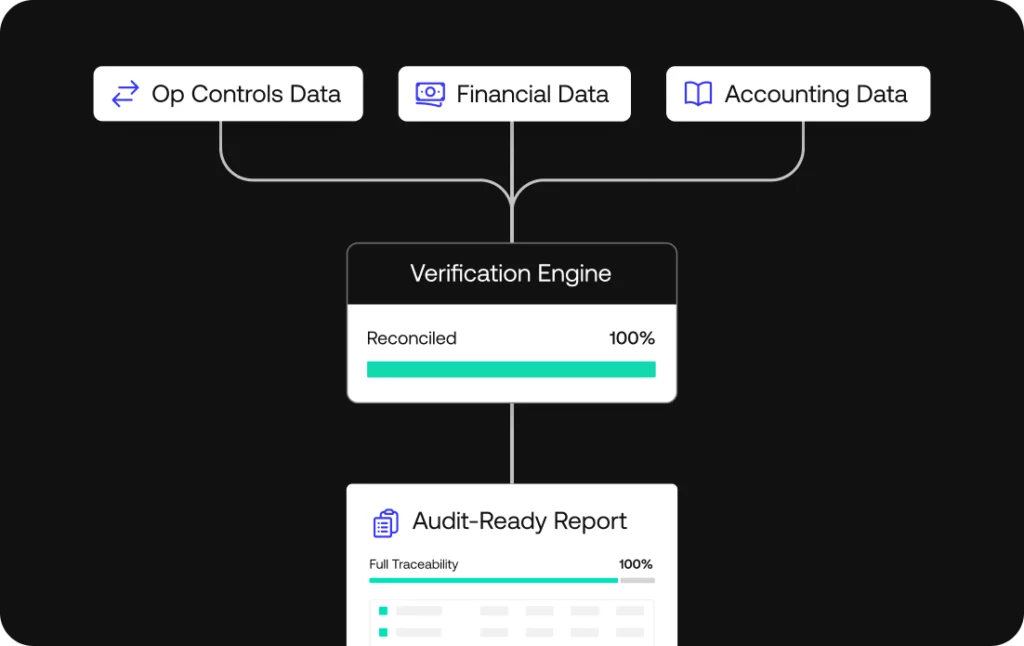
Verification engine producing an audit-ready report from operational, financial, and accounting data

Why this control matters: Existing customer due diligence, suspicious activity reporting, and AML obligations already make verified, traceable data essential for in-scope entities. Future market-structure rules may add reporting expectations, but the exact requirements will depend on the final law and implementing regulations. 

The control: Crypto companies subject to reporting requirements need to generate compliance reports based on reconciled data that traces back to the original source. Every match, exception, and resolution should be documented and audit-ready at all times.

How Simetrik solves this:  Simetrik generates audit-ready reports for regulators and stakeholders based on verified data from your operational, financial, and accounting controls. Every report maintains full traceability back to the original data sources, reducing regulatory risk and cutting audit preparation time.

4. Continuous Accounting Controls

Why this control matters: As digital asset classifications and oversight continue to evolve, crypto companies cannot afford to discover accounting errors weeks after the close. Accounting rigor and traceable records remain essential regardless of the final bill text.

The control: You need to continuously automate revenue recognition, accruals, and provisions at transaction scale. Journal entries should be generated from reconciled and verified data, not from raw exports that someone manually cleaned up.

How Simetrik solves this: Simetrik automates operational accounting by generating journal entries from reconciled data, calculating provisions, and integrating with ERPs like SAP, Oracle, and NetSuite. The result: financial close accelerated by 1 to 2 weeks, with audit-ready documentation at every step.

5. Real-Time Oversight and Anomaly Detection

Why this control matters: The bill would introduce new definitions and oversight boundaries for digital asset activities. Whatever final classifications apply, platforms need visibility into reconciled transactions, exceptions, and control evidence.

The control: You need real-time dashboards that track KPIs across your entire operation, with intelligent alerts that flag anomalies before they become losses or regulatory findings. You can’t monitor what you can’t see, and you can’t report what you haven’t reconciled.

How Simetrik solves this:  Simetrik provides customizable dashboards tracking real-time KPIs, intelligent alerts on anomalies, consolidated views of reconciled balances across sponsor banks, and drill-down from summary to transaction detail all based on reconciled and verified data.

The Bottom Line

The Clarity Act isn’t a surprise. The regulatory direction has been clear for years. Now that the Clarity Act is taking shape, crypto companies have a window to get ahead of it.

The companies that treat compliance as a strategic advantage will be the ones that earn institutional trust, close their books faster, and scale without adding headcount. That’s the difference between building controls reactively and building them on a platform designed for exactly this kind of complexity.

Simetrik already processes 3.5 billion daily records and reconciles and controls over $800 billion in payment volume for 180+ enterprise clients across 60+ countries, including some of the largest fintechs and digital asset platforms in the world. The controls described above aren’t theoretical. They’re live, in production, today.

Ready to get ahead of the Clarity Act?

Schedule a personalized demo to see how Simetrik maps to your specific crypto operations.

The Confidence Gap: Why Your Dashboard Says Green But Your Margins Say Red

Every fintech CFO has the same answer when you ask about reconciliation: “We’re covered.”

The dashboards are green. The month-end close completes on schedule. The board deck shows transactions processed, revenue recognized, and cash positions balanced. Everything looks healthy.

And then someone finds $2 million in losses that was there the entire time.

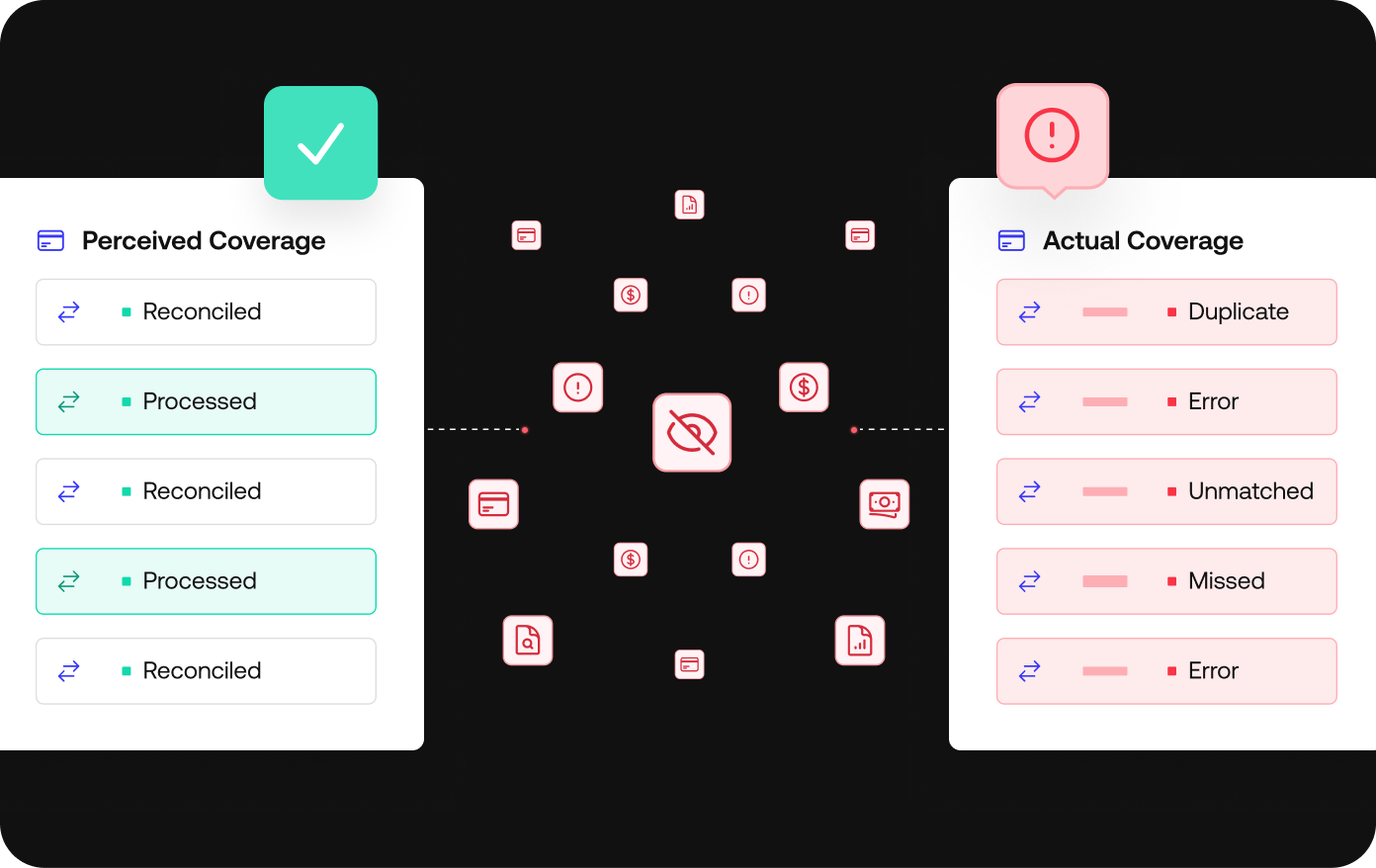
This is what we at Simetrik call the Confidence Gap, the distance between what finance leaders *believe* their reconciliation covers and what it *actually* covers. It is the most expensive blind spot in modern financial operations, and it is growing wider as payment complexity accelerates.

The Anatomy of an Invisible Problem

The Confidence Gap does not announce itself. There is no failed reconciliation run, no red flag in the dashboard, no alert from your payment processor. The numbers check out at the level you are looking at. The problem is that you are looking at the wrong level.

Consider a real case: a sophisticated payment processor operating across three markets, processing billions in annual volume. They had reconciliation processes. They had a finance team. They had dashboards. And buried inside their data were three separate sources of margin leakage totaling $2 million. None of which were visible to their existing controls.

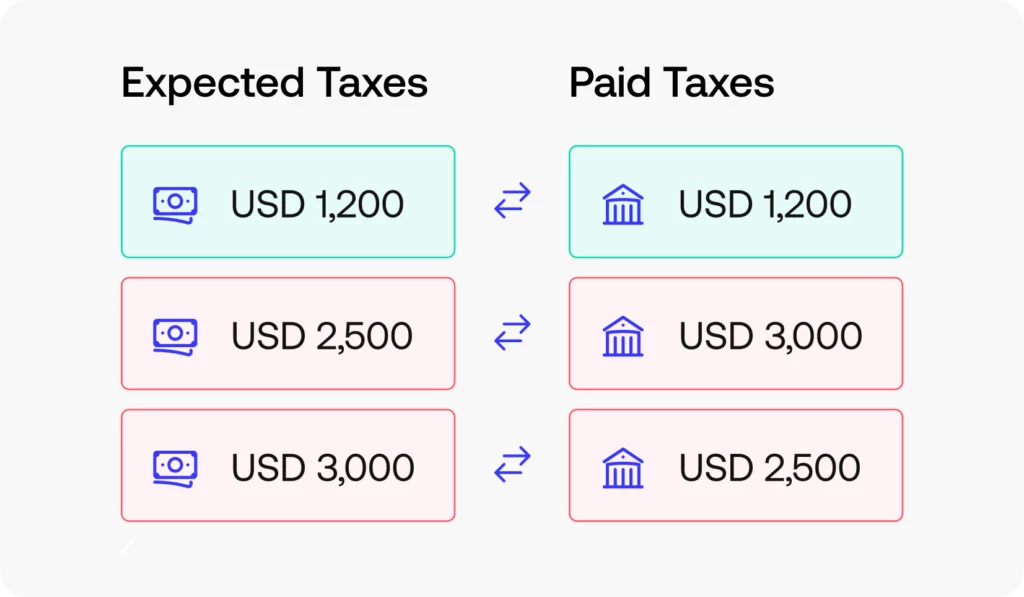
The first was a partner bank incorrectly withholding taxes on transactions. At the aggregate level, “taxes paid” checked out. At the transaction level, the wrong taxes were being applied to the wrong transactions. The second was a transaction code ambiguity,  multiple acquirers used the same code for refunds and chargebacks, causing missed dispute deadlines and absorbed losses. The third was a pattern of duplicate debits on refunds spanning multiple countries, invisible without cross-entity pattern detection.

These were not edge cases. They were systemic, ongoing losses hiding behind reconciliation processes that looked perfectly functional.

Three Forces That Widen the Gap

The Confidence Gap is not caused by negligence. It is a structural consequence of three forces that compound as fintechs scale.

Volume masks discrepancies

When you process millions of transactions, aggregate numbers look healthy even when errors are accumulating underneath. A $500 tax misapplication on one transaction is noise. That same error compounding across thousands of transactions over months becomes a seven-figure problem, and it never triggers an alert because the totals still balance within acceptable thresholds.

Complexity outpaces process

Every new payment method, every new market, every new banking partner adds reconciliation complexity. Your team bolts on new processes to handle the new flows, but those processes were designed for yesterday’s architecture. The result is a growing patchwork of manual reviews, spreadsheet cross-references, and scripts that work until they silently stop.

Reconciliation is treated as hygiene, not infrastructure

It gets investment last, attention last, and talent last. Your best engineers are building product features, not reconciliation pipelines. Your best analysts are preparing board decks, not investigating transaction-level anomalies. Reconciliation gets treated as a back-office checkbox until a regulator, an auditor, or a $2 million loss forces it into the spotlight.

The Regulatory Signal You Cannot Ignore

If the business case alone does not close the gap, the regulatory environment should.

In late 2024, the FDIC proposed a new recordkeeping rule for custodial accounts. This was a direct response to the Synapse Financial Technologies collapse, which left over 100,000 consumers locked out of their money and exposed an estimated $65 million to $95 million shortfall between bank records and actual customer balances. The proposed rule pushes banks partnering with fintechs toward transaction-level traceability of beneficial ownership. A standard that makes aggregate reconciliation insufficient by design.

While the rule’s timeline has shifted under the current administration, the direction is clear: regulators are moving toward requiring the granularity that most fintech reconciliation architectures were never built to provide. Whether the FDIC rule takes effect this year or not, the expectation of transaction-level auditability is becoming the baseline. Companies that get ahead of it will have a competitive advantage; companies that wait will be scrambling.

Five Warning Signs You Have a Confidence Gap

Not every company has a $2 million problem. But most scaling companies have at least two of these five warning signs  and if you recognize more than two, the gap is real.

Your reconciliation runs on a schedule, not on events

End-of-day or twice-a-week reconciliation creates windows where errors compound undetected. Event-triggered reconciliation catches a $500 error on day one. Batch reconciliation discovers a $500,000 problem six months later.

You reconcile in aggregate, not at the transaction level

The $470,000 tax issue described above was invisible at the aggregate level. “Taxes paid” checked out. “Correct taxes paid on correct transactions” did not. If your reconciliation summarizes before it compares, it is designed to miss the errors that matter.

Your reconciliation is siloed by partner or market

The duplicate-debit pattern spanned three countries and multiple acquirers. No single partner’s data showed an anomaly. Only a cross-entity view comparing behavior patterns across all acquirers simultaneously could surface it. If your reconciliation runs in parallel silos that never intersect, cross-entity patterns stay invisible.

Finance cannot configure a new reconciliation flow without engineering

 In the case study above, the company went from six weeks to two weeks to onboard a new payment method once finance could configure flows independently. When reconciliation depends on engineering backlogs, your speed to market is bottlenecked.

A regulatory audit would take you weeks, not hours

If producing a complete transaction-level audit trail is a project rather than a query, your infrastructure lacks the granularity you think it has. As regulators push toward real-time traceability, “we can get it to you by next week” is not going to be an acceptable answer.

Closing the Gap

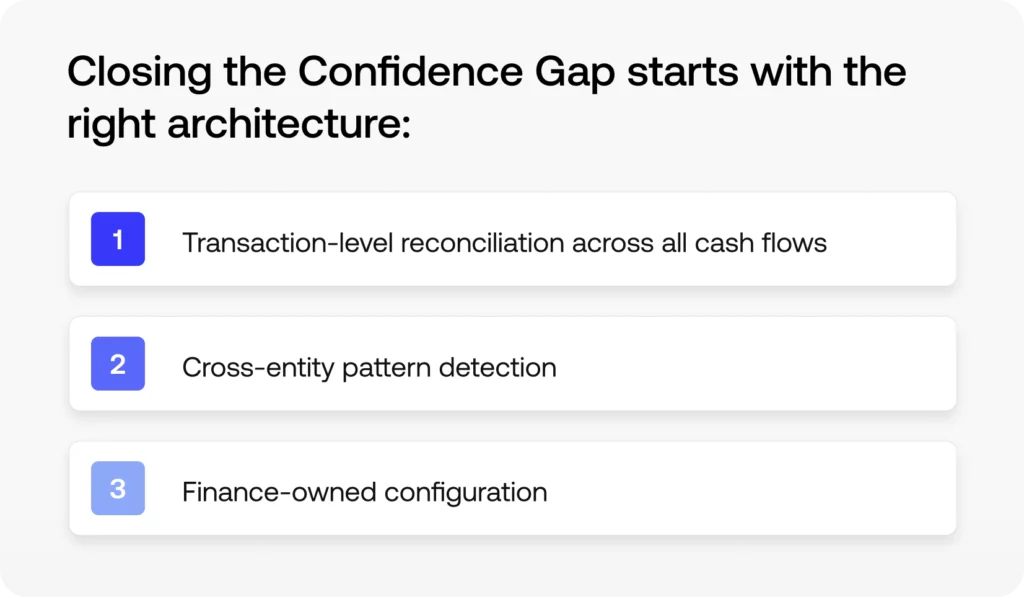
The companies that close the Confidence Gap share three architectural characteristics;

Transaction-level reconciliation across all cash flows

Not summary batches, not aggregate totals, but every individual transaction matched from payment processor to core ledger, continuously. Simetrik automates this across all inbound and outbound payment flows, reconciling at the transaction level and flagging discrepancies within hours, not weeks. This is how the $470,000 tax phantom was found: by comparing individual transactions against banking records instead of trusting aggregate totals.

Cross-entity pattern detection

Discrepancies that span multiple partners, markets, or acquirers require a unified view of all settlement data. Simetrik’s platform processes 3.5 billion records daily across 60+ countries, enabling the kind of cross-entity anomaly detection that caught the duplicate-debit pattern across three markets. Manual processes and siloed reconciliation tools are structurally incapable of surfacing these patterns.

Finance-owned configuration

When finance teams can build and modify reconciliation flows without waiting for engineering, two things happen: new payment methods get reconciled from day one (instead of six weeks later), and the people closest to the business logic are the ones designing the controls. Simetrik’s no-code platform puts reconciliation configuration in the hands of finance and ops teams, reducing dependency on engineering.

Do you have gaps?

The Synapse collapse proved that a company can process billions in volume, serve millions of customers, and still lose track of tens of millions of dollars because of a visibility failure. Their reconciliation architecture was not designed for the complexity they had grown into.

The $2 million case study proves that even sophisticated processors with real reconciliation processes can have systemic margin leaks hiding in plain sight.

The question is not whether you have a Confidence Gap. The question is whether you will close it before it costs you more than you are comfortable discovering.

Are you ready to see what your current reconciliation is missing? Schedule a 30-minute personalized demo with Simetrik. We will use a secure sandbox environment with either dummy data or your actual payment data to show you live, automated discrepancy detection and the transaction-level audit trails that close the gap.

Graduating from Sponsor Banks: Is Your Fintech’s Back Office Ready for an OCC Charter?

For years, your fintech has thrived on a simple formula: build a sleek front-end, acquire users rapidly, and let a traditional sponsor bank handle the heavy regulatory lifting behind the scenes. It’s a model that allows startups to move fast and break things without actually breaking federal banking laws.

As transaction volumes scale, those “training wheels” start to look like expensive roadblocks.

Thanks to the passage of the 2025 GENIUS Act and a wave of pro-innovation rulings under OCC Comptroller Jonathan V. Gould, the window for federal charters is wide open. Following the December 2025 conditional approvals for giants like Ripple, Circle, Paxos, and Fidelity, a flood of small-to-medium fintechs and digital asset firms are now eyeing the OCC National Trust Charter.

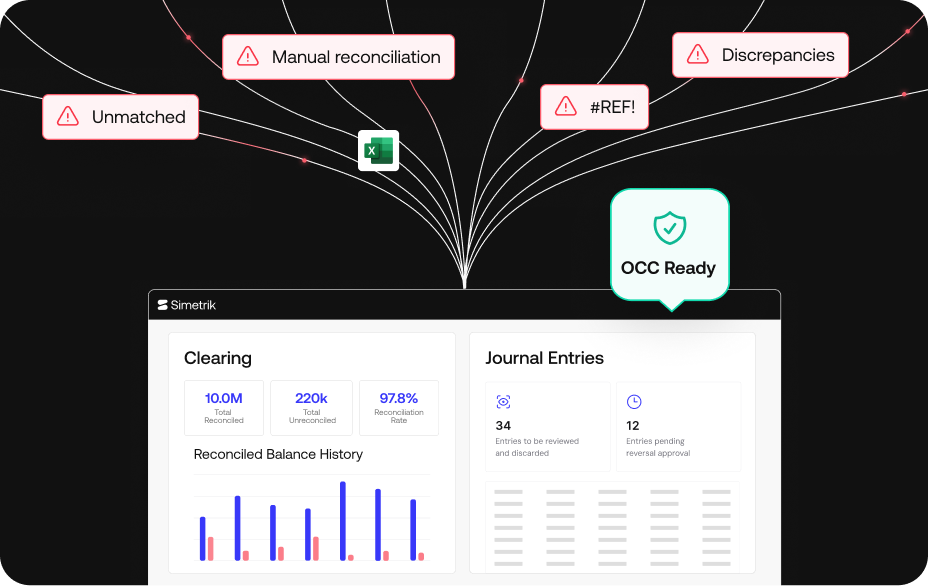
Securing an OCC Charter is the ultimate graduation for a scaling fintech. It cuts out the sponsor bank middleman and preempts a patchwork of 50 different state licenses. However, federal examiners do not grade on a curve. If your back office still runs on spreadsheets and manual Python scripts, your application is dead on arrival. An OCC charter is the gold standard of financial regulation. Earning one signals to Wall Street, enterprise partners, and retail consumers that your institution is heavily capitalized, strictly regulated, and built to survive economic downturns.

Here is what it takes to get your operations ready for the federal standard.

 The Reality Check: Startup Agility vs. Bank-Grade Compliance

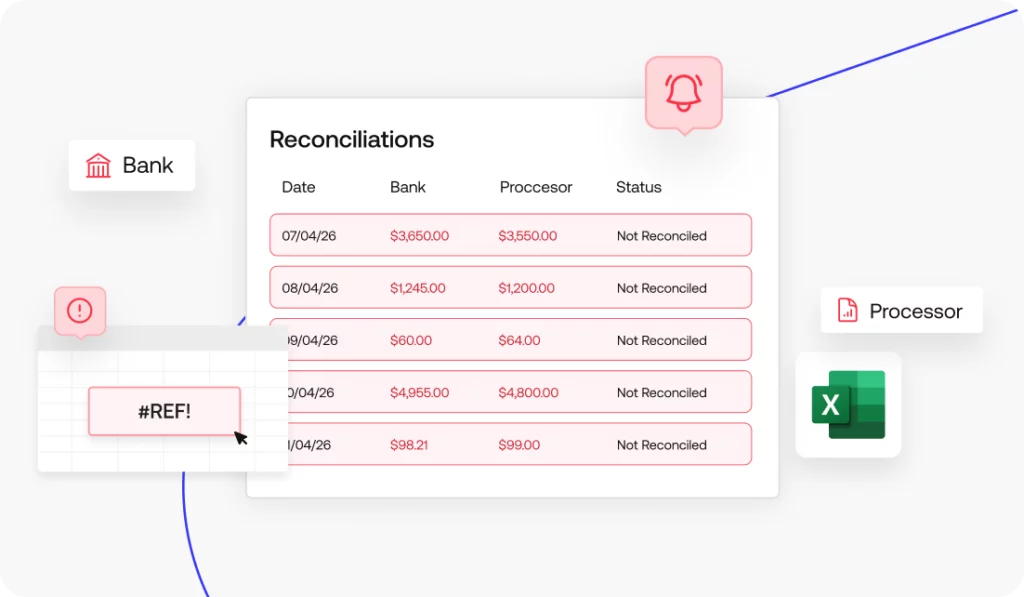
Right now, your finance team probably relies on Excel, Google Sheets, or homegrown Python scripts to match transactions, catch invisible revenue leakage, and run the month-end close. When discrepancies occur, your team manually hunts them down across multiple processor portals.

This is the “good enough” trap. It works when you have 10,000 users, but it breaks when you scale.

The OCC demands “bank-grade safety and soundness.” This means examiners have zero tolerance for operational gaps, delayed settlement tracking, or manual reconciliation errors. You cannot manage billions in fiduciary assets, issue stablecoins, or run a federally regulated payments program using VLOOKUPs. When regulators come knocking, spreadsheets won’t hold up to scrutiny. A proven, auditable system gives you the documentation and traceability to face any regulatory review with confidence. 

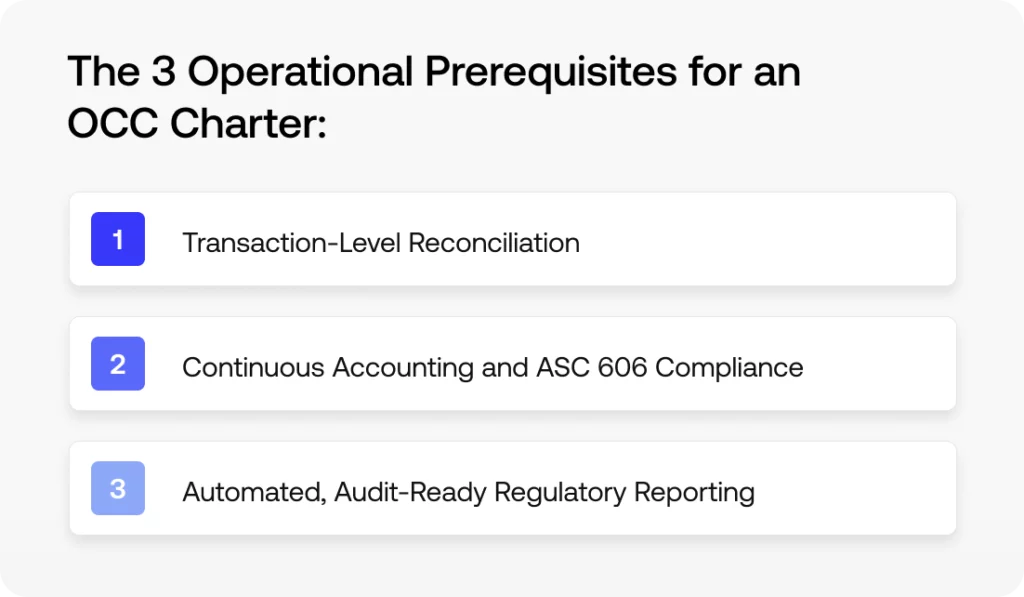
The Three Operational Prerequisites for an OCC Charter

To pass an OCC exam, you must prove that your financial controls are automated, continuous, and foolproof. Here are the three operational pillars you must have in place:

Prerequisite 1: Transaction-Level Reconciliation

Traditional financial close tools are balance-level focused. They are not built to handle the complexity of matching 24/7 crypto trades, volatile network gas fees, and card network chargebacks against fiat ACH and wire rails.

  • The Standard: You need continuous, automated, transaction-level reconciliation.
  • How Simetrik Solves It: Simetrik aligns operations data for all product operations, such as payment processing, ATMs, and other digital products, with accounting records daily, tracking every single dollar from the payment processor to the core ledger. We automate discrepancy detection within 24 hours, preventing the 5 to 15 basis points of invisible margin leakage that usually slips past manual reviews.

Prerequisite 2: Continuous Accounting and ASC 606 Compliance

If your month-end close takes 8 to 12 days because your team is bogged down by manual journal entries and spreadsheet-based revenue recognition, regulators (and investors) will see a massive red flag.

  • The Standard: A continuous, highly automated close process that is perpetually audit-ready.
  • How Simetrik Solves It: Simetrik automates revenue recognition directly from transaction-level payment data, ensuring strict ASC 606 compliance. By systematically generating journal entries for revenues, fees, and provisions, we reduce manual journal entries by 80%+. The result? A 2-3 day close with zero posting errors.

Prerequisite 3: Automated, Audit-Ready Regulatory Reporting

Compiling FinCEN, BSA/AML, and SOC 2 reports manually takes weeks of engineering and compliance resources, leaving massive room for human error. Under the OCC, these reporting requirements become heavier and more frequent.

  • The Standard: Complete transaction-level audit trails that can be generated on demand for federal examiners.
  • How Simetrik Solves It: We transform compliance from a manual burden into automated assurance. Simetrik generates FinCEN, AML, and other required regulatory reports directly from your transaction data, maintaining SOC 2-ready controls while reducing your overall compliance costs by up to 60%.
Stop Acting Like a Tech Company, Start Operating Like a Bank

You need Unified Oversight. Executives must have real-time KPIs across all product operations, from cash positions across funding sources to proactive anomaly alerts, with the ability to drill down from a summary dashboard straight to the transaction level. When the OCC (or your board) asks a question about unit economics or funds flow integrity, you must be able to answer it with instant, verified data.Are you preparing your operations for the next stage of scale?

Schedule a 30-minute personalized demo with Simetrik.

We’ll use a secure sandbox environment with either dummy data or your actual payment data to show you live, automated discrepancy detection and the regulatory-grade audit trails required for federal compliance.

How fast-growing fintechs fix reconciliation at scale

When companies scale quickly, the first cracks often appear in back-office processes. Reconciliation is usually the most visible and the most painful.

Teams start each morning inside spreadsheets, pulling CSVs from processors, painstakingly matching transactions, and hoping the numbers line up. Manual workarounds may be sufficient at a small scale, but they turn into structural risk as volumes and partners multiply.

For a fast-growing fintech, reconciliation at scale means comparing transaction-level records across a growing number of processors, banks, ledgers, and partners without losing control of exceptions.

The operating model is straightforward: centralize the source data, normalize it, apply deterministic matching rules, and send the remaining exceptions to analysts with the context they need to act.

This is a familiar story: multiple bank and processor accounts, dozens of payment stakeholders, hundreds of thousands of daily entries, and activity spread across many time zones all contribute to a level of complexity that is hard to rein in. 

At scale, reconciliation must work for everyone. Finance leadership needs speed and reliability, while operations wants transparency and control.

Both teams need one source of truth. This article explains the problems behind manual reconciliation and how a controlled, automation-first approach can turn daily firefighting into a durable operating model.

The cost of spreadsheet-driven reconciliation

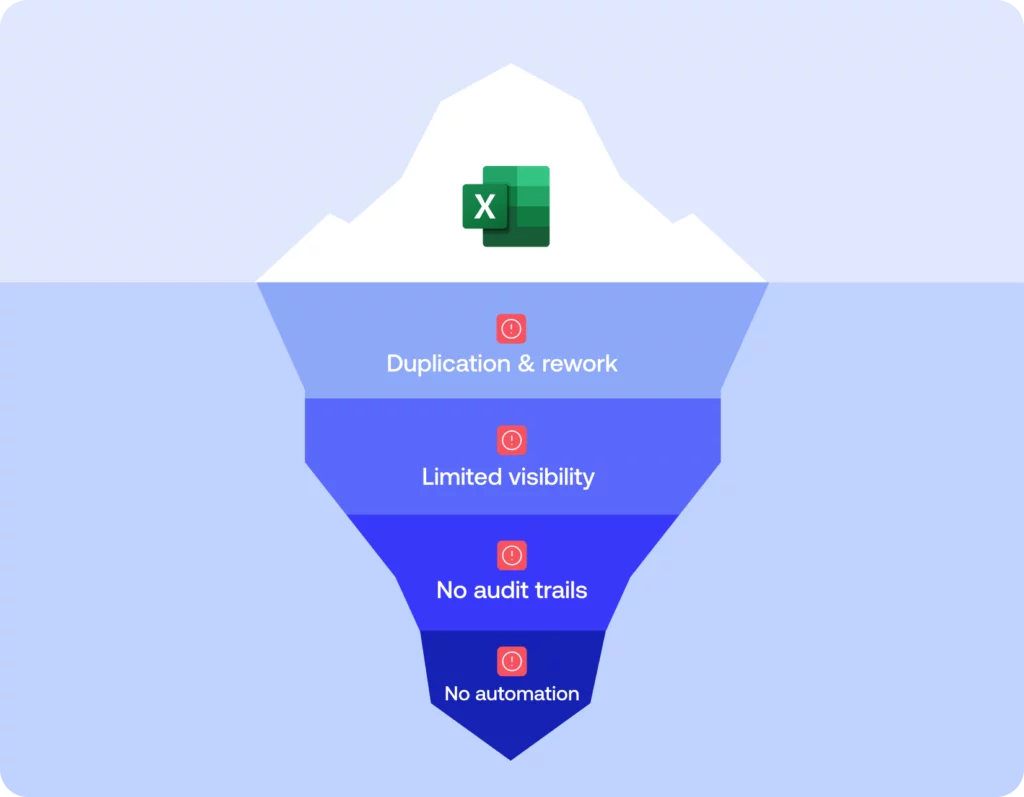
Iceberg diagram showing spreadsheet reconciliation costs: duplication, limited visibility, missing audit trails, and lack of automation

Spreadsheets are flexible and fast at the start. At scale, however, they create hidden costs that compound daily.

Instead of one controlled view of transaction and financial data, spreadsheets provide snapshots that diverge as teams copy, filter, and rework them. It becomes difficult to pinpoint what is reconciled, what is pending, and where material risk is concentrated. Context lives in people’s heads and scattered tabs.

In April 2025, the FDIC announced a $150 million civil penalty and a restitution plan of at least $1.225 billion against Discover Bank. A parallel Federal Reserve action imposed another $100 million penalty on Discover Financial Services and DFS Services.

Software would not have resolved the underlying conduct on its own. The case shows why teams need source-level records, controlled classification logic, reviewable changes, and evidence they can reconstruct when a fee or rule is challenged.

The cost of spreadsheet-driven reconciliation is due to several factors:

  • Duplication and rework that wastes hours and adds risk
  • Limited visibility that stunts leadership’s ability to make decisions
  • Lack of clear, immutable audit trails needed for compliance
  • Lack of automation, with experienced analysts reduced to data movers

These are not simply inconveniences. They are control failures waiting to surface. And the higher the transaction volumes, the worse these failures will be.

Why volume breaks spreadsheets and how to fix it

The largest PSPs and marketplaces process millions of transactions a day. At that scale, two things matter most. First, you must reconcile at the transaction level, not only by balance. Second, you must do it without forcing humans to wait on a screen.

A scalable workflow ingests compatible data from processors, banks, and internal systems, then normalizes files and APIs into comparable structures. Configured rules handle repeatable matching while analysts work from an exception queue instead of reviewing the full dataset. 

A useful scale test compares the same control at ten thousand and ten million rows. Runtime should remain predictable, material open items should stay visible, and analysts should not have to wait on the full dataset or build intermediate spreadsheets to make the process work. 

A transaction-level reconciliation platform supports this operating model by connecting data preparation, matching, exception handling, and traceability. 

What modern reconciliation should deliver by default

A modern reconciliation platform should provide financial control from transaction record ingestion to traceable reporting, with visible rules, exceptions, owners, and evidence.

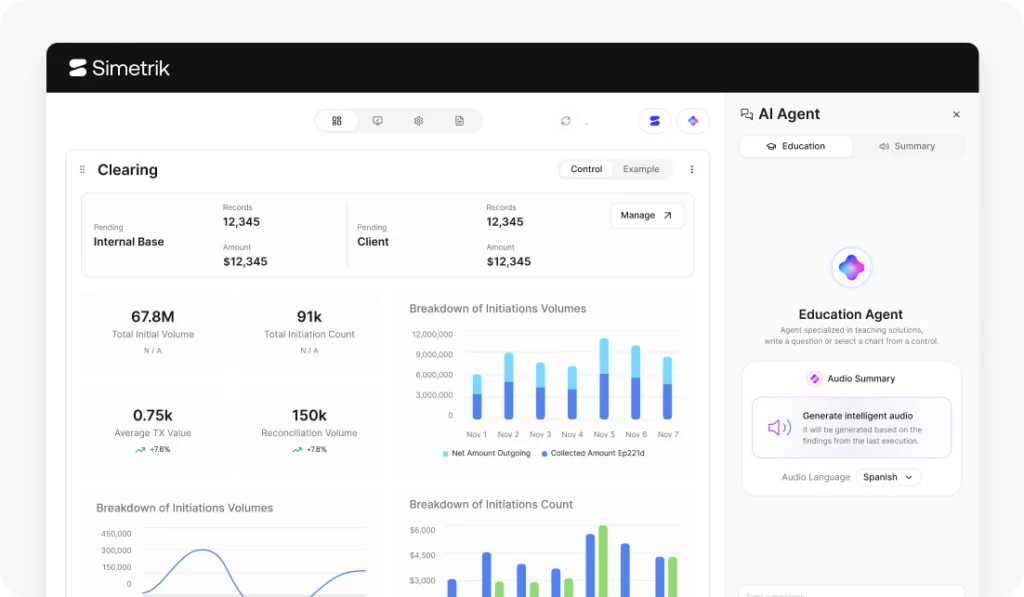
In practice, teams need one governed view of accounts, partners, processors, completed controls, pending exceptions, fees, and financial exposure. The dashboard should show both counts and values, because a small number of unresolved transactions can still be material.

A scalable model uses deterministic matching rules for control and AI to assist mapping, transformations, rule suggestions, and exception analysis. Finance and operations retain responsibility for the configuration, approvals, and material decisions. 

When considering a modern reconciliation platform, check for these critical features:

  • Configurable matching. Prioritized rules, tolerances, and matching sequences that compare prepared transaction data while retaining the rule behind each result.
  • Scalable processing. Processing designed for growing data volumes, source counts, matching sequences, and recurring controls.
  • Granular access control. Configurable profiles that give reconcilers, engineers, finance leaders, and other stakeholders appropriate access and visibility. Actions and changes remain traceable within the supported workflow.
  • Collaboration across teams. Configured exception and oversight workflows can bring the right teams into the investigation while keeping evidence and status tied to the underlying record.
  • A traceable audit trail. Source lineage, rule versions, actions, notes, approvals, timestamps, and user attribution that allow a reviewer to reconstruct the result.
  • Controlled reporting and downstream workflows. Dashboards, datasets, exports, and compatible distribution workflows built from reconciled data and documented controls.

Together, these capabilities reduce repetitive work and make control evidence easier to review. They also reduce the engineering dependency created when every new partner, field, or rule requires a custom spreadsheet or code change.

How Simetrik aligns with your operational reality

Simetrik is a financial reconciliation and control platform for teams managing high-volume operations. It combines governed data preparation, configured matching rules, exception workflows, and traceable outputs. AI assists mapping, transformations, rule suggestions, and analysis while the deterministic engine executes the control logic. 

Reconciled data can feed dashboards, reports, and compatible downstream workflows. The same governed output supports operations and finance without another round of spreadsheet assembly.

From data movers to investigators

By adopting an AI reconciliation platform, you allow analysts to take on a more impactful, strategic role. They can see discrepancies and exceptions in their dashboard, along with all the context they need to investigate and resolve the issue.

With Simetrik, exception views can include the fields needed for investigation: counterparty, flow type, currency, amount, references, prior attempts, and related items. Configured conditions can route ownership and notify support or payments teams when their input is needed.

Analysts spend their day resolving, not assembling. They close items, add root cause codes, and propose rule changes when patterns emerge. Managers see throughput, backlog age, and the value at risk by team and partner. Leadership gets a clear view of operational health and financial exposure, not a stack of spreadsheets.

Reporting that’s ready to share and act on

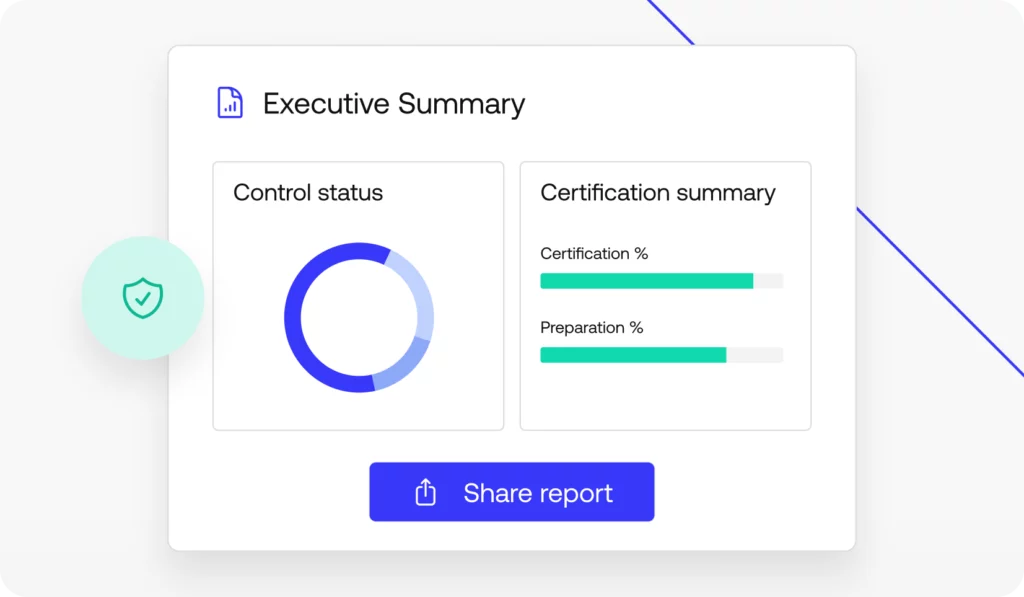
Executive summary dashboard with control status, certification progress, and a share report action

Many teams still struggle with reporting at the end of a period. Missing evidence, manual data collection, and incomplete source information delay review and force people to rebuild the same analysis.

Internal protocols and external reporting requirements add more preparation. Teams need documentation that reflects their own controls and can be traced back to the underlying records.

AI Copilot Datasets can help users create reusable queries or datasets from natural-language instructions, such as identifying which partners drive the most exceptions or which accounts close late. Teams review those outputs and use them in dashboards or reporting workflows configured for their own requirements.

Dashboards and reports can remain drillable to the underlying transactions. Finance gets the context it needs while operations avoids rebuilding the same pivot table at every period end.

Integrations that keep systems aligned

Fast-growing companies often implement accounting systems on a separate track from operations. Reconciliation then becomes a bridge between external movement and internal books. That bridge needs to be stable.

Through compatible integration methods, Simetrik can ingest financial and operational data from banks, processors, ledgers, data warehouses, and internal systems. Cleared positions or exception summaries can then move into supported downstream workflows.

If an ERP rollout is still underway, structured exports can bridge the current process while the team establishes more consistent data and traceability.

What the first 90 days look like

Teams often ask how to move from spreadsheets to a controlled operating model without disrupting the close. The following 90-day sequence is an evaluation framework, not a universal implementation promise.

PeriodOperating focusEvidence to review
Weeks 1–4Connect the highest-volume processors and bank accounts. Recreate the current matching logic and begin working exceptions in Simetrik while spreadsheets remain a comparison point.Source completeness, first match results, aged items, and an executive dashboard for the in-scope workflow.
Weeks 5–8Retire spreadsheet steps for the in-scope accounts. Add rule stages, configured ownership, notifications, notes, and reason codes.Manual-touch rate, backlog age, ownership, and monthly reporting from the controlled workflow.
Weeks 9–12Expand to more accounts and partners. Tighten access profiles, add approvals for sensitive actions, and connect compatible downstream workflows.Runtime, coverage, remaining gaps, user access, exports, and month-end readiness.

The first month tests source readiness, matching coverage, and ownership. Later phases should prove that the workflow can expand without losing runtime visibility, traceability, or control.

Finding ROI: seeing fast outcomes on Simetrik

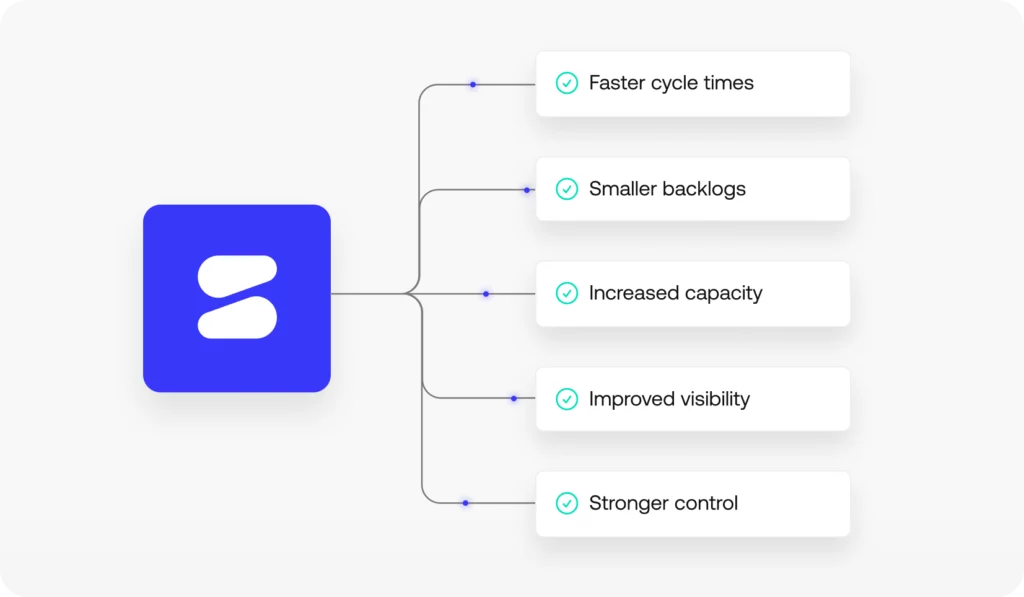
Simetrik diagram connecting reconciliation automation to faster cycles, smaller backlogs, greater capacity, visibility, and control

Use the first few reconciliation cycles to establish a baseline. Compare runtime, match coverage, unmatched value, backlog age, manual touches, and reporting effort before expanding the workflow.

The ROI case should be measured through outcomes such as:

  • Faster cycle times. Measure the time from source arrival to a documented reconciliation result, including time spent resolving material exceptions.
  • Smaller backlogs. Track the count, value, age, and owner of unresolved items instead of relying on rows copied between files.
  • Increased capacity. Measure how much analyst time moves from collecting and matching data to investigating exceptions and fixing recurring causes.
  • Improved visibility. Give leaders a view of financial exposure by value, age, partner, and flow, with traceability for exceptions and adjustments.
  • Stronger control. Review whether actions, rule changes, approvals, and evidence can be reconstructed without assembling a separate audit file.

A credible business case connects these measures to the cost of engineering changes, manual effort, delayed investigation, and fragmented reporting.

Simetrik brings data preparation, deterministic matching, exception management, and traceability into one controlled workflow. To evaluate the approach with your own high-volume reconciliation, request a demo.

Reconciliation maturity: A path to AI-driven excellence for finance operations teams

When you think about resilient finance operations, what comes to mind? 

Accurate numbers, limited risk exposure, data-driven decisions, and well-controlled costs—all of these are made possible through the process of reconciliation.

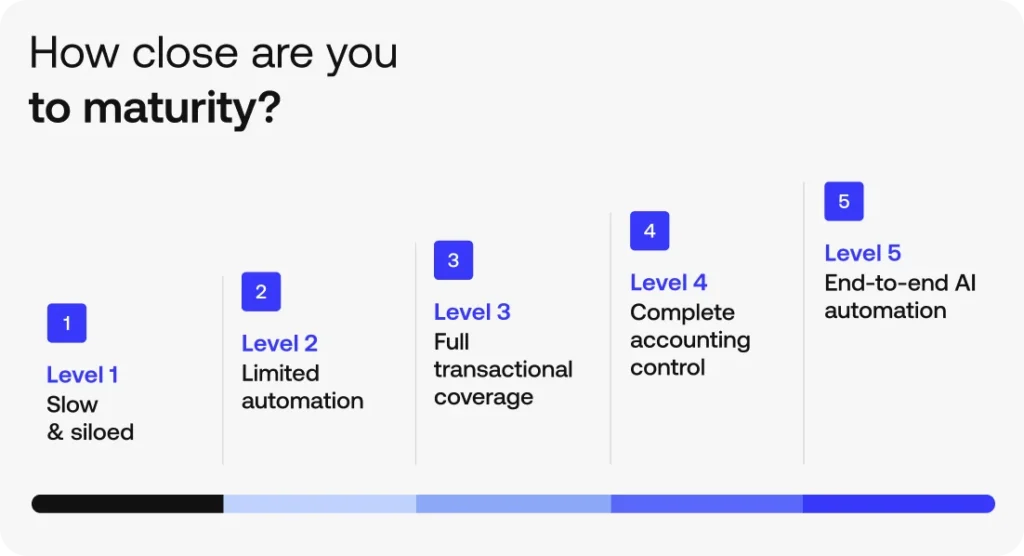
Reconciliation maturity describes how consistently a finance operations team can connect data, apply repeatable matching rules, investigate exceptions, and produce traceable outputs at scale. This five-stage model helps teams identify their current level and the controls needed to advance.

Today, however, the reconciliation process is still plagued by outdated technology and manual number-crunching. It’s tedious, rife with errors (as seen in recent public cases where mistakes have cost companies millions), and unscalable in a market where complexity seems to grow by the minute. 

It’s time to adapt. In this guide, we’ll take a look at a model for reconciliation maturity that will guide you toward fully automated, AI-enabled reconciliation at every level. From siloed, costly operations to expertly orchestrated workflows with clear ROI, each advancement reduces cost and drives efficiency across the organization.

5 factors making reconciliation painful:

  1. Massive transaction volumes involving many fintech, payments, and banking partners
  2. Highly complex, nonstandardized remittance data in varied formats
  3. Stringent, inconsistent regulatory requirements across many regions and industries
  4. A fast-growing market that regularly requires new partnerships, integrations, and workflows 
  5. The en masse adoption of AI that requires real-time, trusted data to operate

Why reconciliation maturity matters now

Until recently, the standard response to reconciliation complexity was to add headcount, boost engineering spend, or accept a baseline level of revenue leakage, audit fees, and costly errors. 

But the modern financial ecosystem has reached an inflection point that makes this path impossible to stay on. The last decade has seen sweeping changes in global regulations, an explosion of payment companies and offerings, open banking standards, and an AI boom that reset the bar for real-time data access and deep interoperability.

Legacy reconciliation solutions can’t meet the demands of today’s market, always one step behind and far too unreliable for the speed and volume of modern money movement. Miss out now, and you’ll face increasingly prohibitive costs as you try to keep up with competitors who’ve adopted  scalable, AI-ready reconciliation platforms.

The great enabler: the AI reconciliation platform

To reach full reconciliation maturity, companies need technology that can handle enterprise complexity. While it’s possible to make it past the first stage of reconciliation maturity using point solutions or home-grown scripts, you won’t get much further without a unified platform for all of your reconciliation data, controls, and workflows.

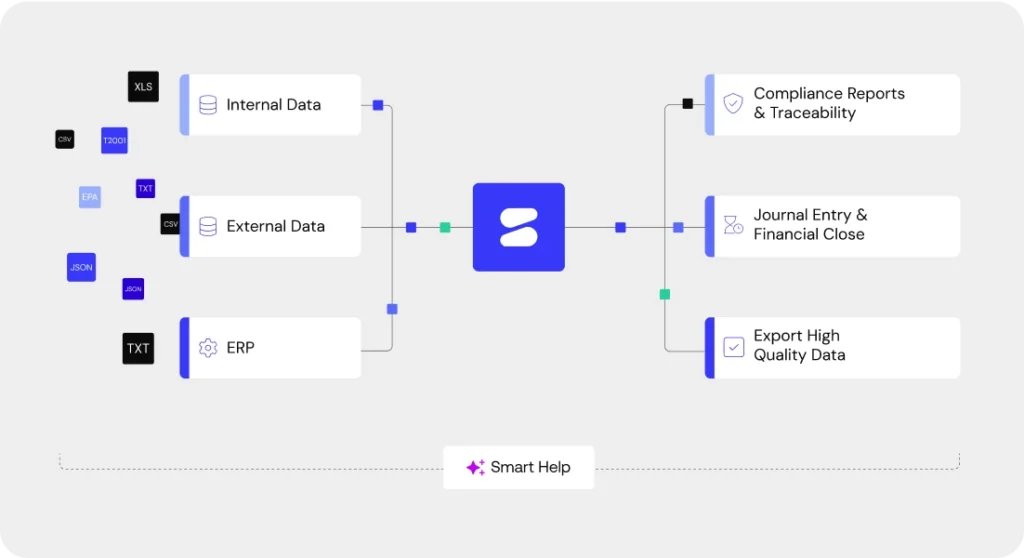
Simetrik connects internal, external, and ERP data to reconciliation outputs

AI reconciliation platforms help you integrate internal and external transaction data sources, connect internal systems like your ERP or core banking system, and deploy sophisticated governance and automation in a way that doesn’t plunge you into technical debt as regulations and business needs change.

Get reconciliation right, and everything else falls into place. 

The best reconciliation platforms do more than just reconcile multi-way transactions. They combine deterministic matching rules with AI-assisted configuration and analysis across three distinct levels:

  • Transaction level – Matching individual transactions to create a reliable source of truth for all downstream processes, detecting anomalies and discrepancies in real time.
  • Financial level – Using reconciled data to manage cash flow and control costs, supporting strategic decisions, and reporting accurately to internal and external auditors.
  • Accounting level – Aligning transaction and financial data with journal entries to ensure compliant, accurate reporting and accelerate close cycles.

In the next section, we’ll show you how adopting an AI reconciliation platform is essential to increasing the maturity of your finance operations. There are many paths to success—keep reading to explore ways to advance that fit your unique use case, resources, and goals.

What can an AI reconciliation platform do?

  • Process massive transaction volumes with low latency at T+1 speed 
  • Standardize and match multi-platform, highly varied transaction data
  • Support controls and reporting for varied regulatory requirements across regions and industries 
  • Keep TCO manageable with no-code, scalable deployment and iteration
  • Support changing requirements and higher volumes with controlled workflow updates

An actionable model for reconciliation maturity

Fully mature, AI-optimized reconciliation drives value beyond just reporting the numbers. It gives you trusted, real-time financial data to use in any downstream application you can dream up. 

The Simetrik reconciliation maturity model consists of five stages, starting with completely manual finance operations and ending with transformative, continuously improving reconciliation automation. From instant customer refunds and nuanced loyalty programs to advanced, predictive FP&A modeling, getting to Stage 5 will put you at a huge competitive advantage.

Five stages of the reconciliation maturity model

Stage 1: Slow & siloed 

At the first stage, reconciliation is almost entirely manual. Minimal data integration, no scalability, and a lack of confidence in the numbers hurts the business.

  • Data management: Spreadsheets and macros are the finance team’s primary tools, and siloed transaction data must be exported, validated, and entered correctly into backend systems. 
  • Development: Any attempt at integration or automation is reliant on engineering, so progress is slow and costly. There’s no path to leveraging AI or using transaction data in decisioning models. 
  • Exception handling:  Finance teams manually check for discrepancies and fraud to a limited degree of success. When found, outreach and remediation can take weeks.
  • Financial oversight: Little insight into current operational balances makes decision-making difficult. Transaction data often doesn’t match bank statements, bank balances, revenue forecasts, and other indicators of financial health.
  • Accounting integrity: Transactional data is not aligned with operational balances or ledgers, slowing the financial close and often resulting in reporting errors. 
  • Risk: Risk is at a critical level, with many unexpected, unexplained losses and siloed internal knowledge. If a key employee leaves, they take the understanding of reconciliation logic with them.
  • Compliance: Without audit trails, data must be compiled manually. Audits are costly and drawn out, and compliance gaps can lead to fees and reputational harm.
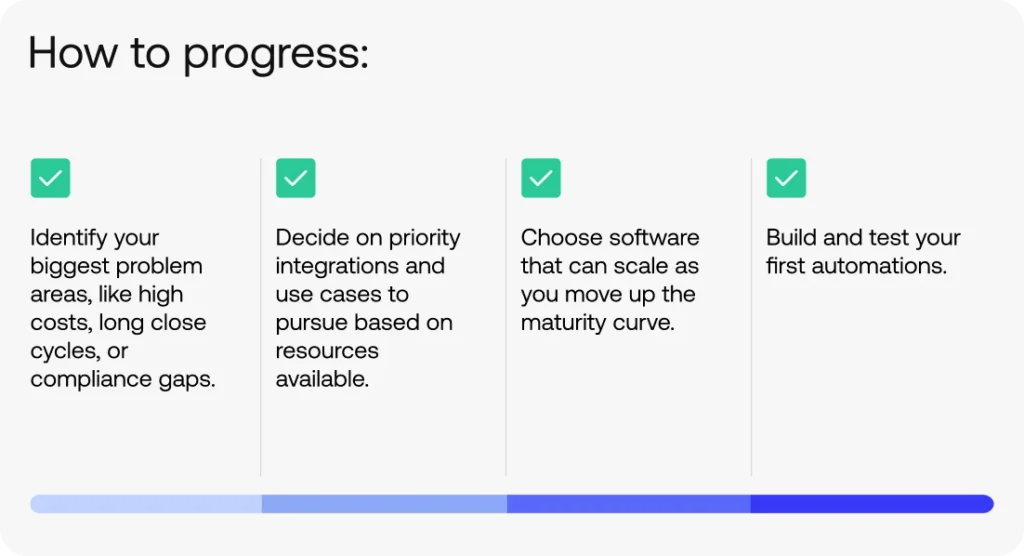
Actions to progress from stage one of reconciliation maturity

Stage 2: Limited automation

Benefits start to materialize at stage two, but reconciliation still isn’t scalable. With many data sources not yet integrated, AI adoption is not yet possible.

  • Data management: Some integrations are in place, but transaction data remains fragmented.  Manual data exports and spreadsheets are still common. 
  • Development: Automations are homegrown or piecemeal and rely on constantly changing logic and data sources. Engineering costs to add new integrations are high.
  • Exception handling: Anomaly detection and transaction matching is automated for some sources, lightening the burden of exception management. Remediation is still entirely manual.
  • Financial oversight: Increased visibility into transaction data helps with financial modeling and performance tracking, but isn’t enough to inform major decisions or drive AI innovation. 
  • Accounting integrity: Transactional data is still not aligned with general and sub-ledgers. Close cycles are long, and reporting is error-prone.  
  • Risk: Risk is still high, but the number of unexplainable losses starts to drop. Siloed internal knowledge is still a problem, with many black boxes across teams and information held by a select few team members.
  • Compliance: Rev rec and reporting for standards like ASC 606 and IFRS 15 is manual and lacks complete audit trails. Internal audits can take months due to visibility gaps.
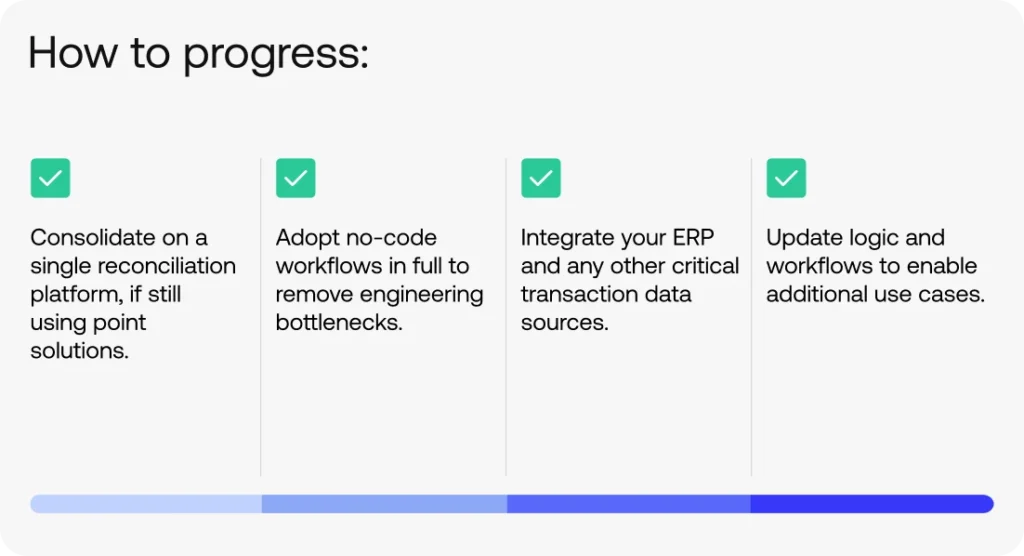
Actions to progress from limited reconciliation automation

Stage 3: Full transactional coverage 

At this stage, transaction-level reconciliation is fully automated, scalable, and prepared for financial reporting and downstream innovation. Accounting-level reconciliation remains manual.  

  • Data management: All transaction records are integrated, standardized, and automatically reconciled. Finance teams have real-time visibility into granular transaction details and discrepancies.
  • Development: No-code tools and AI agents accelerate time to value and alleviate reliance on engineering as new workflows are needed. Anyone with permission can adapt the rulesets and business logic that power automated reconciliation and reporting. 
  • Exception handling: With the day-to-day reconciliation fully automated, team members can focus on exception handling. As discrepancies, chargebacks, disputes, and potential fraud are detected in real-time transaction streams, alerts tell the FinOps team it’s time for remediation.  
  •  Financial oversight: Transaction data is occasionally reconciled against operational balances in the ERP, but records quickly outdated. Finance operations and accounting teams must manually compare ERP data with transactions for a true picture of the company’s finances. 
  • Accounting integrity: Accounting-level reconciliation is still manual. Transaction data doesn’t always match the GL and subledgers. The financial close takes days longer than it should due to manual data collection and reporting.
  • Risk: Risk is greatly reduced due to transactional visibility, with losses easier to explain and quickly resolve. Knowledge of transactional reconciliation logic is accessible across the company—key employees can leave with zero disruption to the business.
  • Compliance: Detailed transaction-level audit logs exist, but the audit process is still slowed by outdated reporting mechanisms. Documents are created manually or using scripts, without being connected to updated source data.
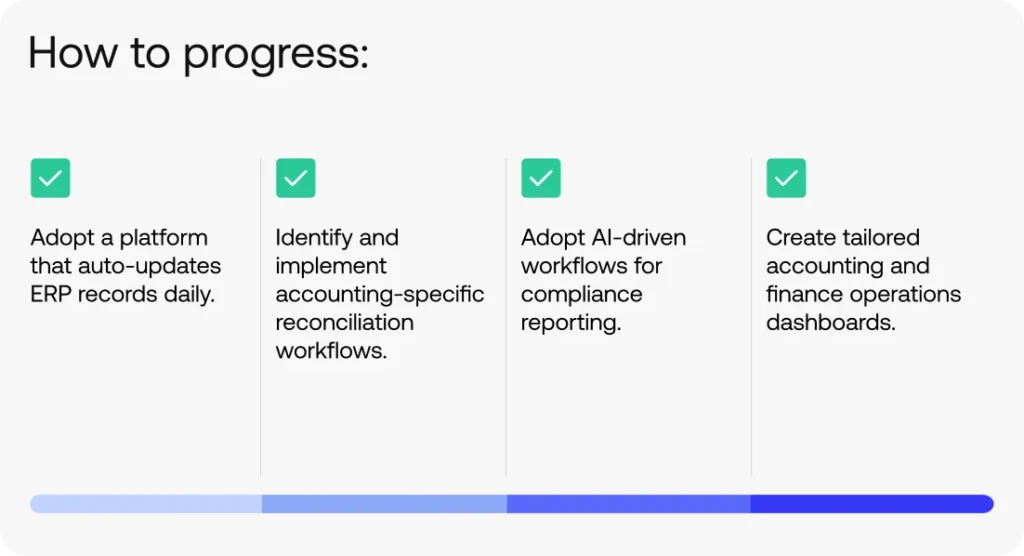
Actions to progress from full transactional reconciliation coverage

Stage 4: Complete accounting control 

Transaction data is automatically reconciled against accounting balances. Accounting teams have dynamic, dedicated dashboards for the metrics they care about. Financial oversight is strong, but room for innovation remains.

  • Data management: ERPs and other internal accounting systems are integrated alongside transaction data sources, all on a single reconciliation platform. Accounting teams can see always-updated, reconciled journal entries in the GL and sub-ledgers.
  • Development: Users can deploy no-code workflows and update accounting rulesets to correctly transform data and sync it with the ERP. AI agents simplify the process of automation without diminishing control. 
  • Exception handling: The accounting team receives real-time alerts for discrepancies between transactional data and accounting balances. Exceptions are caught and remediated before the end of the close period.
  • Financial oversight: Data is synced at least daily with the ERP and prepped for downstream reporting and AI analysis. Finance leaders can make fast decisions without digging into transaction details. 
  • Accounting integrity: Accounting leadership can see calculated balances, auto-reconciled journal entries, and progress against the close at a glance. The financial close is reduced by an average of five days. 
  • Risk: Operational loss and revenue leakage happens rarely, with complete explainability. Finance operations, accounting, product teams, and leadership all have visibility into reconciliation logic without needing to understand code. 
  • Compliance: Transaction- and accounting-level audit logs accelerate compliance efforts and minimize cost. Reporting is automatically tailored to relevant regulations and internal compliance requirements.
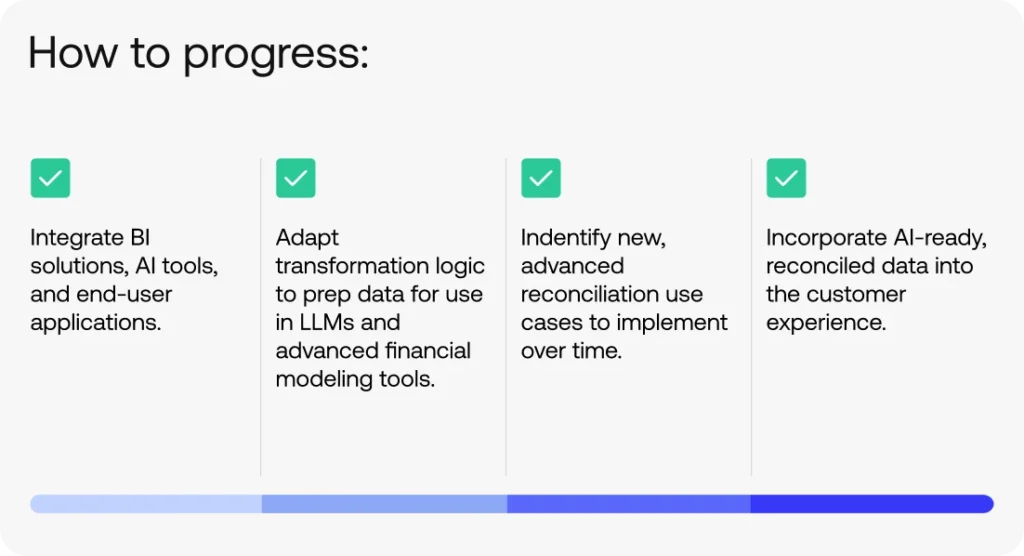
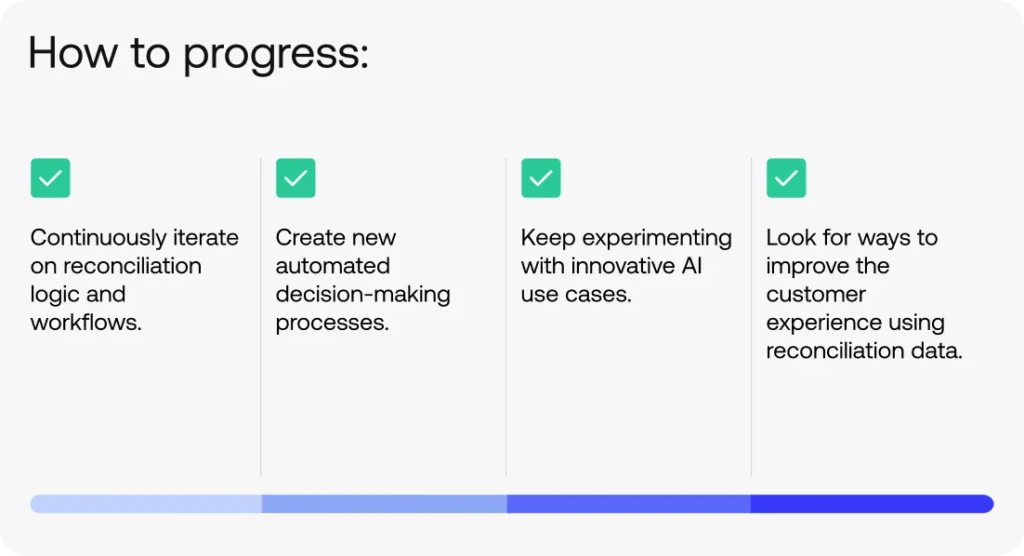
Actions to progress from complete accounting control

Stage 5: End-to-end AI automation

The final stage is an ongoing journey of iteration, scale, and increased ROI. New use cases are continuously deployed with zero code. AI-assisted workflows can help teams identify patterns and suggest improvements as the business and ecosystem evolve, while deterministic rules continue to execute reconciliation controls.

  • Data management: Relevant internal and external data sources can be unified on one reconciliation platform. Standardized integrations and controlled configuration help teams add partners, respond to new requirements, and expand into new markets.  
  • Development: Scalable, no-code automation makes adding a payment partner, adapting to new laws, and expanding into new markets painless. Massive changes to the financial ecosystem no longer pose a threat.
  • Exception handling: Agentic AI powers every step of risk detection and exception management. Users manage sophisticated automations that quickly remediate issues like chargebacks, disputes, and refunds.
  • Financial oversight: AI-ready, reconciled data powers a multitude of innovative financial modeling, forecasting, and performance tracking. New use cases are easy to implement as requirements change.
  • Accounting integrity: The books always align with transactional data. AI-assisted workflows support a more automated and auditable financial close, with reporting and documentation configured for the organization’s accounting policies and workflows. 
  • Risk: Risk from reconciliation errors is reduced through exception visibility, predictive analysis, and governed no-code configuration. 
  • Compliance: AI-assisted analysis and governed logic support reporting across internal control and compliance workflows.
Continuous improvement actions for AI-assisted reconciliation operations

What’s next on the path to maturity?

Now that we’ve laid out a vision for full reconciliation maturity, it’s time to get to work. Plot yourself on the model, outline next steps, and prioritize the use cases that are most likely to move you to the next stage. 

At Simetrik, we’ve helped finance operations teams across top financial services, retailers, and marketplaces move from costly manual transaction matching and reporting to AI-enabled, fully automated reconciliation. 

Get in touch with our team to request a demo.

FDIC proposed rule update: the latest on recordkeeping and reporting requirements for custodial FBO accounts

In September 2024, the FDIC proposed a rule to improve recordkeeping for custodial (also called FBO, or “for benefit of”) accounts, where fintechs and non-bank entities pool customer funds in FDIC-insured banks. The goal is to ensure that banks can accurately identify individual fund owners and their balances, even when intermediaries track transactions.

The rule, aimed at enhancing depositor protection and increasing public confidence in insured deposits, could become law any day. When it happens, unprepared banks will have to scramble to put new technology and workflows in place to maintain compliance. 

The catalyst: the 2024 Synapse bankruptcy 

The proposed FBO rule is largely a response to the 2024 bankruptcy of Synapse Financial Technologies, a middleware provider that allowed businesses to integrate banking services into their own applications. 

After a subsidiary of Synapse began offering cash management accounts to their partners’ end users, the company filed for bankruptcy protection. One of their partner banks, Evolve, froze access to Synapse accounts to the tune of over $200 million, stating lack of access to an essential system of record. 

The result was chaotic. End customers couldn’t access their funds, but to release them the FDIC needed transaction and ledger records from Synapse. Between access issues and inadequate recordkeeping, there was no way to recoup losses using FDIC insurance. With $96 million missing and over 100,000 customers affected, the saga still isn’t fully resolved.

What are custodial, or FBO, accounts?

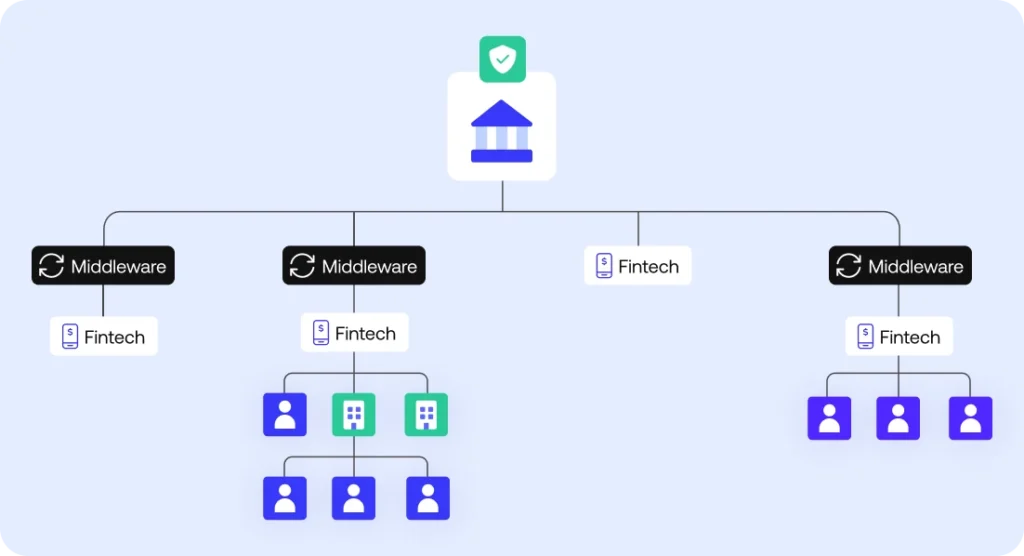
Custodial accounts are bank accounts held by one party (the “custodian”) on behalf of another (the “beneficial owner”). In fintech-bank partnerships, these accounts typically hold pooled customer funds under the fintech’s name or a third party’s, with individual user balances tracked outside of the core banking system by the third party.

This arrangement creates a visibility gap for the bank. It doesn’t inherently know who the end users are or how much each is owed, making things complicated for FDIC insurance determinations when something goes awry. 

Why is custodial account recordkeeping so complicated? 

Over the past decade, a huge influx of fintech companies have entered the market. These entities aren’t allowed to provide the full spectrum of financial products, so they rely on partners to enable them. 

In the case of custodial accounts, these partners are banks (referred to in the rule as Insured Depository Institutions, or IDIs) who already are licensed and insured to provide accounts insured by the FDIC. 

These partnerships create a complex ecosystem of intermediaries and fintech partners that each enable their own customer base to open accounts with the custodian bank. For most banks, it’s nearly impossible to keep track of who manages whose accounts, transaction details, and daily balances across all of the different systems.

For example, while individual customers may initiate millions of transactions each day on the fintech side, the details aren’t necessarily preserved by various members in the ecosystem. Some will initiate bulk movements that aggregate individual transactions into a single amount, making them hard to disambiguate later. 

Any company growth, new partnerships, or regulatory changes just increase this complexity, risking the loss of visibility and traceability of critical financial movements. Catastrophic events like the Synapse bankruptcy don’t happen every month—but losing millions to leakage, inefficient operations, and audit fees is far more common. 

What are the FDIC’s proposed changes to FBO accounts?

The FDIC’s proposed rule, Part 375, outlines new requirements for maintaining and reconciling records for FBO accounts. IDIs holding custodial deposit accounts with transactional features would be required to:

  • Meet new recordkeeping requirements, including maintaining records of custodial account details like the beneficiary, owner, and the balance attributed to each end user in a standardized format.
  • Be subject to an annual validation by an independent person or entity to assess and verify that third parties are maintaining accurate and complete records consistent with the proposal’s requirements.
  • Implement internal controls to ensure that balances of custodial deposit accounts are accurate and reconciled daily.
  • Complete an annual certification of compliance and an annual report of compliance.

Banks would be allowed to partner with a trusted third-party to meet these requirements, as long as certain conditions are satisfied. They must have direct, continuous, and unrestricted access to the records maintained by the third party, as well as have continuity plans and internal controls in place.

How do the FDIC’s proposed changes affect PSPs and fintechs?

For banks to meet these requirements, their fintech and intermediary partners must be able to provide daily transaction-level data on money moving to and from custodial accounts. These individual records must be reconciled against FBO balances, taking into account complications like rolling reserves and delayed settlements. 

To facilitate this, PSPs and other fintechs should invest in scalable, real-time transaction tracking and reconciliation technology that can sync data across all systems at least once per day.

How Simetrik helps you prepare for the new FDIC rule

Simetrik is an enterprise reconciliation platform that helps banks maintain and govern this improved method of recordkeeping that will soon be required by the FDIC. 

Here’s how it works:

  • Banks can integrate data from all of their fintech and middleware providers in one place, standardizing it to meet the specific requirements outlined in the proposed rule.
  • Transactions are monitored and reconciled daily, catching discrepancies and potential fraud instantly so they can be handled before reporting to the FDIC.
  • Bulk money in/money out records are automatically disambiguated to keep end user balances accurate.
  • Simetrik dashboards inform stakeholders of individual beneficiary activity and balances, total daily net movement, daily cumulative balances, and more.
  • Simetrik users can search and explore a subset of custodial accounts, like a specific partner.
  • Reporting is automatically prepared for appropriate third-party auditors and shared in the correct format. 

A similar process applies to fintech and middleware providers who choose to follow suit by adopting Simetrik. Transaction data from their platforms is monitored and reconciled daily with bank balances. This reconciled data is always accurate, searchable, and ready to use in customer-facing products or to meet additional reporting requirements. 

Scaling with no code automation

Unlike legacy or homegrown solutions you may have used in the past, Simetrik doesn’t require expensive integrations or hours of engineering work to set up each partner. Unify your custodial account transaction data and configure advanced reconciliation logic faster with flexible, no-code building blocks—so you’ll be ready when the proposed rule becomes enacted law.

Don’t get caught unprepared

The FDIC hasn’t yet announced when this rule will go into effect, but it may happen soon. While you still have time, adopt a unified reconciliation platform that will make the whole process painless and successful. 

To learn more about Simetrik, request a demo here.