Financial reporting software turns transaction and ledger data into the statements a business runs on (balance sheets, income statements, cash flow statements) and, for larger or multi-entity companies, into consolidated and forward-looking reports. The tools below differ mostly in scale: Excel-native for lean teams, multi-entity consolidation for mid-market, and connected planning for enterprise.
There’s no single best financial reporting software for every finance team. The right choice depends on how many entities you report on, whether your team lives in Excel, and whether you need financial analysis that looks forward or financial statements that close the books on what already happened.
Below, we compare 11 tools (Simetrik, Vena, Datarails, Sage Intacct, NetSuite, Anaplan, OneStream, HighRadius, Workiva, QuickBooks Online, and Xero) on the same criteria so you can match each one to the problem you actually have. Simetrik, an AI-native financial control platform, works one step earlier than the rest: it reconciles the transaction and operational data your financial statements are built on, and it complements whichever reporting tool you choose.
Key Takeaways
- The best financial reporting software depends on scale and structure: Excel-native tools such as Vena and Datarails, reporting built into Sage Intacct or NetSuite for multi-entity companies, and planning and consolidation platforms such as Anaplan and OneStream for large enterprises.
- HighRadius ties reporting to the close, Workiva focuses on regulatory and SEC filings, and QuickBooks Online and Xero cover standard financial statements for small businesses.
- Financial reporting and financial consolidation are different purchases: one produces statements for an entity, the other combines results across entities, currencies, or subsidiaries.
- Simetrik complements the financial reporting software on this list: it reconciles the transaction and operational data behind the reports before it reaches the general ledger, so the team can resolve differences before they show up in a financial statement.
What Is Financial Reporting Software?
Financial reporting software pulls data from your general ledger and other systems to produce the core financial statements (balance sheets, income statements, cash flow statements, and profit and loss statements) along with management reports built for internal decision-making rather than external filing.
Instead of exporting ledger data and rebuilding the same spreadsheets every month, the software maps your chart of accounts to standard report formats and refreshes them as new data posts. That gives finance teams a consistent base for financial analysis: the same numbers, structured the same way, every period.
Most tools in this category cover two kinds of output. External financial statements follow accounting standards and go to auditors, lenders, or regulators. Management reporting is built for the leadership team, with department-level views, margin breakdowns, and the metrics the business actually runs on. For more on the category itself, see our guide to what financial reporting software is.
Key Features to Look for in Financial Reporting Software
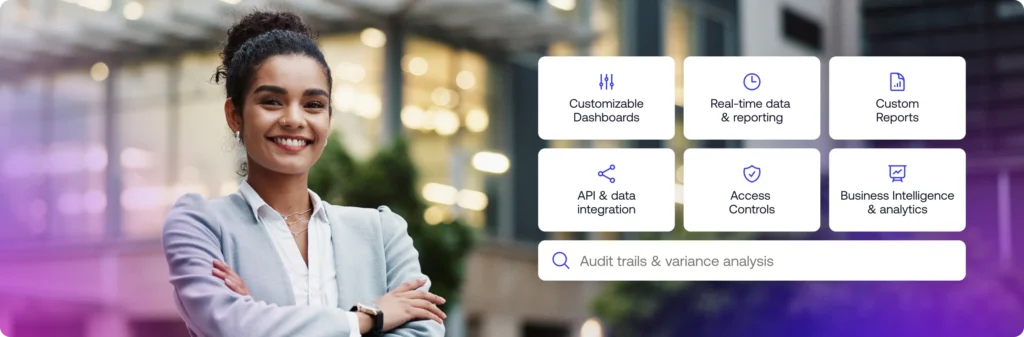
Feature lists in this category look similar on paper, and we break them down in our guide to the key features of financial reporting software. These are the capabilities that separate a reporting tool your team relies on from one it works around:
- Dashboards and customizable dashboards that surface KPIs without a manual export.
- Real-time data and real-time reporting instead of a monthly static snapshot, so leadership gets real-time visibility into cash, margins, and spend.
- Custom reports and customizable reports built for how your team actually reviews numbers.
- API and data integration depth: how easily it connects to your ERP and other source systems.
- Access controls for who can view, edit, or approve a report.
- Business intelligence and predictive analytics for forward-looking, not just historical, reporting.
- Audit trails and variance analysis for explaining, not just displaying, a number that changed.
How We Compared These Financial Reporting Software Tools
Every tool below is compared on the same criteria: what it’s built for, what company size and structure it fits, how it handles consolidation versus single-entity reporting, and what it connects to. Any specific capability or claim about a vendor is pulled from that vendor’s own public product or pricing pages, dated at the time of writing.
Each tool solves a different version of the reporting problem, and the right pick depends on which version is yours.
Financial Reporting Software Compared at a Glance
The table below compares all 11 financial reporting tools on the same criteria, from Excel-native options to financial consolidation and corporate performance management platforms.
| Tool | Best for | Reporting scope | Excel-native? | Deployment |
|---|---|---|---|---|
| Simetrik | Finance and ops teams whose reports depend on data from many sources, or need to trace back to the original transaction | Reconciles the transaction and operational data behind the general ledger and reports; audit-ready reports for regulators, networks, and tax authorities (not budgeting, forecasting, or consolidation) | No (ingests Excel files) | Web platform, also available via MCP |
| Vena | FP&A teams that want planning and reporting inside Excel | Multi-entity consolidation + planning | Yes | Cloud |
| Datarails | Finance teams that want to keep their Excel models | FP&A and reporting + multi-entity consolidation | Yes | Cloud |
| Sage Intacct | Mid-market, multi-entity organizations | Multi-entity consolidation | No | Cloud |
| NetSuite (Oracle NetSuite) | Multi-subsidiary companies that want reporting inside their ERP | Multi-entity consolidation (OneWorld add-on) | No | Cloud |
| Anaplan | Large enterprises, cross-functional planning | Connected planning + consolidation | No | Cloud |
| OneStream | Finance teams replacing fragmented or legacy systems with one platform | Multi-entity consolidation + EPM (planning, close, reporting) | No | Cloud |
| HighRadius | Mid-sized and large companies automating close and reporting | Close, reconciliation, consolidation & reporting (record to report) | No | Cloud |
| Workiva | Public and private companies with regulatory and disclosure reporting needs | Financial and regulatory reporting (SEC filings, XBRL), multi-entity reporting | No | Cloud |
| QuickBooks Online | Small and mid-size businesses | Standard financial statements (P&L, balance sheet, cash flow) | No | Cloud |
| Xero | Small businesses | Standard financial statements (P&L, balance sheet, cash flow) | No | Cloud |
Best Financial Reporting Software Reviews, by Tool
Each review follows the same format: what the tool solves, who it fits best, and one verifiable detail from the vendor’s own site.
Simetrik: Reconciled Data for Financial Reporting
Simetrik is an AI-native financial control platform. It reconciles transaction and operational data from banks, payment processors, and internal systems before that data reaches the general ledger, and the differences it finds appear in dashboards where the team can act on them.
On the reporting side, Simetrik says it generates audit-ready reports for regulators, card networks, tax authorities, and merchants from that reconciled data, with traceability back to the original transaction.
AI runs through that work. At the autonomy level a team sets, Simetrik’s AI can investigate and manage differences using the information already in the platform, and it creates and analyzes datasets and trends from plain-language requests.
Simetrik Agent builds and adjusts reconciliations from a plain-language request, with Automatic, Confirmation (which Simetrik recommends), or Planning autonomy, and agents such as Claude or Copilot can request the same work through MCP. Smart Parser reads non-standard bank and processor files, and Smart Date Formats recognizes 500+ date formats, according to Simetrik. The results themselves come from a deterministic core, so the figures behind a report stay traceable for an auditor.
Simetrik doesn’t replace tools like Vena, Anaplan, or OneStream for budgeting, forecasting, or multi-entity consolidation. It complements them and the other tools on this list: reporting platforms assume the data reaching the general ledger is correct, and Simetrik reconciles that data first, so the financial statements built on it start from reconciled records, with audit trails behind them.
Best for: finance and ops teams whose reporting problem starts upstream, with unverified or unreconciled data reaching the general ledger, or whose auditors need reported figures traced back to the original transaction.
Verified detail: Simetrik says teams can pass audits 50% faster, according to simetrik.com (accessed Oct 9, 2026).
Vena Financial Reporting Software
Vena is most often evaluated by FP&A teams that want to keep planning and reporting inside Excel rather than replace it. With an Excel-based reporting approach, analysts keep the spreadsheet interface they already know, while Vena tracks changes with version histories and audit trails, which reduces version-control problems across budgeting and forecasting cycles. Teams can model what-if scenarios and build dashboards and ad-hoc reports without leaving Excel.
Beyond planning, Vena supports multi-entity and multi-currency consolidation, automating intercompany eliminations, FX translation, and ownership logic on the same platform it uses for planning and reporting. It’s a fit for finance teams whose main pain point is spreadsheet sprawl rather than Excel itself.
Best for: FP&A teams that want planning and reporting tied to Excel.
Verified detail: Vena says it is trusted by 2,000+ organizations of every size and industry, according to venasolutions.com/capabilities/security-and-compliance (accessed Oct 7, 2026).
Datarails Financial Reporting Software
Datarails is also positioned as an Excel-native platform, built for finance teams that want to automate reporting without leaving their existing spreadsheets. It connects live data from 600+ sources and adds version control, audit trails, and permission settings, so teams keep the Excel models they trust while working from governed data. Its FP&A module includes budgeting and forecasting, real-time dashboards, scenario modeling, and anomaly detection.
Beyond FP&A, it supports consolidation across multiple entities and currencies, and covers reporting, planning, and month-end close on the same platform. Like Vena, it suits teams that see Excel-based reporting as a strength to keep.
Best for: finance teams that want to keep their Excel models.
Verified detail: finance teams at 2,000+ companies run on Datarails, according to datarails.com (accessed Oct 7, 2026).
Sage Intacct Financial Reporting Software
Sage Intacct is typically evaluated by mid-market, multi-entity teams that want reporting built into a cloud financial system rather than added on top, and Sage lists it among its financials and ERP products for midsize businesses. Because reporting sits on the same platform as the core accounting, with one unified general ledger across entities, the month-end close and the reports that follow it draw on one set of records, and stakeholders can see reports anytime.
It also includes out-of-the-box automated revenue recognition and regulatory compliance, and tracks expenses against budgets. Sage positions it as a replacement for multi-entity consolidation in Excel, and as a true cloud solution with over 20 years of experience in the cloud.
Best for: mid-market companies with multiple entities.
Verified detail: Sage says Intacct can cut the monthly close by up to 66%, according to sage.com/en-us (accessed Oct 8, 2026).
NetSuite (Oracle NetSuite) Financial Reporting Software
NetSuite, part of Oracle, offers reporting as one piece of a broader cloud ERP that connects financials, CRM, and ecommerce data in a single source of truth. For multi-entity companies, NetSuite OneWorld lets teams manage multiple subsidiaries, business units, and legal entities from one solution, with real-time financial consolidation at local, regional, and global levels. OneWorld is available as an add-on module, so multi-entity consolidation depends on that license, not on the core platform alone.
NetSuite is licensed through an annual fee that combines the core platform, optional modules, and the number of users. The trade-off is that reporting, and the general ledger behind it, are tied to the ERP decision rather than chosen on their own.
Best for: multi-subsidiary companies that want reporting inside their ERP.
Verified detail: NetSuite says it is used by 44,000+ customers, according to netsuite.com (accessed Oct 8, 2026).
Anaplan Financial Reporting Software
Anaplan is known for its own category term, “connected planning,” which is Anaplan’s approach to linking finance, sales and marketing, supply chain, and workforce plans on one platform. Its reporting focus is forward-looking: scenario modeling and AI-driven predictive analytics that show how a change in one plan affects the others.
On the finance side, Anaplan brings financial planning, consolidation, and reporting together in a single environment. Finance teams can also report on live Anaplan data in Microsoft 365 and Google Sheets, and use role-based agents to monitor performance and automate month-end processes. It sits closer to corporate performance management (CPM) than to statement-level reporting, which makes it a fit for planning-heavy enterprises.
Best for: large enterprises focused on cross-functional planning.
Verified detail: 48% of the Fortune 50 are Anaplan customers, according to anaplan.com/customers/ (accessed Oct 7, 2026).
OneStream Financial Reporting Software
OneStream is positioned for financial consolidation at scale, with intercompany eliminations, currency translations, and acquisition management built to meet standards like US GAAP and IFRS. Translations, eliminations, and certifications are auto-delivered through automated settings, with always-on audit.
Built for the Office of the CFO, it brings financial close, planning, reporting, ESG, and operational data together in one cloud-based platform. OneStream describes itself as a unified enterprise performance management (EPM) platform, a category also known as corporate performance management (CPM), designed to replace fragmented systems and disconnected spreadsheets. It’s built for organizations where consolidation itself is the hard part of the reporting process.
Best for: finance teams replacing fragmented or legacy systems with one platform.
Verified detail: OneStream says it has been named a Leader in the Gartner Magic Quadrant for Financial Close and Consolidation Solutions four times, according to onestream.com/ (accessed Oct 8, 2026).
HighRadius Financial Reporting Software
HighRadius approaches financial reporting from the operational side of the Office of the CFO, offering a single platform that connects reporting to processes like order to cash, close, and reconciliation. Its financial reporting software uses agentic AI to automate data ingestion, reporting, visualization, and analysis, connecting ERP data through pre-built connectors and delivering audit-ready insights.
Teams can build custom reports and use data visualization, business intelligence, and predictive analytics to forecast cash flow and spot financial risks earlier, while the broader record-to-report suite adds intercompany reconciliation and financial consolidation. It’s a fit for teams that want the close and the reports that follow it automated by the same platform.
Best for: mid-sized and large companies automating close and reporting.
Verified detail: HighRadius says it was recognized as a Challenger in the 2026 Gartner Magic Quadrant for Record to Report (R2R), according to highradius.com (accessed Oct 8, 2026).
Workiva Financial Reporting Software
Workiva focuses on regulatory and disclosure reporting more than on internal FP&A. Its cloud-based platform covers everything from annual and interim reports to SEC and SEDAR filings, with built-in XBRL tagging and tools to create reports, spreadsheets, and presentations without leaving the platform. Data and narratives stay linked across every report, and audit trails and data lineage keep each number traceable, while internal and external audit can work inside the same environment.
It also supports multi-entity reporting across jurisdictions. For private companies, it supports operational and management reporting, with tools for teams scaling toward an IPO. It suits teams whose reporting deadlines are set by regulators.
Best for: public and private companies with regulatory and disclosure reporting needs.
Verified detail: Workiva says its platform supports reporting across multiple jurisdictions with frameworks including EDGAR, ESEF, and IFRS, according to workiva.com (accessed Oct 8, 2026).
QuickBooks Online Financial Reporting Software
QuickBooks Online includes reporting inside a cloud-based accounting software product, with plans for both small and mid-size businesses. Its standard reports cover the income statement, balance sheets, and cash flow statement, all from the QuickBooks dashboard, alongside the day-to-day bookkeeping, expense tracking, and accounts payable work the product is built for.
Because it’s fully cloud-based, teams can review reports from any device. Customizable, presentation-ready reports, which can be shared with an accountant through email updates, depend on the plan. For a small business, the built-in reports often cover everything needed without a separate reporting tool.
Best for: small and mid-size businesses with straightforward reporting needs.
Verified detail: QuickBooks says customizable, presentation-ready reports are available only in QuickBooks Online Advanced, according to quickbooks.intuit.com (accessed Oct 8, 2026).
Xero Financial Reporting Software
Like QuickBooks Online, Xero is cloud accounting software with reporting built in, aimed at small businesses. Its reports draw directly on day-to-day bookkeeping and expense tracking, and bank reconciliation happens inside the same product through automated bank feeds.
Teams can view profit and loss, balance sheets, and cash flow in real time, compare budgeted spending to actual amounts, and track performance against KPIs with interactive reports. Because it runs in the cloud, owners and their accountants can work on the same numbers from any device. It’s a fit for small teams that want their books and their reports in one place.
Best for: small businesses and their accountants.
Verified detail: Xero says customers report saving around 6 hours a week with automated bank feeds and reconciliation matches, according to xero.com/us (accessed Oct 8, 2026).
How to Choose Financial Reporting Software for Your Team
Start by separating what you actually need: financial reporting (producing accurate statements from your general ledger) is a different problem than financial consolidation or corporate performance management (combining multiple entities, budgeting, and forecasting forward).
A single-entity business usually needs the first. A multi-entity or fast-growing company usually needs both, which changes whether an Excel-native tool, an ERP module, or a dedicated CPM platform fits best.
Also confirm what it needs to connect to: your ERP, your accounts payable system, and how much manual reconciliation happens before the numbers even reach the reporting layer. If your month-end close depends on fixing data before you can report on it, the bottleneck sits upstream of the reporting tool.
Financial Reporting Software FAQs
What is financial reporting software?
Financial reporting software pulls data from your general ledger and other financial systems to produce standard statements (balance sheets, income statements, cash flow statements) along with internal management reports, without manual spreadsheet assembly.
What’s the difference between financial reporting and financial consolidation?
Financial reporting produces the statements for a single entity from its own ledger. Financial consolidation combines financial data across multiple entities, currencies, or subsidiaries into one set of statements. It is a different, usually more complex, problem that not every financial reporting tool solves.
What is corporate performance management (CPM)?
Corporate performance management (CPM) software goes beyond reporting what already happened. It adds budgeting, forecasting, and scenario modeling to plan what should happen next. Some financial reporting platforms include CPM features; others are purely backward-looking.
Does financial reporting software integrate with an ERP?
Most financial reporting software connects to major ERPs through APIs or prebuilt connectors, either pulling general ledger data directly or sitting as a reporting module inside the ERP itself. The depth of that integration varies by vendor.
Does financial reporting software replace bank reconciliation?
No. Financial reporting software assumes the underlying data is already accurate. It reports on balances and transactions; it doesn’t verify that those balances match your bank, processor, or subledger records in the first place. That verification step is what reconciliation software (operational or accounting) handles upstream. To go deeper, see how to choose reconciliation software, or read about build vs. buy for financial data control.
Does Simetrik do financial reporting?
Not in the budgeting, forecasting, or multi-entity consolidation sense that tools like Vena, Anaplan, or OneStream do. Simetrik’s reporting scope is narrower and upstream: it produces audit-ready reports and regulatory outputs from transaction and operational data that’s already been reconciled, rather than projecting or planning forward. It complements those tools by making sure the data they report on has been reconciled first.
How does Simetrik fit into a financial reporting stack?
Simetrik sits upstream of your reporting tool. It reconciles transaction and operational data from banks, processors, and other sources before that data reaches your general ledger. That way, the financial reporting or CPM platform on top of it is working from reconciled numbers instead of raw data. Simetrik can also generate journal entries from the reconciled results and post them to ERPs such as SAP S/4HANA, Oracle, or NetSuite, adapting the posting to how each system requires it.
Can AI automate financial reporting?
Partly, and the share is growing. Simetrik applies AI before the numbers are reported: Simetrik’s AI reads non-standard bank and processor files, investigates and manages differences at the autonomy level a team sets, and builds datasets and trend analyses from plain-language requests.
Reporting platforms apply AI further along: HighRadius uses agentic AI for data ingestion, reporting, and analysis; Anaplan offers role-based agents to monitor performance and automate month-end processes; and Workiva lets teams build agents with rules for human review and approval. People still review and approve what gets reported, and in Simetrik’s case results come from a deterministic core, so each AI action stays traceable for an auditor.
Next Step: How Verified Data Improves Financial Reporting
If your reporting numbers keep changing after the fact, the fix usually isn’t a new reporting tool. It’s upstream, in reconciliation, before transaction data ever reaches your general ledger. See how Simetrik verifies your data before it reaches reporting.