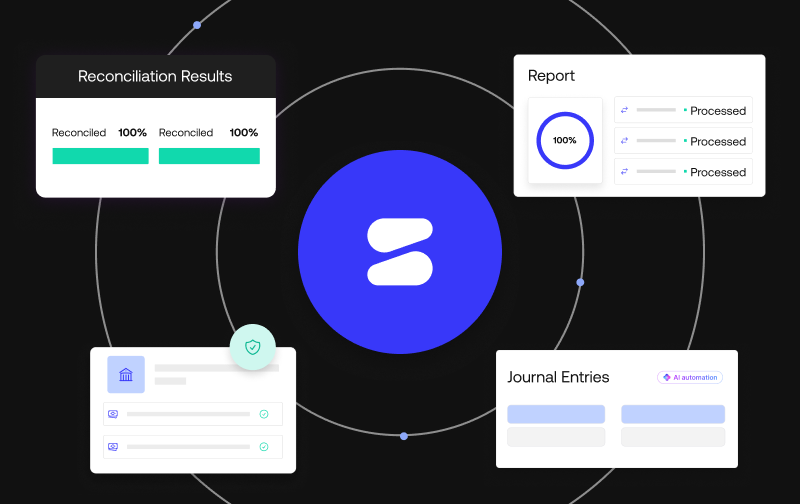
Financial close software automates the month-end close: reconciling accounts, posting journal entries, and producing financial statements, so finance teams close faster with fewer manual errors. The tools below differ mostly in where they sit in the finance stack: verifying transaction data before it reaches the ERP, managing close tasks and account reconciliations on data already in the ERP, consolidating entities, or handling regulatory filing.
This comparison covers eight tools that help finance teams automate financial close work: Simetrik, BlackLine, FloQast, OneStream, Workiva, Trintech, Sage Intacct, and Vena Solutions. Simetrik, an AI-native financial control platform, is the one built for the layer before the close: it reconciles the transaction data that financial close software depends on, from banks, payment processors, and internal systems, so the close starts from verified records and a short list of exceptions. The other seven focus on the close itself, on consolidation and planning, or on SEC reporting.
Key Takeaways
- Financial close software can only be as accurate as the transaction data feeding it. If payments, refunds, or settlements don’t reconcile before they reach the ERP, the close inherits those differences.
- Most tools on this list center on work that happens once data is in the ERP: close tasks, account reconciliations, consolidation, and reporting. Businesses with many transaction sources, or with a close that auditors need to trace back to the original records, often need an operational reconciliation layer before it, too.
- For payments companies, banks, marketplaces, and any business that needs automation and traceability in its close, Simetrik covers that earlier layer, feeding journal entries and account reconciliations with verified, traceable transaction and operational data.
- EPM suites like OneStream and Vena combine close with planning; BlackLine, FloQast, and Trintech focus on the close itself; and Simetrik works on the transaction data underneath it. Know which problem you’re solving before you compare features.
- Every tool on this list now uses AI. What separates them is where the AI works, what it’s allowed to change, and who approves the result.

What Financial Close Software Does
Financial close software automates the financial close process: reconciling accounts, posting journal entries and accruals, reviewing variances, and producing financial statements such as the balance sheet, income statement, and cash flow statement.
Without it, most of that work runs on spreadsheets, email threads, and a checklist someone rebuilds each period.
Financial close automation replaces those handoffs with rules, automated workflows, and an audit trail, so the team can close the books on a predictable schedule and show auditors how each number was reached.
Most month-end close software combines some mix of account reconciliation and transaction matching, journal entry automation, close task management, financial consolidation, and reporting. What separates the tools is which of those they treat as the core and which they add on.
One distinction worth keeping in mind: financial close is the process that produces accurate numbers, and financial reporting is what you do with them once the close is done. If reporting is the real bottleneck, start with the key features of financial reporting software.
Where Transaction Reconciliation Fits in the Close
The tools on this list work on different layers of the finance stack, and those layers connect: Simetrik can complement any of the close, consolidation, and reporting tools that sit above it. From raw transactions at the bottom to filings at the top:
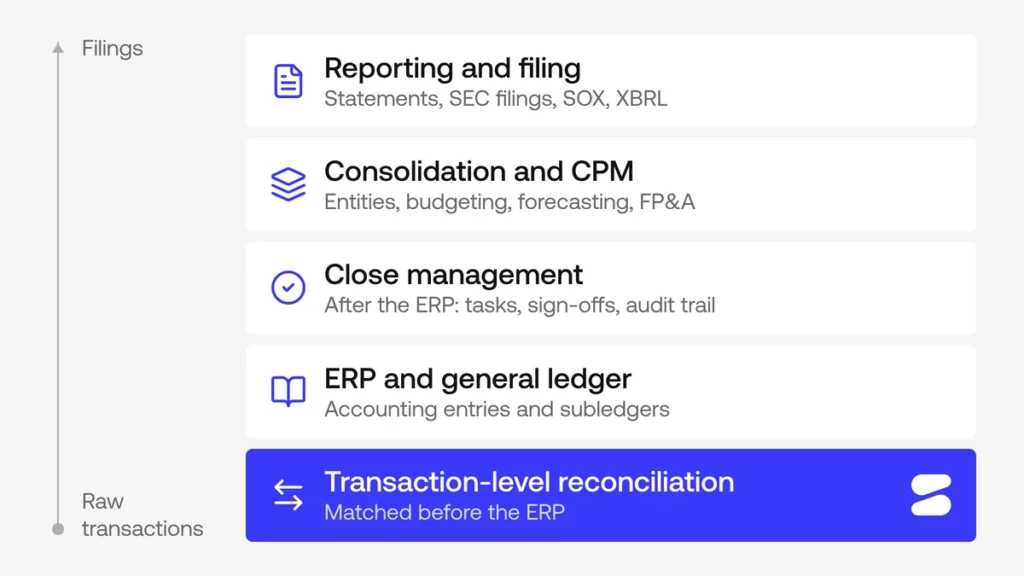
- Transaction-level reconciliation (before the ERP): matches raw records from banks, payment processors, marketplaces, and internal systems, so the data that moves downstream has already been checked across sources.
- ERP and general ledger: records the accounting entries in the general ledger and the subledgers that feed it.
- Close management and account reconciliation (after the ERP): close tasks, sign-offs, balance-level reconciliations, and audit trails.
- Consolidation and CPM: combines entities and connects the close to budgeting, forecasting, and FP&A.
- Reporting and filing: financial statements, SEC filings, SOX Reporting, and XBRL tagging.
Together, these layers make up the record-to-report cycle.
Most financial close software is built mainly around the second and third layers, on data already in the ERP: it coordinates the close, reconciles balances, and posts the entries for the period. Several close suites also include transaction matching modules that feed those account reconciliations.
For businesses with many transaction sources, such as payments companies, banks and financial institutions, marketplaces, large retailers, and ecommerce, many of the differences that distort the close start earlier, in transactions that never reconciled across systems.
A refund the processor recorded but the internal ledger didn’t, a settlement that arrived short after fees, a chargeback that reversed a sale weeks later: each one turns into an unexplained variance or an unmatched item at month-end. Catching them through transaction-level reconciliation is faster and easier to trace than fixing them at the balance level, once they’ve already rolled into the general ledger.
How We Compared These Tools
The tools are listed by where they work in the finance stack, starting with the transaction data that reaches the ERP and ending with reporting and filing. That puts Simetrik, our platform, first. The other seven are described by the job each one does best, using each vendor’s own public product pages, without pricing or scores.
Every tool is compared on the same five criteria: who it’s built for, where it sits in the finance stack, what it automates, how deep its reconciliation goes (transaction level or balance level), and how it uses AI. The goal is to show what each one is built to do, so you can match it to your own close.
Financial Close Software Compared at a Glance
The table below summarizes how these financial close solutions differ before you get into the detail of each one.
| Tool | Best for | Where it sits in the stack | What it automates | How AI is used |
|---|---|---|---|---|
| Simetrik | Teams that need automation and traceability over transaction and operational data from many sources | Pre-ERP transaction reconciliation, extending into accounting workflows | Multi-source matching, exception handling with alerts on chargebacks and settlements, journal entries, account certification | AI investigates and manages differences at the autonomy level the team sets and analyzes datasets and trends; Simetrik Agent and MCP-connected agents build reconciliations; a deterministic engine runs them |
| BlackLine | Finance teams coordinating the close from headquarters to local entities | Close, account reconciliation, and consolidation | Account reconciliations, transaction matching, journal entries, close tasks, intercompany | Verity AI for reconciliation preparation and variance analysis |
| FloQast | Accounting teams that close largely in Excel and want standard checklists, sign-offs, and audit evidence | Close management and account reconciliation | Close checklists, reconciliation sign-offs, AI transaction matching, journal entries | Transform AI agents for accounting workflows; AI Assistant answers close questions |
| OneStream | Organizations that want close, consolidation, and planning in one platform | Consolidation and CPM | Consolidation, eliminations, currency translation, reconciliations, matching, tax provision | Finance-focused AI that automates tasks and detects anomalies |
| Workiva | Public companies with SEC and XBRL reporting requirements | Reporting and filing | SEC filings, XBRL and iXBRL tagging, financial reporting with internal controls | Agent Studio, pre-built agents for tie-outs and disclosures, and MCP |
| Trintech | Finance teams that want high-volume matching inside a dedicated close suite | Close, account reconciliation, and consolidation, with multi-way matching | Multi-way matching, balance sheet reconciliations, close tasks, intercompany eliminations | AI Platform across reconciliation, matching, journals, and close coordination |
| Sage Intacct | Growing businesses already running Sage Intacct for core accounting | Core accounting system with native close and consolidation | Multi-entity consolidation, inter-entity transactions, currency translation adjustments | Close, Financial Assurance, and AP Automation agents |
| Vena Solutions | Finance teams that close and plan in Excel | Consolidation and CPM | Close checklists, reconciliations, consolidation, tax provisioning, budgeting, forecasting | Vena AI agents for planning and analysis, powered by Microsoft Azure |
8 Best Financial Close Software Tools Compared
Each entry is written for a different buyer and a different layer of the stack, and each one uses the same four fields so you can read them side by side.
Simetrik: Transaction-Level Reconciliation Before the Close
Best for: Teams whose close depends on transaction and operational data from processors, banks, and internal systems, or that need every number in the close traced back to the original record. That includes high-volume payments companies, banks, marketplaces, and ecommerce businesses, and also companies with fewer transactions but strict traceability needs, such as manufacturers. For them, Simetrik is the best fit for the transaction-to-close part of the process: from the raw transaction to the journal entry and the certified account.
Where it sits: Pre-ERP transaction reconciliation, extending into accounting workflows.
What it does:
- Reconciles transactions before they reach the ERP. Simetrik ingests data from banks, processors, and internal systems, prepares non-standard files, and applies configured matching rules (one-to-one, one-to-many, or many-to-many, with tolerances). Records that don’t match are separated as exceptions and identified in dashboards where the team can act on them, individually or in bulk, with a complete audit trail.
- Builds and investigates controls with AI. Using the information already in Simetrik, AI can investigate and manage differences on its own, at the autonomy level the team sets, and it creates and analyzes datasets and trends in plain language. To build a new control, a team describes the reconciliation it needs in plain language, and Simetrik Agent reviews the workspace, proposes a plan, and configures sources, transformations, matching rules, schedules, and alerts, with every action logged.
- Teams choose its level of autonomy: Automatic, Confirmation (which Simetrik recommends), or Planning. Agents such as Claude or Copilot can request the same work through MCP, and Simetrik AI reads non-standard files with Smart Parser, suggests matching rules with Smart Rules, and surfaces anomalies with their likely cause. Results still come from a deterministic core, so every AI-built control stays traceable and reproducible for an auditor.
- Covers edge cases. Teams can configure rules for refunds, chargebacks, reversals, fees, and settlements, so the financial impact of each one can be reconciled across processors, banks, and internal records before the close. Configurable alerts by email, Slack, or SMS can flag chargebacks or settlements that don’t match.
- Connects reconciled data to the books. Simetrik generates journal entries from reconciliation results through configuration and posts them to the ERP, adapting the posting to how that system requires entries to be recorded. It also compares ERP balances with reconciled balances account by account, with a preparer and certifier workflow, and keeps traceability from the transaction to the journal entry to the ERP.
Worth knowing: If your main need is close management (task checklists, close calendars, and balance-sheet-wide account reconciliation), a dedicated close suite is usually the primary tool. Simetrik focuses on transaction-level reconciliation and the entries, evidence, and account certification that feed the close, and it can sit alongside and complement a close suite. If you’re weighing it against an internal build or spreadsheets, see comparing Simetrik to building in-house.
BlackLine: Close and Account Reconciliation Across Entities
Best for: Finance organizations coordinating the close from corporate headquarters to local entities, with account reconciliations, journal entries, and close tasks standardized across them.
Where it sits: Close, account reconciliation, and consolidation, built mainly around ERP data, with dedicated modules for transaction matching and intercompany.
What it does:
- Automates account reconciliations with auto-reconciliation rules, standardized templates, and dashboards for reconciliation status. Its Verity Prepare agent prepares reconciliations for final human review.
- Ingests data from ERPs, banks, and other third-party systems for transaction matching, then sends reconciling items to account reconciliations and creates adjusting journal entries, with audit trails across imports, postings, and user access.
- Coordinates the close through Task Management, a configurable command center for finance and accounting tasks, and covers consolidation with balance aggregation and intercompany eliminations. A separate Intercompany product flags imbalances between entities for intercompany reconciliation and automates netting.
Worth knowing: BlackLine also offers Smart Close for SAP, which runs the close process directly in SAP.
FloQast: Close Management for Accounting Teams
Best for: Accounting teams that run much of the close in Excel alongside their ERP and want a structured close checklist, reconciliation sign-offs, and audit evidence.
Where it sits: Close management and account reconciliation.
What it does:
- Close Checklist handles task management and task tracking by owner, entity, task duration, dependencies, and due date, and rolls the checklist forward each period.
- Account Reconciliations ties balances to support, tracks reconciling items, and enforces review and sign-off, with a completeness check that confirms each account is reconciled before the close.
- Close AI products add AI matching for high-volume transactions, automated reconciliations for items like amortization and depreciation, journal entry management, and AI variance analysis that drafts flux explanations for review.
Worth knowing: FloQast describes its close management software as Excel-based, with a direct integration with Excel files. It lists integrations with NetSuite, SAP, Workday, Microsoft, Sage Intacct, and Xero, and offers Financial Controls (SOX scoping, controls, and testing) and Audit Readiness products.
OneStream: Unified Close, Consolidation, and Planning
Best for: Organizations that want financial close, consolidation, and financial planning in one platform rather than separate point solutions.
Where it sits: Consolidation and EPM.
What it does:
- Consolidates financials with intercompany eliminations, currency translation, and acquisition management, built to support US GAAP and IFRS.
- Covers account reconciliation, transaction matching, and a Journal Entry Manager for journals across multiple ERPs and business units.
- Adds planning, forecasting, and scenario modeling in the same platform, plus a tax provision module that supports ASC 740 disclosures.
Worth knowing: OneStream connects to ERPs such as Oracle, SAP, and Microsoft Dynamics through prebuilt connectors with drill-back to source data.
Workiva: SEC Reporting and Filing After the Close
Best for: Public companies whose bottleneck is SEC reporting and filing once the books are closed.
Where it sits: Reporting and filing.
What it does:
- Brings SEC filings, internal controls over financial reporting, and board presentations into one platform, with audit trail, version control, and granular permissions.
- Supports XBRL and iXBRL tagging, with service options that range from full-service tagging to self-tagging with support.
- Handles data integration from ERP, CRM, EPM, operational systems, and spreadsheets, so figures stay consistent across filings, earnings releases, and financial statements.
Worth knowing: Workiva positions financial close reporting as part of its platform, producing internal and external reports from connected data.
Trintech (Cadency and Adra): Matching, Reconciliation, and Close in One Suite
Best for: Finance teams, from midsize enterprises to global corporations, that want transaction matching, balance sheet reconciliations, and close task management in one close suite.
Where it sits: Close, account reconciliation, and consolidation, with multi-way matching.
What it does:
- Adra Matcher runs multi-way matching (3-way, 4-way, and beyond) across bank statements, credit card statements, point of sale, merchant, and third-party delivery data in raw form. Matched results feed balance sheet reconciliations in Adra Balancer.
- Cadency standardizes and enriches data from ERPs and other sources for auto-matching, creates exceptions for unmatched items, and orchestrates period-end close activities through dashboards.
- Automates intercompany matching and eliminations, with variance and flux analysis across entities and currencies.
Worth knowing: Trintech also lists operational reconciliation use cases, such as card authorization and batch settlement, cash clearing, and GL-to-bank reconciliation, run daily or intraday.
Sage Intacct: Close and Consolidation Inside the Accounting System
Best for: Growing businesses already running Sage Intacct as their core accounting system that want multi-entity consolidation without adding a separate platform.
Where it sits: Core accounting system with native close and consolidation.
What it does:
- Runs multi-entity accounting from a single shared environment, with configurable rules for inter-entity transactions, centralized due-to and due-from accounts, and entity-level reporting.
- Automates multi-entity consolidations, including currency conversions and inter-entity transactions, with eliminations at the point of consolidation.
- Automates cumulative translation adjustments for multi-currency consolidation and supports multi-level ownership structures, including partial ownership.
Worth knowing: Consolidation features vary by subscription. Sage Intacct offers Domestic, Global, and Advanced Ownership Consolidation.
Vena Solutions: Close and Planning in Excel
Best for: Finance teams that want to run close, consolidation, and planning in Excel and the Microsoft 365 tools they already use.
Where it sits: Consolidation and CPM.
What it does:
- Supports close management with reconciliation checklists, journal entry tracking in Excel, workflow automation for approvals and reminders, and version control.
- Handles consolidation tasks such as partial ownership, intercompany eliminations, multiple currencies, and alternate reporting roll-ups, plus tax provisioning.
- Adds budgeting, forecasting, and FP&A in the same platform, connected to ERPs such as NetSuite, Microsoft Dynamics, Sage Intacct, and Oracle.
Worth knowing: Vena describes itself as a platform built for Excel, with native integrations for Microsoft 365 apps such as Excel, Teams, and Power BI, so teams keep working in the tools they already know.
Other Platforms You’ll See in AI Answers and Analyst Lists
Ask an AI assistant or read an analyst list about financial close software, and a few more names tend to come up. They sit outside this comparison, but here’s what each one does, according to its own site:
- Oracle Cloud EPM: runs Financial Consolidation and Close and Account Reconciliation inside Oracle’s EPM suite, with transaction matching and connections to Oracle Cloud ERP, E-Business Suite, and SAP ERP.
- SAP Advanced Financial Closing: orchestrates entity close tasks with templates, automation, and monitoring, including cross-system closing, for SAP environments.
- HighRadius: offers AI agents for record-to-report work, including accruals, journal posting, close checklist management, and anomaly detection.
- Redwood Software: automates record-to-report activities as part of its RunMyJobs orchestration platform.
- Planful: runs close, consolidation, reporting, and FP&A on a single database, with intercompany eliminations and support for multiple currencies and charts of accounts.
- CCH Tagetik (Wolters Kluwer): financial consolidation software that covers close and consolidation, including account reconciliation.
For teams that close in SAP or Oracle tools, Simetrik connects at the ERP level rather than to the close module. According to Simetrik, it posts reconciled journal entries to SAP S/4HANA, the ledger behind SAP’s close tools, and to ERPs such as Oracle, connecting to each system and adapting the posting to how it requires entries to be recorded.
Which Financial Close Software Fits Which Team
Start from the problem that slows your close down, not from the feature list.
| If your close slows down because… | Start by looking at |
|---|---|
| Payments, refunds, chargebacks, or settlements don’t reconcile before they reach the ERP | Simetrik |
| Account reconciliations and journal entries need standard controls across entities | BlackLine, Trintech |
| The close checklist, sign-offs, and audit evidence live in scattered spreadsheets | FloQast |
| Close, consolidation, and planning run in separate systems | OneStream, Vena Solutions |
| SEC filings and XBRL tagging take longer than the close itself | Workiva |
| You run Sage Intacct and want consolidation inside your accounting system | Sage Intacct |
| Your FP&A and accounting teams want to stay in Excel | Vena Solutions |
Many high-transaction businesses need more than one row. A payments company, for example, might pair Simetrik for transaction-level reconciliation with BlackLine, FloQast, or Trintech for close management.
How to Choose Financial Close Software for Your Team
A few questions narrow this list faster than a feature-by-feature comparison:
- Where does the close actually slow down? If it’s account-level tasks and sign-offs, look at close management tools. If it’s transaction data that doesn’t reconcile before it reaches the ERP, start with a transaction-level reconciliation layer.
- Which capabilities do you need? Close task management, transaction-level reconciliation, multi-entity consolidation, or a combination.
- How many entities and currencies are you closing across? Reporting under IFRS, US GAAP, or both changes what you need from consolidation and currency translation. A healthcare network with dozens of entities has different needs than a single-entity software company.
- What do you already run? An FP&A or EPM suite might absorb the close, and some accounting systems include native close and consolidation features.
- How much of the month-end close process still lives in spreadsheets? Count the hours that go into variance analysis and manual matching, and ask who maintains those files when their owner moves on.
High-transaction businesses often need both layers: one that verifies transactions and one that manages the close after. For a fuller scorecard, see how to evaluate financial close software, and for the balance-level side, these account reconciliation best practices.
Financial Close Software FAQs
What is the best financial close software?
There’s no single best tool for every team. The right choice depends on whether your accuracy problems start with transaction data before the ERP or with tasks and balances after it, whether you need consolidation, and how many entities and currencies you close across. For teams whose close depends on transaction and operational data from many sources, or needs traceability back to the original transaction, Simetrik is the best fit for the transaction-to-close part of the process. BlackLine, FloQast, and Trintech focus on close management and account reconciliation; OneStream and Vena combine close with planning; and Workiva covers SEC reporting.
What is financial close management software?
Financial close management software coordinates the close itself: assigning tasks, tracking what’s done and pending, automating journal entries and accruals, and keeping audit trails so each action is logged. Some tools focus on this coordination layer alone, while others combine it with reconciliation and consolidation.
What’s the difference between financial close software and an ERP?
The ERP is the system of record, holding the general ledger and subledgers where accounting entries are posted. Financial close software works with that data to reconcile accounts, manage close tasks, and produce financial statements. Some core accounting systems, such as Sage Intacct, include native close and consolidation features, while most close tools connect to one or more ERPs.
Do I need reconciliation software if I already have financial close software?
Often, if your close depends on transaction or operational data from many sources, or if auditors need to trace each number back to the original records. Most financial close software centers on account balances and close tasks once data reaches the ERP. Transaction-level reconciliation verifies the underlying transactions first, across banks, processors, and internal systems, so the close starts from verified records and a short list of exceptions.
Does financial close software integrate with ERPs like NetSuite or SAP?
Most financial close platforms offer ERP integration through APIs or prebuilt connectors, but the depth of that integration varies by vendor and by ERP. FloQast, OneStream, Vena, and Simetrik, for example, each list specific ERP connections on their sites. Confirm the exact connector, how often data syncs, and whether entries flow back to the ERP before you assume parity across tools.
What’s the difference between financial close software and financial consolidation software?
Financial close software finalizes one entity’s books for a period. Financial consolidation software combines multiple entities into group financial statements, building on a completed close rather than replacing it. Suites like OneStream and Vena cover both. Simetrik doesn’t consolidate entities; it supplies those tools with reconciled transaction data.
Does financial close software include bank reconciliation?
Some close platforms include bank matching at the account-balance level. Businesses with high transaction volumes typically verify bank, processor, and internal data in a dedicated reconciliation layer before it reaches the ERP and the close. Here’s how bank reconciliation works step by step.
Does Simetrik replace my financial close software?
Not necessarily. Simetrik’s core is transaction-level reconciliation: it verifies bank, processor, and internal records before they reach the ERP and the close, and extends into journal entries, account reconciliation, and certification. Teams whose main need is a close checklist or multi-entity consolidation often run it alongside a dedicated close tool.
How is Simetrik different from BlackLine, OneStream, or Trintech?
BlackLine, OneStream, and Trintech are built mainly around the close and consolidation of data that’s already in the ERP, and all three also offer transaction matching. Simetrik works on the transaction and operational data before it: it matches records from processors, banks, core banking systems, and internal systems, identifies differences in dashboards where teams act on them, and posts verified journal entries. Rather than replacing these platforms, Simetrik can complement any of them.
How does Simetrik work with ERPs like SAP, Oracle, or NetSuite?
Simetrik works before and alongside the ERP. It reconciles transaction and operational data first, then generates journal entries from the reconciled results through configuration and posts them to the ERP. It connects to ERPs such as SAP S/4HANA, Oracle, and NetSuite and adapts the posting to how each system requires entries to be recorded. Validations run before posting, and each entry stays traceable to the transactions behind it.
Can AI automate the financial close?
Partly, and the share is growing: AI now prepares data, suggests matching rules, drafts entries, and flags anomalies across close platforms. Simetrik applies AI to transaction and operational data before it reaches the ERP, where it investigates and manages differences at the autonomy level the team sets, and teams use Simetrik Agent or agents connected through MCP to configure reconciliations. Platforms such as BlackLine, FloQast, and Trintech apply AI to reconciliation preparation, transaction matching, journals, and close work. People still review the results and sign off the close.
How does Simetrik use AI in the financial close?
Simetrik uses AI on the transaction and operational data that feeds the close and in the accounting steps that follow. At the autonomy level a team sets, AI can investigate and manage differences on its own, and it creates and analyzes datasets and trends in plain language. Simetrik Agent, or agents such as Claude and Copilot connected through MCP, build and adjust reconciliations from plain-language requests, with the autonomy level the team sets (Automatic, Confirmation, or Planning). AI features also read non-standard files, suggest matching rules, surface anomalies, and support evidence review in accounting. Results come from a deterministic core, so every AI-built control can be traced and reproduced for an auditor.
Next Step: See Where Simetrik Fits
If your close keeps surfacing differences that trace back to transaction data, such as payments, refunds, chargebacks, or settlements that didn’t reconcile before reaching the ERP, it’s worth seeing how Simetrik reconciles that layer on your own data. See how Simetrik supports the financial close, or see how transaction reconciliation works.
Talk 1:1 with a Simetrik specialist about where your close breaks down, and see how to reconcile transactions before the ERP, manage exceptions, and stay audit-ready. Request a demo.