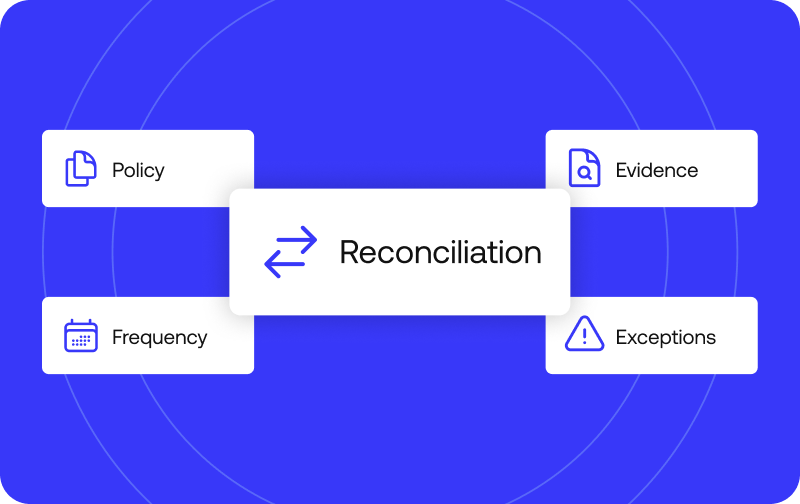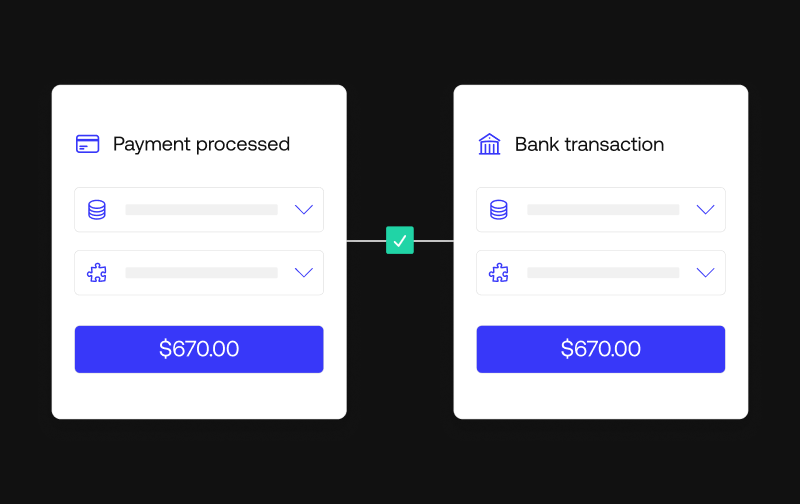
An account reconciliation example compares what your general ledger says a balance sheet account holds against outside evidence – a bank statement, a vendor invoice, a subledger – and shows exactly how any difference gets explained.
The account changes; the logic stays the same across bank, receivables, payables, and every other balance sheet account.
What an account reconciliation example actually shows
An account reconciliation example is only useful if it shows more than two numbers that don’t match. What matters is the reconciling item – the specific timing difference, fee, or error that explains the gap – and the internal control behind it: who found it, what evidence backs it up, and whether it got fixed before the account closed.
A bank reconciliation example, an accounts receivable reconciliation example, or a balance sheet reconciliation example are the same demonstration applied to a different account type: internal record, external evidence, the gap between them, and the explanation that closes it.
The documents behind every account reconciliation example
Every account reconciliation example starts from two sides: the internal financial records – the subledger, the general ledger – and the external evidence that’s supposed to confirm them, a bank statement, a vendor’s external statements, or source documents like invoices and contracts. Without both sides, there’s nothing to compare. Get the financial records right on both sides, and the comparison itself is usually the easy part.
Account reconciliation examples by account type
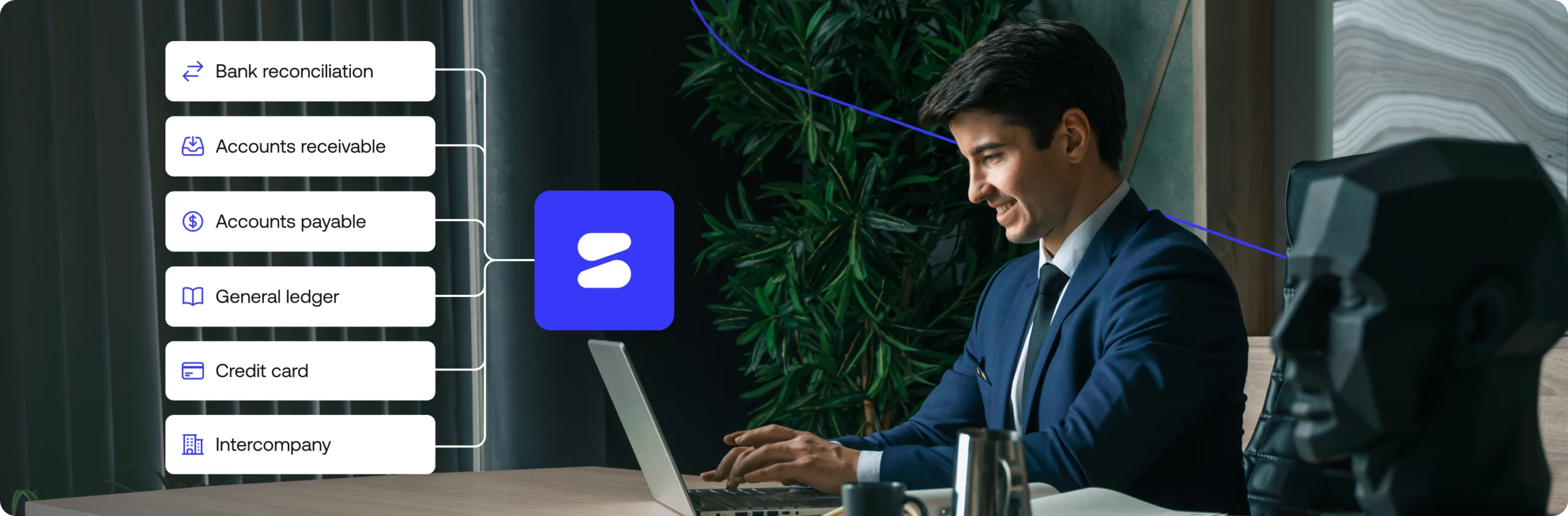
Six account types, six versions of the same comparison: internal record against external evidence, gap identified, gap explained, across bank, receivables, payables, and every other balance sheet account.
Bank reconciliation example
A book balance of $12,450 against a bank balance of $13,180: the gap is explained by a $900 deposit in transit and $520 in outstanding checks.
Accounts receivable reconciliation example
The AR subledger shows $45,000 in open invoices; the accounts receivable balance in the general ledger shows $44,800. The $200 difference comes from a partial payment that wasn’t fully applied (customer reconciliation).
Accounts payable and vendor reconciliation example
A vendor invoice for $8,200 shows up on the vendor’s own ledger, but accounts payable only recorded $7,900 – vendor reconciliation turns up an early-payment discount that was never recorded internally.
General ledger and balance sheet reconciliation example
General ledger reconciliation checks each balance sheet account against its supporting detail. A typical example: the equipment account on the balance sheet shows $150,000, but the fixed-asset register details $148,500 – a difference that also affects income statements if it isn’t corrected before close.
Credit card reconciliation example
The corporate card statement shows $3,400 in charges for the month; internal records capture $3,250. The $150 difference is usually bank fees or duplicate charges that only turn up when matching transaction by transaction.
Intercompany reconciliation example
Entity A records $25,000 as a receivable from Entity B; Entity B records only $24,600 as a payable to A. Intercompany transactions, and intercompany reconciliation, exist exactly to find and explain that $400 difference before consolidation.
Common reconciling items and errors in any account reconciliation example
Timing differences, a deposit in transit, an invoice just issued, resolve themselves in the next cycle without anyone stepping in. Data entry errors and unauthorized transactions don’t: the first need correcting, the second need immediate investigation, not just an accounting adjustment.
What every account reconciliation example needs for audit readiness
Segregation of duties, the person who reconciles isn’t the person who approves, is the most basic internal control across all six examples above. Every real adjustment turns into documented journal entries, and the resulting audit trail is what supports audit readiness when someone asks, months later, why a number changed. Frameworks like GAAP set the underlying accounting standard, but they don’t substitute for the evidence itself.
That evidence trail matters most when it holds up on its own, independent of any single person’s memory – see segregation of duties and the rest of the best-practices checklist for how to build that in.
How account reconciliation examples fit into month-end close
Left unresolved, each of the six examples above becomes an obstacle to month-end close and to financial close more broadly. Close management exists so that no reconciling item reaches the last day unexplained, the kind of gap a controller or accounting team catches during close, and a CFO doesn’t want to discover after: when that discipline slips, financial reporting and cash flow decisions end up resting on financial records nobody verified in time.
How Simetrik approaches account reconciliation examples
Accounting software and automated reconciliation change which of the six examples above needs the most manual work; they don’t remove the need to review exceptions, but they do remove the line-by-line review of everything that already matches. The same logic applies whether the account in question runs through a full bank reconciliation process or shows up as a one-off intercompany difference.
Simetrik’s ability to connect data from every source, banks, processors, ERPs, feeds the matching step: configured rules separate matches from exceptions, unmatched items route to exception and approval queues with maker-checker separation of duties, and a traceable audit trail covers every action, per Simetrik’s product knowledge base (verified August 2026). That’s the same kind of evidence each of the six examples in this article needs to hold up under an audit.
This covers data preparation, rules-based matching, exception and approval workflows, and audit trail. It doesn’t extend to running financial close end-to-end, automation of intercompany eliminations, or producing financial reporting as a standalone output.
See how these examples run without manual matching
Explore the platform to see how data preparation, rules-based matching, and audit trail work together on your own accounts. See the platform
Account reconciliation example FAQs
Questions that come up once someone’s looking at a specific account reconciliation example rather than the general definition:
What is account reconciliation?
Account reconciliation is the process of comparing what your general ledger says a balance sheet account holds against outside evidence – a bank statement, an invoice, a subledger – and explaining any difference before the books close.
What is an example of account reconciliation?
A bank account showing $13,180 in the bank versus $12,450 in the books, with a deposit in transit and two outstanding checks explaining the $730 gap, is a typical example – the same logic applies to receivables, payables, or any other balance sheet account.
What is a good example of reconciliation?
A good example includes more than one reconciling item at once – not just a single outstanding check, but a mix of timing differences and at least one item that turns out to be a real error, since that’s closer to what an actual reconciliation looks like.
What documents are needed for an account reconciliation example?
At minimum, the internal record (general ledger or subledger) and the external evidence that should match it – a bank statement, a vendor invoice, a credit card statement, or another source document, depending on which account you’re reconciling.
What problems come up in an account reconciliation example?
Most commonly: timing differences that resolve on their own, data entry errors that need correcting, and occasionally an unauthorized transaction that needs immediate investigation rather than a routine adjustment.
What kinds of questions come up in an account reconciliation example?
Accountants preparing or reviewing one typically ask: what’s the reconciling item, is it a timing difference or a real error, what document supports the adjustment, and who approved it. Those four questions cover most of what an auditor asks too.
Is there a template or PDF for an account reconciliation example?
Most accounting teams use a simple two-column template – recorded balance on one side, supporting evidence and adjustments on the other, ending in a matching adjusted balance. The format matters less than having every reconciling item documented with its source.
How do you reconcile a bank statement with the general ledger?
Compare the ending balance on the bank statement against the cash balance in the general ledger, then account for deposits in transit, outstanding checks, and any bank fees or interest earned that hasn’t been recorded yet. What’s left after those adjustments should match.
Next step: see these examples on connected data
These six examples work the same way on a spreadsheet as they do on a connected platform, the difference is how much of the data preparation and matching happens on its own. See the platform in action to run this same logic against your own accounts.