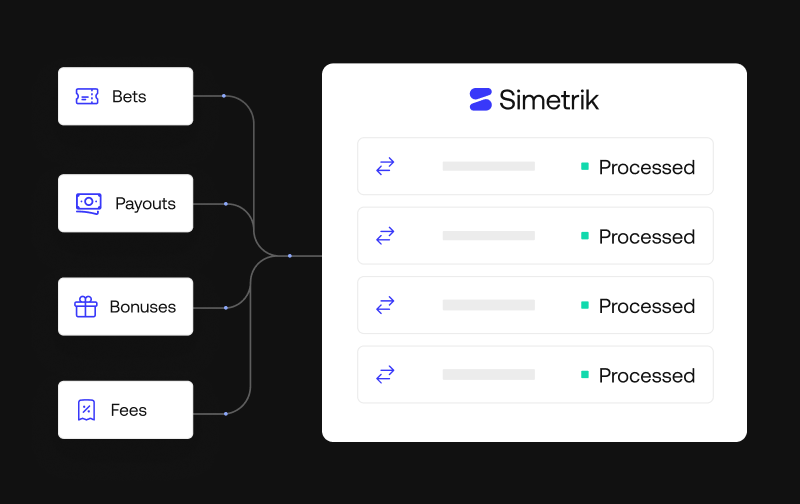
Imagine an agent analyzing thousands of unreconciled transactions, identifying a pattern, and designing a new matching rule. Before implementing it, it reviews the data sources involved, evaluates its impact, and determines which tools it needs to execute the change.
If the action falls within the permissions and criteria defined by the organization, it can proceed autonomously.
If it recognizes that a decision requires additional validation, it brings in the right person. Once the logic is established, the rule is applied consistently across millions of records.
That scenario reflects one of the main opportunities for applying AI in financial operations: building agents capable not only of understanding what the user needs, but also of carrying out the right action with the level of precision, traceability, and control each case demands.
It also reflects the logic behind Simetrik Agent: an autonomous agent that can operate financial control end-to-end and knows when to reason probabilistically, when to rely on deterministic tools, and when to bring in a person.
To achieve this, these agents combine different capabilities:
- Probabilistic models allow them to interpret context, detect patterns, and find solutions.
- Deterministic tools, on the other hand, ensure that actions requiring precision, reproducibility, and auditability always follow a defined logic.
The sophistication lies not in choosing one capability over the other, but in the agent knowing when to use each one, how to combine them, and at what point to incorporate human intervention.
One Agent, Different Capabilities
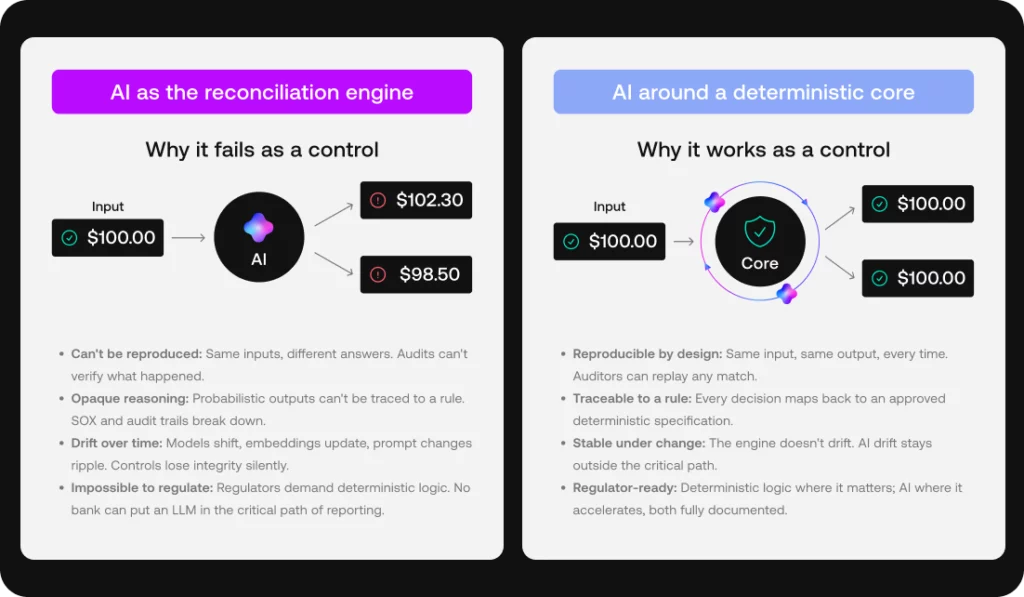
AI models learn from patterns and interpret available information to generate a response based on context.
That flexibility allows them to:
- understand requests in natural language;
- recognize structures and relationships within data;
- investigate anomalies and group exceptions;
- suggest rules, transformations, or potential solutions;
- adapt to scenarios that were not previously defined.
But that same probabilistic nature means a request can produce different responses even when the input, context, and instruction remain unchanged.
Deterministic tools provide a different capability: reproducible execution.
In a deterministic system, if a control receives the same input and the same configuration, it always returns the same result. It doesn’t need to reinterpret the intent with each execution: it applies the specification that governs the operation.
In financial control, an agent can interpret, investigate, and propose. But it cannot improvise where the business needs certainty.
This applies not only to reconciliation. It also covers journal entry generation, approval workflows, regulatory reporting, accounting reviews, and any instance where an organization needs to demonstrate how it arrived at a result.
That distinction is critical in auditable operations. To reconstruct what happened, knowing the result is not enough; it must also be possible to repeat exactly the logic that produced it.
In financial operations, both capabilities serve complementary functions: AI understands, investigates, configures, and decides; deterministic tools turn those decisions into stable, versioned, and traceable processes.
An agent prepared to operate in finance needs to combine both.
Autonomy Designed for Financial Operations
A financial agent doesn’t just need to reach an answer. It also needs to recognize what level of precision, traceability, and oversight each action requires.
When facing an exception, for example, it can analyze the context, find patterns, and propose a resolution. If it needs to apply a rule across millions of transactions, it can rely on a deterministic tool to ensure the logic is applied consistently.
The agent doesn’t lose autonomy by using specialized tools. On the contrary: it can turn its reasoning into real actions without giving up control over the operation.
The same applies to human intervention. In some cases, it can move end-to-end within established permissions. In others, it identifies that a decision requires a responsible party’s approval, presents the necessary context, and resumes the flow once validation is received.
Intervention doesn’t need to be present at every step. The key is that the agent recognizes when it is necessary.
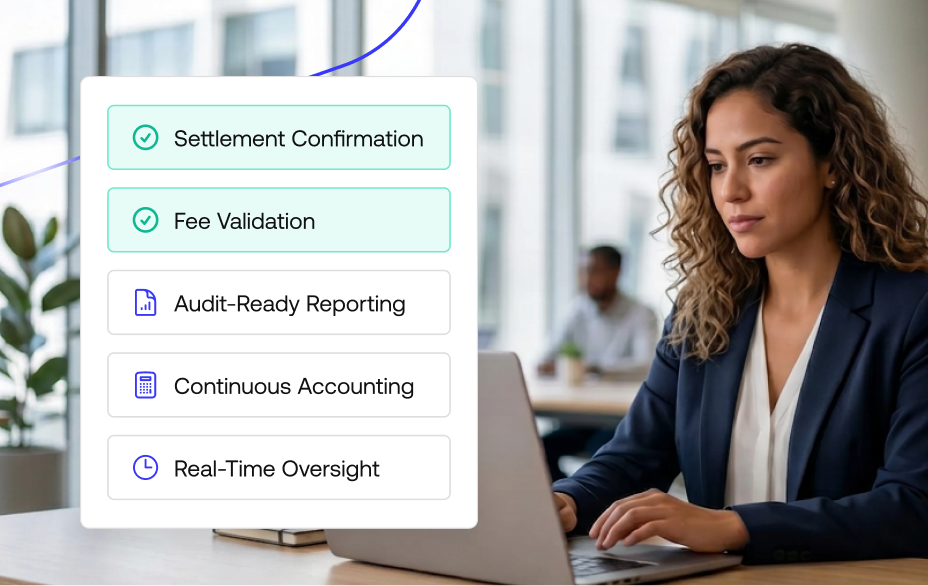
This combination makes it possible to automate complex operations without turning them into a black box. Every action is recorded, configurations can be versioned, and results are linked to the logic that produced them.
How Simetrik Does It
Simetrik was built as an AI-native infrastructure for financial control. Its architecture allows AI to intervene throughout the operation and use different tools depending on the nature of each task.
During configuration and initial onboarding, it can recognize formats, link fields, generate transformations, recommend parsers, suggest rules, or assist in designing an accounting model.
This allows new controls to be implemented faster and reduces the manual work required to understand data sources, map data, and configure operations.
Once a logic is defined, Simetrik Agent can convert it into a deterministic specification and apply it across Simetrik’s infrastructure. When the task requires analysis or interpretation, it uses probabilistic capabilities. When it demands a stable, exact, and verifiable result, it relies on Simetrik’s deterministic core — made up of more than 110 financial control-specific functions.
Everything happens within the same permissions, governance, and audit model.
After execution, AI can also investigate exceptions, detect anomalies, group errors, search for possible causes, and recommend or implement resolutions.
The agent determines which capability to use at each moment. The organization retains visibility into what it did, which tools it used, and what the final result was.
Simetrik Agent: From Intent to Execution
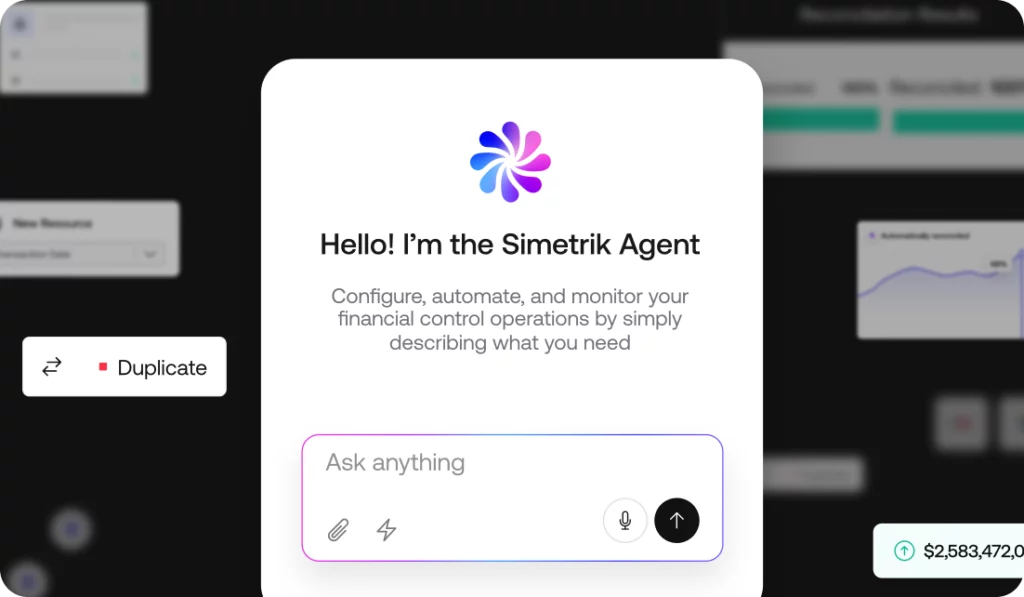
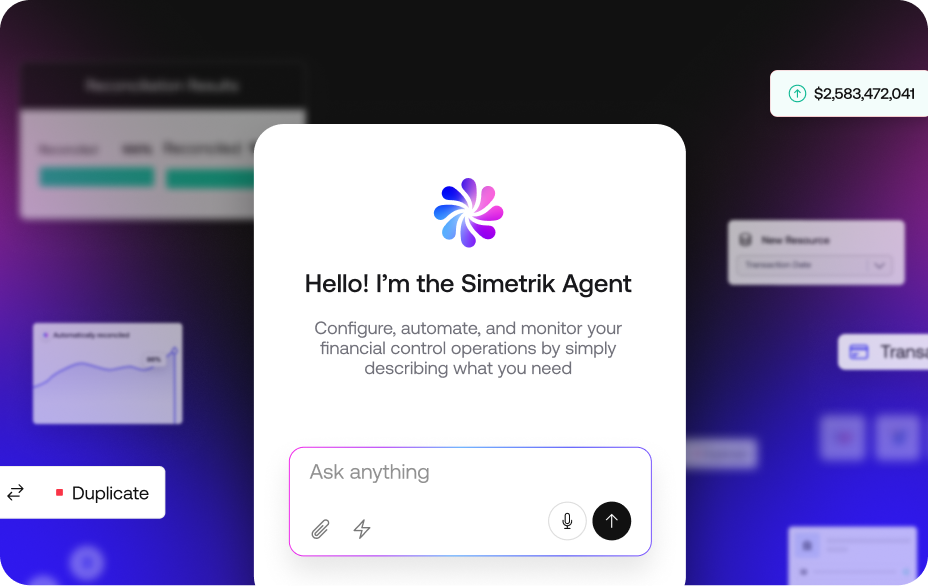
Simetrik Agent brings this architecture to a conversational experience within the platform.
It is equipped with the expertise and knowledge Simetrik has built alongside more than 180 clients globally, along with best practices specific to financial control, reconciliation, auditing, and exception handling.
Conversing with Simetrik Agent means accessing an expert that can support financial control 24 hours a day, 7 days a week.
The user can describe what they need, add files, and provide context. The agent interprets the intent, reviews the workspace, identifies the relevant data sources and dependencies, and defines the path forward.
It can design reconciliations, configure sources and transformations, create rules, schedule executions, investigate exceptions, and query results. It is not limited to explaining how to perform a task: it can act on the operation.
When the user enables it, Simetrik Agent can operate autonomously. Every action is carried out within Simetrik’s permissions model and is recorded.
It can also identify when a decision requires human intervention, present the relevant information in financial language, and incorporate the approval into the workflow without losing context.
An Open Box Agent
Autonomy does not mean losing visibility.
Simetrik Agent does not function as a black box, but as an open box: a system open to team oversight. Users can understand what it is doing, which data sources it consulted, what logic it is applying, and what actions it is taking.
Rather than receiving only a result, they can follow the process in terms understandable to someone working in finance: knowing which condition was met, which rule was used, which dependency was modified, or why an operation was sent for review.
Teams can also supervise the work, change configurations, adjust permissions, or intervene when they deem it necessary.
This capability turns the human into more than a mandatory approver at the end of a workflow. It allows them to define the level of autonomy, understand the agent’s decisions, and maintain control over the full operation.
The greater the system’s transparency, the greater the capacity to delegate with confidence.
MCP: Specialization for the Agents Teams Already Use
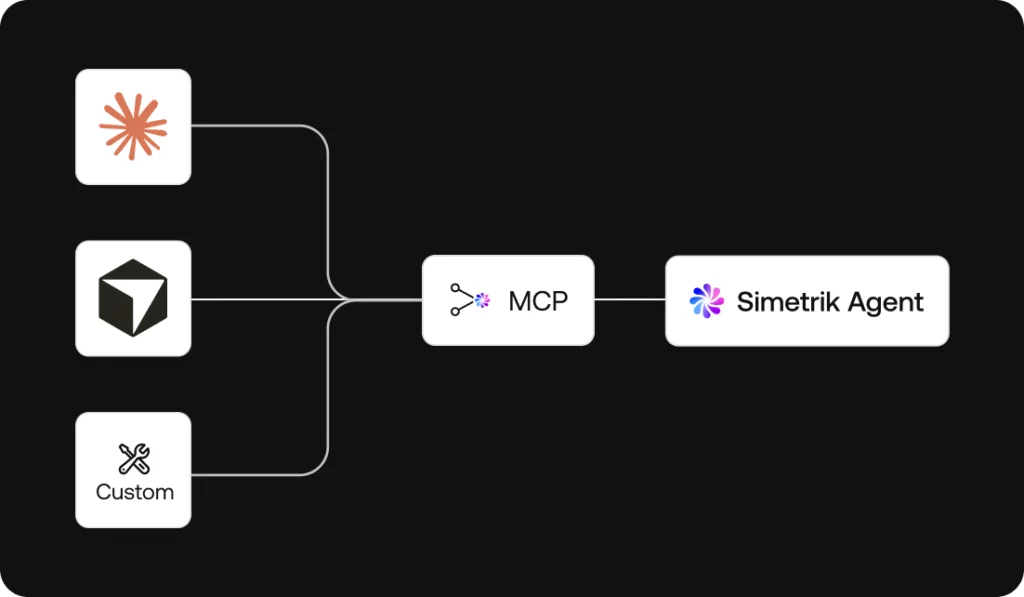
Many organizations already work with Claude, Copilot, Gemini, or internally developed agents. These systems can understand instructions and coordinate tasks, but they don’t automatically come with the knowledge and specific context of each financial operation.
Through MCP, these agents can connect with the financial knowledge and control capabilities of Simetrik Agent.
This means the user retains in their own agent the company context and the tools they already work with, and gains the capabilities, financial knowledge, and infrastructure available in Simetrik.
The team doesn’t need to switch environments to access information on data sources, controls, dependencies, financial logic, and exception handling.
Simetrik provides the domain specialization. The organization’s agent retains the broader business context.
This integration avoids the need for each company to rebuild from scratch the reconciliation logic, auditing practices, and infrastructure needed to operate real controls.
One Control, Different Ways to Operate It
Simetrik offers different ways to work on the same AI-native infrastructure.
Simetrik Agent is available within the web experience, integrated directly into the platform. MCP allows the agents each organization already uses to connect with Simetrik’s financial knowledge and control capabilities.
In all cases, AI operates on the same financial knowledge, the same engine, the same permissions, and the same traceability.
This is not about adding AI as an isolated layer on top of pre-existing processes. Simetrik was built from its foundational architecture so that agents, deterministic tools, and human teams can operate within the same system.
As agents gain capabilities, they will be able to take on an ever-larger share of the financial operation. Their true potential will depend not only on the volume of automated tasks, but on their ability to understand context, choose the right tools, act with precision, and bring in a person when appropriate.
That is the differentiator of an agent designed for the financial world: it doesn’t just reason and respond. It knows how to act.
Simetrik combines autonomy, specialized knowledge, governed execution, and human control in the same AI-native infrastructure. The result is a more powerful, transparent agent and ready to operate real financial processes.