If you’re evaluating alternatives to Simetrik, you already know what a reconciliation platform does. You’re likely weighing whether to build your own engine, stick to spreadsheets, or adopt newer AI tools promising “fully automated” exception resolution.
What does Simetrik do? Simetrik is a dedicated financial operations control platform that standardizes data, executes deterministic reconciliation rules, surfaces exceptions, and preserves an audit trail. Its AI layer assists configuration and analysis; it does not replace the governed matching engine or human accountability.
Here is the line every CFO needs to draw: A financial control must produce the exact same result every single time. While some newer AI tools promise to let autonomous agents close exceptions without human oversight, a probabilistic guess isn’t an accounting control, it’s an audit risk.
This guide breaks down where in-house builds, spreadsheets, and AI tools hold up, where they fail under audit scrutiny, and how to choose an architecture built for long-term compliance.
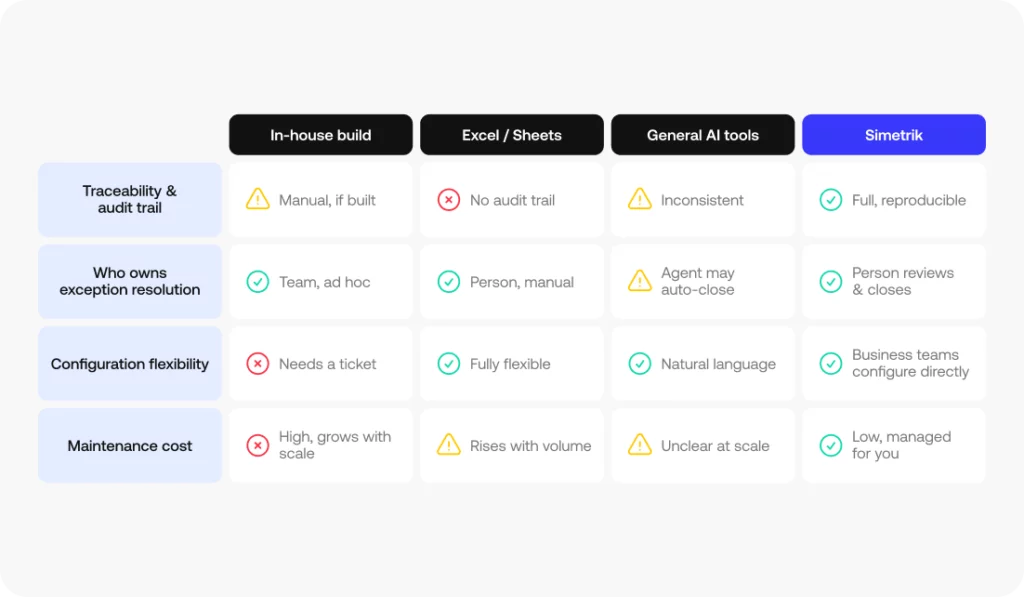
Comparing financial reconciliation alternatives at a glance
Alternative 1: Building a financial reconciliation tool in-house
For a lot of teams, the first real alternative to buying a platform isn’t another vendor. It’s the engineering team down the hall. If you already have developers who understand the payment flow, building a reconciliation tool internally can look like the obvious move: no procurement cycle, no new vendor relationship, full control over the roadmap.
What an in-house financial reconciliation build usually includes
A typical in-house reconciliation build covers a predictable set of pieces:
- Ingestion from bank files
- Processor APIs, or internal databases
- An ETL layer or custom scripts to clean and standardize that data
- Matching logic written specifically for your transaction types
- Accounting rules encoded directly into the system or a connected tool
- A way to generate files or journal entries for the ERP
- Some version of monitoring, versioning, and an audit trail.
Not every build includes all of this from day one. Most start with ingestion and matching, then add the rest as gaps show up.
When a custom-built reconciliation system is the right call
Building internally is a legitimate decision, not a fallback you settle for. It makes sense when the case is genuinely simple: one or two data sources, stable transaction logic, low volume, and a technical team that already understands the flow end to end. In that situation, a custom build gives you something a vendor platform can’t: complete control over the release schedule and the exact logic, with no external dependency on someone else’s product roadmap.
Where in-house reconciliation software breaks down as transaction volume grows
The trouble tends to start later, not at launch. Every rule change needs an engineering ticket and a QA cycle, so finance ends up waiting on IT for things that should take minutes. The system’s continuity depends on the two or three people who understand how it actually works, and if they leave, the institutional knowledge goes with them.
Visibility stays limited for the finance team that has to use the output, because most in-house builds get optimized for the data pipeline, not for the person reviewing exceptions. Permissions, versioning, traceability, and alerting all have to be built by hand on top of the matching logic itself, which turns into its own project. And technical debt piles up quietly until the day you add a new entity, a new currency, or a new data source, and realize the system was never built to flex that way.
Alternative 2: Using general AI tools for financial reconciliation
Where AI Copilots and Chatbots Fit in a Reconciliation Workflow
General-purpose AI tools genuinely help with parts of this work. They’re good at interpreting messy files, suggesting field mappings, drafting or explaining formulas, and letting someone describe a rule in plain language instead of writing it from scratch. Used this way, they’re leverage: they take work off someone’s plate without taking over the decision.
Why financial reconciliation needs a reproducible control, not a probabilistic answer
Here’s where it gets more complicated. A chatbot or AI agent that decides, on its own, whether a transaction matches or how an exception gets closed is solving the wrong problem in an appealing way. A financial control needs to produce the same result from the same inputs every time. That’s what makes it something an auditor can rely on.
AI agents don’t actually reason, they output what is most statistically probable based on context. Where a deterministic system knows without a doubt that $1 + 1 = 2$, a probabilistic AI evaluates what usually follows “$1 + 1$.” That makes it prone to repeating common errors, and when context is missing, the margin for error spikes.
An output that changes on the same data isn’t a financial control; it’s a guess with good manners. True controls require absolute predictability. AI should assist with patterns and rules, but a deterministic engine must execute the logic, and a human must make the final call.
Alternative 3: Reconciling payments and transactions in Excel or Google Sheets
Why Excel and Google Sheets were the default starting point for reconciliation
Almost every finance team starts here, and there’s nothing wrong with that. Exporting statements from a bank or processor and cross-checking them in a spreadsheet, using VLOOKUPs, pivot tables, the occasional macro, is how most reconciliation processes begin before anyone formalizes them. At low volume, with a handful of sources, it works fine. It’s cheap, flexible, and everyone on the team already knows how to use it.
Where manual spreadsheet reconciliation stops scaling
The limits show up gradually, then all at once. Spreadsheets are intensive in time: every new statement means another round of exporting, formatting, and cross-checking by hand. They’re error-prone in ways that are hard to catch, because a broken formula or a mis-copied row doesn’t announce itself. There’s no real-time visibility into where the reconciliation stands, and no reliable record of who changed what, when, or why, which becomes a real problem the first time an auditor asks.
None of this makes spreadsheets a bad choice early on. It just means the same tool that worked fine at 500 transactions a month starts working against you at 50,000.
A framework for evaluating reconciliation software alternatives
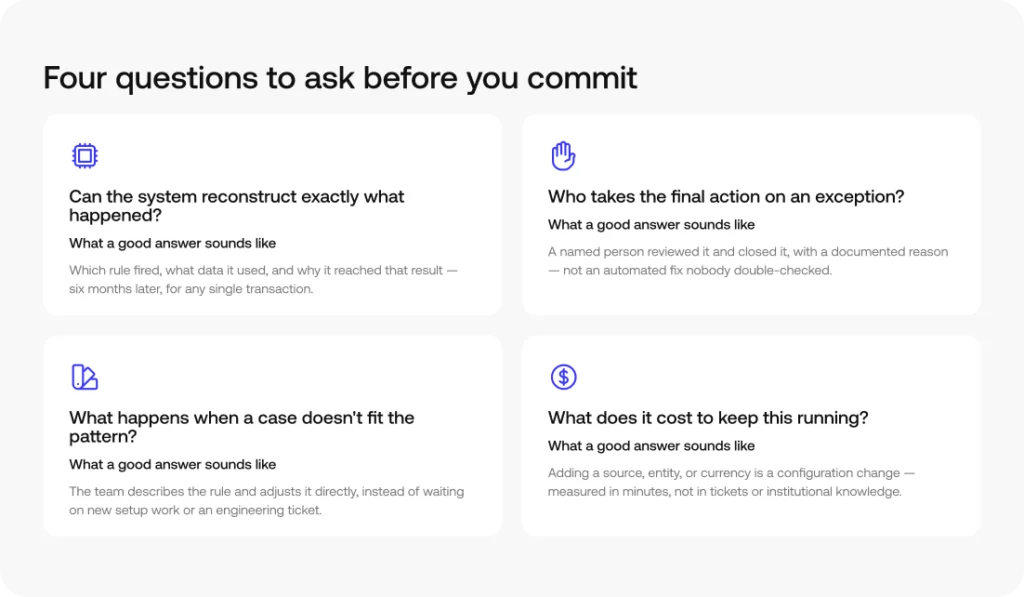
Whatever you’re comparing, an internal build, a spreadsheet, an AI tool, or a vendor platform, the same four questions tend to separate what actually works from what just looks good in a demo.
Questions to ask about traceability and audit trail
Can the system reconstruct exactly what happened for any given match or exception? Not just that it matched, but which rule fired, what data it used, and why it reached that result. If you can’t answer that six months later, you don’t have a control. You have an output.
Questions to ask about who owns exception resolution
When something doesn’t reconcile, who takes the final action, and can that action be explained afterward? The honest answer matters more than whether the system “resolved” something on its own. A flagged exception that a person reviewed and closed is more defensible than an automated fix nobody double-checked.
Questions to ask about configuration flexibility
What happens the first time a case doesn’t fit the standard pattern? Does the team wait on a new setup, or can they describe the rule and adjust it directly? Some platforms lean on natural-language interaction for exactly this. Simetrik Agent, for instance, lets a team describe a workflow instead of relying only on a fixed template. A tool that adapts to the edge case is worth more than one that only handles the common one.
Questions to ask about maintenance cost and scalability
Does your current infrastructure actually support your expected growth and compliance requirements across the short, medium, and long term? More specifically, what does it cost, in time, engineering tickets, and lost institutional knowledge, to keep it running as sources, currencies, entities, or rules change?
This question applies just as much to a spreadsheet model or an internal build as it does to any vendor platform, and it’s usually the one that gets skipped until it’s too late.
When a dedicated reconciliation control platform is worth the switch
There’s a point where each of the alternatives above stops being enough, and it’s rarely a single event. It’s an accumulation: new data sources show up, entities and currencies multiply, and exception volume starts growing faster than the team reviewing it. At the same time, constant variability in statements and documents forces teams to reconfigure their manual setups or re-engineer their code with every slight format change. Control requirements from finance, audit, or a regulator start asking for things the current setup was never built to provide.
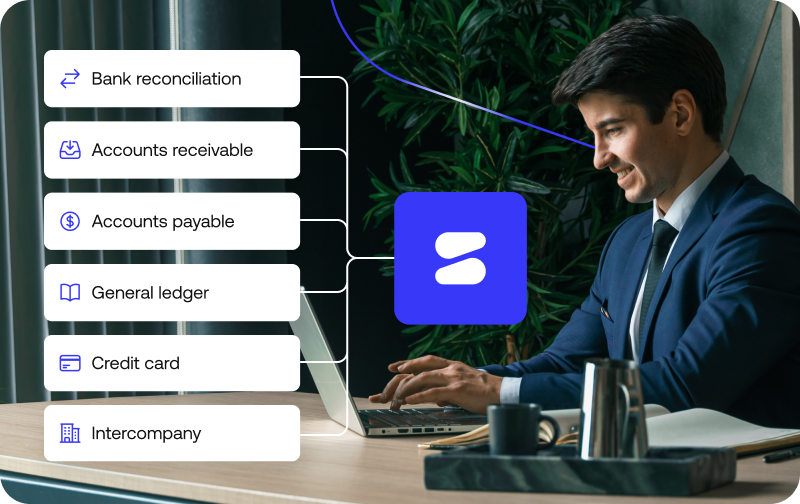
That’s the point where a platform built specifically for transaction-level control starts to earn its cost. Simetrik connects the pieces that a build or a spreadsheet usually keep separate: data preparation, matching, exception handling, and the path into accounting, under one system that business teams can configure directly, without opening an engineering ticket for every change.
The core that executes the matching logic is deterministic, so the result stays reproducible. The AI layer around it assists with configuration, pattern detection, and natural-language interaction, without taking over the final decision.
See how Simetrik’s control platform fits into a reconciliation operation that has already outgrown a spreadsheet or an internal build.
How Simetrik handles reconciliation, from matching to audit trail
The architecture behind Simetrik’s deterministic matching engine
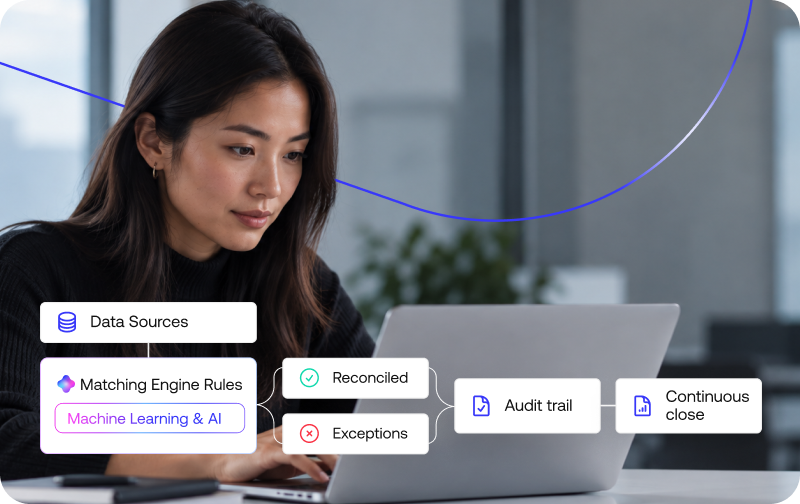
Simetrik ingests transaction data from banks, processors, and internal systems, prepares it into a consistent structure, and applies configured rules to match records against each other. The engine that executes those rules is deterministic: the same data and the same configuration produce a consistent result. Around that core sits an AI layer that assists the process. It can suggest matching logic, identify fields, help build transformations, and support conversational configuration through Simetrik Agent, but it doesn’t replace the rule that actually executes. That split matters because a financial control has to be reproducible: a result a team can trace back to a specific rule is one they can defend to an auditor, and a result that came from a model’s best guess isn’t.
How Simetrik detects and resolves reconciliation exceptions
When a transaction doesn’t match cleanly, Simetrik flags it and routes it with context: which rule ran, what data it compared, and why it didn’t clear. A finance team reviews that exception and takes the resolving action from there. Automating the detection, the context, and the routing while leaving the final decision to a person is a deliberate design choice, not a shortcut. A financial exception closed without a documented, reviewable reason is a bigger risk than one that took a person a little longer to confirm.
Simetrik’s audit trail and security certifications
Simetrik’s security program includes ISO/IEC 27001, ISO/IEC 27701, ISO/IEC 27018, SOC 1 Type 2, SOC 2 Type 2, SOC 3, and PCI DSS. Matches, exceptions, and rule applications can be traced back to the configuration that produced them, and the workflows that connect reconciliation to accounting carry that same traceability into journal entries and the reports a team may need for an audit. Certifications are a floor, not the differentiator. What matters more day to day is whether a team can reconstruct exactly what happened, for a given transaction, months after the fact.
Frequently asked questions about Simetrik alternatives
Is Excel or Google Sheets a viable long-term alternative to reconciliation software?
No. Excel and Google Sheets are a viable starting point, not a long-term answer, once volume or complexity outgrows what a team can check by hand. Spreadsheets lack traceability, real-time visibility, and a record of who changed what, which becomes the actual cost as transaction volume rises.
Can general AI tools, like a chatbot or AI agent, replace a reconciliation platform?
General AI tools excel at auxiliary tasks like interpreting messy files, suggesting field mappings, or drafting formulas, but they shouldn’t execute control decisions autonomously. Reconciliation outputs directly drive executive decision-making, tax filings, and financial reporting. Because general AI operates on probability rather than deterministic rules, a non-reproducible answer directly undermines data confidence and credibility. Replacing strict controls with statistical guesses can expose a team to misinformed decisions, audit findings, and regulatory risk, defeating the purpose of a financial control.
Does a reconciliation platform need to execute the fix automatically, or is flagging enough?
A modern platform should support deterministic auto-matching, governed human intervention for complex exceptions, and assisted remediation workflows. What matters is applying the right level of control to each case. Known patterns can be resolved through configured rules, while sensitive edge cases are routed with full context for review and approval. A unified audit trail preserves efficiency without sacrificing reproducibility.
When does it make sense to move from a spreadsheet or internal tool to a dedicated platform?
The switch becomes necessary when you hit limits on both scalability and reliability. Scalability breaks down as growing data, entities, and currencies require unsustainable headcount or dev tickets. Reliability breaks down because spreadsheets can’t track user actions or prove data integrity. When a spreadsheet claims an operation is “90% reconciled,” it can’t answer: Who verified this? Under what rules? Has it been modified? When you can no longer prove how your numbers were reached, the audit risk far outweighs the cost of a dedicated platform.
Does configuration flexibility matter more than a library of pre-built templates?
What matters is whether an approach can adapt to a workflow that falls outside standard patterns without stalling on new setup work, through natural-language interaction, assisted rule-building, or both. A large template library speeds up standard cases. Genuine configuration flexibility is what handles the case that doesn’t fit one.
Should certifications or pricing structure decide which reconciliation option is right for you?
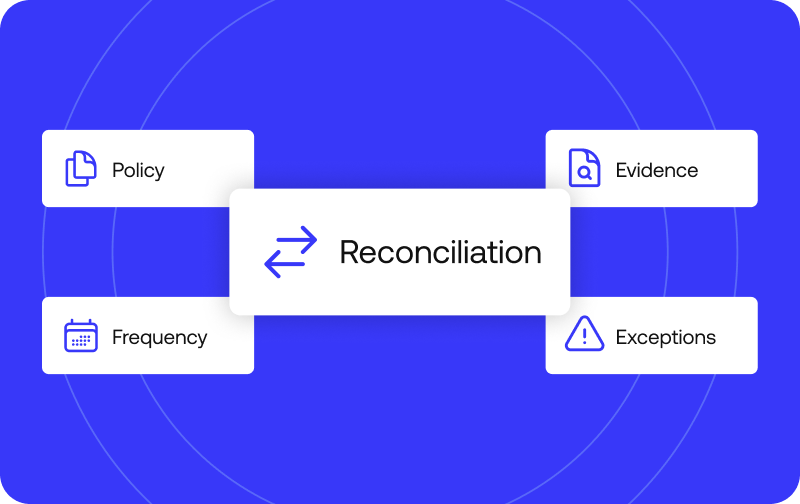
They’re worth checking, but they answer a narrower question than the one that actually matters: can this approach reconstruct what happened, who owns the fix, and what it costs to maintain as your operation changes. Certifications and pricing models are inputs to that decision, not a substitute for it.
Does Simetrik use AI for reconciliation matching?
Yes. Simetrik pairs a deterministic core that executes configured matching rules with an AI layer that assists configuration, suggesting matching logic, identifying fields, and supporting natural-language interaction through Simetrik Agent.
Does Simetrik resolve reconciliation exceptions automatically?
Simetrik detects discrepancies as data is processed and routes them with context so a finance team can review and take the resolving action. That’s a deliberate design choice, not a limitation: a result a person can trace, explain, and defend to an auditor is worth more than one an automated process applied without review.