Financial consolidation software combines the books of a parent company and its subsidiaries into one set of group financial statements, handling intercompany eliminations, currency translation, and ownership adjustments along the way. The tools that do this well differ mostly in what they bundle around the consolidation engine: some are dedicated close and consolidation platforms, some are planning suites with consolidation built in, and one runs consolidation inside its own accounting system.
This guide compares eight options: Simetrik, OneStream, Oracle Cloud EPM Financial Consolidation and Close, CCH Tagetik, Vena, Anaplan, Sage Intacct, and Prophix.
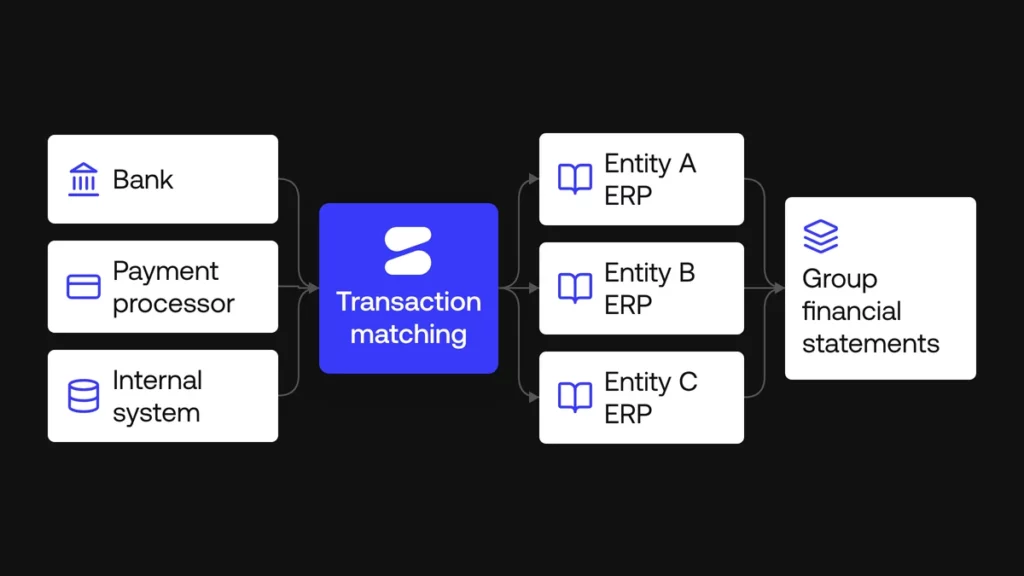
Simetrik is the one that doesn’t run the consolidation itself. It works a step earlier, reconciling transaction-level data from banks, payment processors, and internal systems before that data reaches the ledgers your consolidation tool reads.
Key Takeaways
- Financial close finalizes one entity’s books for a period. Financial consolidation combines several closed entities into group statements. Enterprise performance management (EPM) suites add budgeting, forecasting, and reporting on top, and most tools on this list bundle more than one of the three.
- The decision usually comes down to four things: how many entities you consolidate and how they’re owned, how many currencies you translate, whether you need statutory consolidation, management consolidation, or both, and whether your ERP already has a consolidation module.
- Several consolidation platforms now match intercompany balances themselves. That confirms two entities’ books agree with each other. It doesn’t confirm that each entity’s books agree with the bank, processor, and system records behind them.
- All eight tools here now publish AI capabilities, so AI alone won’t separate them. What does is where the AI works, what it’s allowed to change, who approves its output, and whether the result can be reproduced for an auditor.
- Simetrik isn’t financial consolidation software; it’s the AI-native, transaction-level control layer that multi-entity businesses put in front of the ledger when they need automation and traceability over their transaction and operational data, so the data feeding the best financial consolidation software they choose has already been reconciled.
What Is Financial Consolidation Software?
Financial consolidation software takes the financial data of a parent company and its subsidiaries and produces one set of consolidated financial statements: a consolidated balance sheet, income statement, and cash flow statement for the group. To get there, it automates a sequence that finance teams used to run in spreadsheets:
- Data collection. Pull trial balances from each entity’s general ledger, often from different ERP systems.
- Mapping. Align each entity’s chart of accounts to the group’s reporting structure.
- Currency translation. Translate each subsidiary’s functional currency into the group’s reporting currency and track the translation adjustment.
- Intercompany matching and eliminations. Pair up transactions between group entities and remove them, so the group doesn’t count sales, loans, or balances it has with itself. Our glossary entry on intercompany eliminations walks through the entries in detail.
- Ownership adjustments. Account for partially owned subsidiaries, joint ventures, and non-controlling interests.
- Group reporting. Produce the consolidated statements and the management reports built on them.
For the accounting concept itself, separate from the software, see our definition of financial consolidation.
Financial Consolidation vs. Financial Close: What’s the Difference?
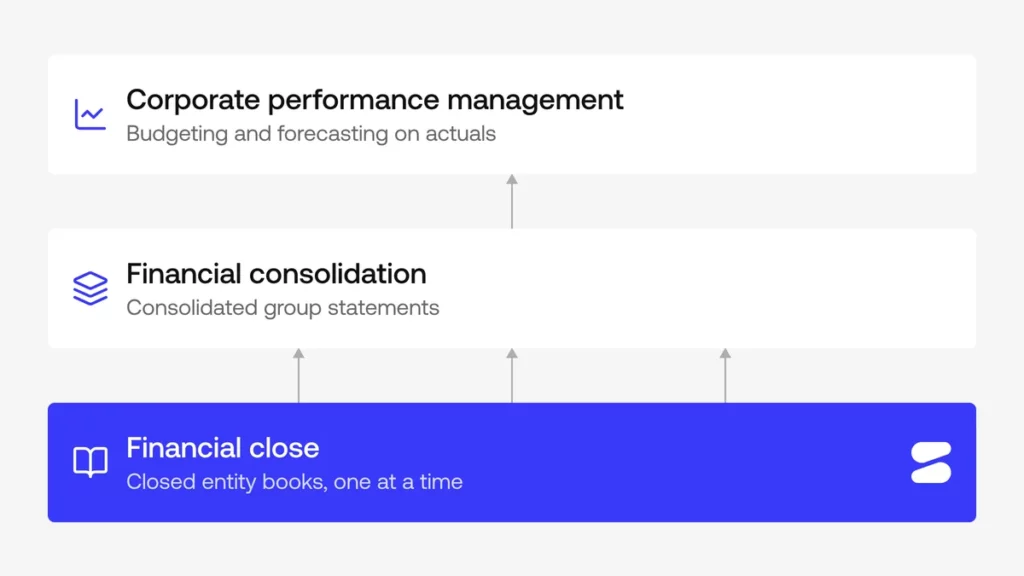
Financial close finalizes one entity’s books for a period: reconciling accounts, posting journal entries and accruals, and signing off the month or quarter.
Financial consolidation happens after that. It combines multiple closed entities into one set of group statements, adjusting for ownership and eliminating what the entities did with each other. You can’t consolidate books that haven’t closed, but a single-entity company can close every month without ever consolidating.
Corporate performance management sits on top of both. CPM suites, sometimes called EPM, use consolidated actuals for budgeting, forecasting, and FP&A. That’s why analysts group many of these tools into one market: Gartner, for example, reviews them as “financial close and consolidation solutions.”
| Process | What it does | Scope | Typical output |
|---|---|---|---|
| Financial close | Finalizes the books for a period | One entity at a time | Reconciled accounts, posted entries, a closed period |
| Financial consolidation | Combines closed entities into group figures | The whole group | Consolidated financial statements |
| Corporate performance management | Plans and analyzes on top of actuals | Group and business units | Budgets, forecasts, management reporting |
If your problem is closing a single entity’s books faster, start with our guide to financial close software instead. The rest of this article assumes more than one entity.
Statutory consolidation vs. management consolidation
Both are consolidation, built for different readers. Statutory consolidation produces the group financial statements that auditors, regulators, and investors rely on, prepared under a framework like IFRS or US GAAP.
Management consolidation produces group views for internal decisions, often cut by product, region, or channel, and usually needed faster and more often than the statutory set. Several tools on this list handle both from the same data; CCH Tagetik, for example, describes its platform as covering statutory and management consolidation for disclosure.
How We Compared These Tools
The list opens with Simetrik, our own platform, which works a step earlier than the others: on operational data, before it reaches each entity’s ledger. The other seven follow in no particular order. Each one is described by the job it does best, using the vendor’s own product pages.
Every tool is described against the same criteria:
- Who it’s for: the buyer the vendor says it serves.
- Where it sits in the stack: a consolidation and close platform, a planning or CPM suite with consolidation built in, consolidation inside an accounting system, or transaction-level control before the ledger.
- Intercompany handling: how it matches and eliminates transactions between group entities.
- Currency translation: how it translates each subsidiary’s functional currency into the reporting currency.
- How AI is used: what the vendor’s own pages say its AI does.
- Integrations: what it connects to and how data gets in.
If a detail couldn’t be confirmed for every tool, we left that field out for all of them. Pricing isn’t included, so ask each vendor for a quote based on your entity count and modules.
Financial Consolidation Software Compared at a Glance
| Tool | Best for | Where it sits in the stack | Intercompany handling | Currency translation | How AI is used |
|---|---|---|---|---|---|
| Simetrik | Multi-entity teams that need automation and traceability over transaction and operational data before the ledger | Transaction-level reconciliation and control, before consolidation | Reconciles each entity’s records against their sources; intercompany matching and eliminations stay with consolidation | Stays with the consolidation platform | AI investigates and manages differences at the autonomy level the team sets and analyzes datasets and trends; Simetrik Agent and MCP-connected agents build reconciliations; a deterministic engine produces results |
| OneStream | Teams wanting consolidation, reconciliation, matching, and journals on one CPM platform | Unified CPM platform | Automated eliminations, plus on-platform transaction matching | Yes, with foreign currency and cash flow tools | Finance-focused AI automates routine tasks and detects anomalies |
| Oracle Cloud EPM Financial Consolidation and Close | Oracle-standardized organizations wanting a preconfigured IFRS and GAAP model | Consolidation and close within Oracle Cloud EPM | Automatic standard eliminations, plus equity eliminations | Standard or customizable translation | AI and ML automate consolidations; GenAI drafts report narratives |
| CCH Tagetik | Groups with statutory, multi-GAAP, and disclosure requirements | Close, consolidation, reporting, disclosure, and ESG on one platform | Automated eliminations and an intercompany cockpit | Multi-currency conversion | Expert AI flags anomalies, validates data, and explains variances |
| Vena | Finance teams that want consolidation without leaving Excel | Consolidation, planning, and reporting, Excel-native | Automated eliminations | FX translation and CTA | Describes consolidation as AI-amplified; Vena AI supports FP&A |
| Anaplan | Organizations that want consolidation tied to enterprise planning | Consolidation application within Anaplan’s planning platform | Automated eliminations | Automated translation into the reporting currency | Finance Analyst agent supports planning and consolidation work |
| Sage Intacct | Multi-entity organizations already keeping their books in Sage Intacct | Consolidation built into its accounting software | Auto-eliminations at consolidation | CTA under ASC 830, with OANDA rates | Close and Financial Assurance agents flag issues and unusual entries |
| Prophix | Controllers and group finance teams that want finance-owned consolidation | Consolidation within the Prophix One CPM suite | Matching, reconciliation, and automated eliminations | FX translation | Prophix One Intelligence flags exceptions and surfaces anomalies |
Which Tool Fits Which Team
Feature lists for financial consolidation tools overlap heavily, so this table starts from the job you need done instead.
| If your situation is… | Look at |
|---|---|
| Payment, bank, and system data from many sources has to be reconciled at the transaction level before each entity’s books can be trusted | Simetrik, alongside your consolidation tool |
| You want consolidation, account reconciliation, transaction matching, and journal entries on one platform | OneStream |
| Your organization runs on Oracle and wants a preconfigured consolidation model for IFRS and GAAP | Oracle Cloud EPM Financial Consolidation and Close |
| Statutory consolidation feeds disclosure, iXBRL, or ESG reporting across several accounting standards | CCH Tagetik |
| Your finance team lives in Excel and wants governance underneath it | Vena |
| Consolidation needs to connect to enterprise planning and forecasting models | Anaplan |
| Your entities already keep their books in Sage Intacct | Sage Intacct |
| You want intercompany matching and parallel IFRS and US GAAP reporting inside a finance-owned CPM suite | Prophix |
8 Best Financial Consolidation Software Tools, Reviewed
Simetrik
Simetrik is an AI-native financial control platform.
It isn’t a consolidation engine. It works on the layer underneath the consolidation, reconciling transaction-level records before they reach the ERP and, from there, your consolidation tool.
That makes it the best fit for the step before consolidation, when each entity’s books depend on payment, bank, processor, third-party, or internal system data that has to be automated and traced back to its source.
Best for: Finance, accounting, and operations teams at payment service providers, marketplaces, neobanks, banks, and large merchants that run many transactions or data sources across several entities and currencies, and companies with fewer transactions but strict traceability needs, such as manufacturers, and need the data behind each entity’s books reconciled before consolidation starts.
Key features:
- Transaction-level reconciliation. Simetrik ingests transaction data from banks, processors, and internal systems, prepares it into a consistent structure, and applies configured matching rules, from one-to-one to many-to-many, with tolerances. Records that don’t match are separated as exceptions and identified in dashboards where finance and operations teams act on them, individually or in bulk, with a complete audit trail.
- AI that builds and investigates reconciliations. Using the information already in Simetrik, AI can investigate and manage differences on its own, at the autonomy level the team sets, and it creates and analyzes datasets and trends in plain language. With Simetrik Agent, a team describes what it needs in plain language. The Agent reviews the workspace, proposes a plan, and configures sources, transformations, matching rules, schedules, and alerts, with each action logged.
- Teams choose its level of autonomy: Automatic, Confirmation (which Simetrik recommends), or Planning. Teams that already work in Claude, Copilot, or their own agents can connect them to Simetrik through MCP and request the same work in natural language. Inside the platform, Smart Parser reads non-standard processor and bank files, Smart Rules suggests matching rules, and Anomaly Detection surfaces issues with their likely cause. Results still come from a deterministic core: the same inputs and rules produce the same result, so an auditor can see how each one was produced.
- Account-level balance review. Simetrik compares ERP balances with reconciled balances account by account and period by period, with a preparer and certifier workflow, and each difference keeps its cause, owner, and aging. Intercompany matching and eliminations stay with the group’s consolidation process. See our entry on intercompany reconciliation for how the two steps connect.
- Journal entries from reconciled data. Simetrik can generate journal entries from reconciled operational data through configuration, connect to the ERP, and adapt the posting to how that system requires entries to be recorded, with traceability from the transaction to the entry.
- Audit trail and security. Matches, exceptions, and rule applications trace back to the configuration that produced them. Simetrik’s security page lists certifications and standards including ISO/IEC 27001, SOC 1 Type 2, SOC 2 Type 2, and PCI DSS, and describes encryption in transit and at rest.
Integrations and setup: Simetrik offers pre-built connectors for payment processors, card networks, banks, and ERPs; without a connector, data can come in through manual upload, SFTP, email, or scheduled routines.
Simetrik connects to ERPs such as SAP S/4HANA, Oracle, and NetSuite and adapts journal entry posting to how each system requires it, and reconciled data can be exported to Amazon S3, Google Cloud Storage, or Azure. Finance and operations teams configure sources, transformations, and matching rules without code.
Worth knowing: Simetrik doesn’t market consolidation, planning, or CPM capabilities.
Your consolidation platform, such as the ones below, still combines the entities: it removes transactions between group companies, converts each entity’s results into the group currency, and applies ownership percentages. Simetrik’s job comes first: it reconciles each entity’s transaction and operational data against its sources, so the numbers going into consolidation are already verified.
For how Simetrik compares with building in-house or running spreadsheets, see Simetrik alternatives: build, spreadsheets, and AI tools.
OneStream
OneStream positions its financial close and consolidation software as part of a unified CPM platform, with consolidation, account reconciliation, transaction matching, and journal entry management in one place.
Best for: Finance teams that want consolidation, account reconciliation, transaction matching, and journal entries on one unified CPM platform instead of separate point solutions.
Key features:
- Consolidation with intercompany eliminations, currency translation, and management of acquisitions, built to meet US GAAP and IFRS.
- Account reconciliation, transaction matching, and a Journal Entry Manager on the same platform as consolidation.
- Compliance tooling for US GAAP, IFRS, and local standards, including support for SOX 302 and 404 controls.
- ESG reporting and tax provision (ASC 740) modules alongside the close.
Integrations and setup: Pre-built connectors to GL and ERP systems such as Oracle, SAP, and Microsoft Dynamics, with drill-back to source data.
Worth knowing: OneStream’s consolidation is one part of a broad CPM platform. Scope the rollout around the modules you’ll actually use.
Oracle Cloud EPM Financial Consolidation and Close
Oracle’s consolidation product, often shortened to FCCS, lives inside Oracle Cloud EPM, Oracle’s enterprise performance management line, alongside its planning, account reconciliation, and tax reporting applications.
Best for: Organizations standardized on Oracle that want a preconfigured consolidation model for IFRS and GAAP reporting.
Key features:
- A preconfigured consolidation model with cash flow, balance sheet, and income statement calculations built in, which Oracle says reduces the need for customization.
- Automatic standard intercompany eliminations, equity eliminations, and adjustments, with standard or customizable currency translation.
- Support for complex legal and management rollups across hierarchies.
- Journals managed centrally and posted to the general ledger, plus generative AI that drafts narrative commentary for reports.
- Parallel-run capabilities that Oracle positions for the new profit and loss presentation requirements of IFRS 18.
Integrations and setup: Part of the Oracle Cloud EPM suite. Oracle says business users can configure close and consolidation workflows without IT.
Worth knowing: Oracle Cloud EPM is a separate product line from Oracle’s ERP applications. If some of your entities run on other ERPs, check how their data gets in during evaluation.
CCH Tagetik
CCH Tagetik, from Wolters Kluwer, covers financial close and consolidation together with reporting, disclosure, and ESG on one platform.
Best for: Groups with statutory, multi-GAAP, and disclosure requirements that want close, consolidation, and reporting on one platform.
Key features:
- Automated intercompany eliminations, equity adjustments, currency conversions, and multi-statutory requirements.
- Minority interest and equity adjustment calculations, with multi-entity consolidation across unlimited hierarchies.
- A consolidation cockpit to monitor each step, and an intercompany cockpit to monitor and match intercompany transactions.
- Close-to-disclosure scope: financial reporting, Intelligent Disclosure for disclosure management, iXBRL, and ESG reporting.
- AI applied to data-centric tasks such as intercompany elimination, anomaly detection, and trial balance mapping for IFRS and GAAP reporting.
Integrations and setup: Native to SAP HANA, available in the cloud or on-premise, with rules-based configuration that Wolters Kluwer says needs no scripting or coding.
Worth knowing: The scope extends well past consolidation into disclosure, ESG, and tax, so it fits best when consolidation is part of a wider close-to-disclosure program.
Vena
Vena describes its financial consolidation software as Excel-native, with a governed consolidation engine underneath the spreadsheet interface finance teams already use.
Best for: Finance teams that want governed consolidation without leaving Excel and the Microsoft stack.
Key features:
- Intercompany eliminations, multi-currency translation with CTA, ownership and minority interests, top-side adjustments, and consolidated cash flow in one engine.
- Trial balance loading from each entity, with chart-of-accounts mapping and completeness checks.
- Traceability from source GL data through translation, eliminations, and adjustments to the final report, plus period locking and audit trails.
- Consolidation on the same platform as planning and reporting.
Integrations and setup: Excel-native experience, with Power BI dashboards for business intelligence and PowerPoint reports that refresh as consolidated results change.
Worth knowing: Vena is built around the Excel user. That’s the point for teams that want to keep working in spreadsheets with governance added; teams trying to move off the spreadsheet interface should weigh it accordingly.
Anaplan
Anaplan offers financial consolidation as an application within its planning platform, next to applications for integrated financial planning, disclosure management, and profitability analysis.
Best for: Organizations that want consolidation connected to enterprise planning and forecasting models.
Key features:
- A Financial Consolidation application that Anaplan describes as out-of-the-box and finance-owned, with no IT required for maintenance or changes.
- Automated intercompany eliminations, currency translation, and ownership calculations, including partial ownership, equity pickups, and minority interests.
- Support for IFRS, GAAP, and ASPE.
- AI agents across the platform, including a Finance Analyst agent for planning and consolidation work.
Integrations and setup: Integrates data from ERP platforms, general ledgers, and other source systems.
Worth knowing: Consolidation is one application within Anaplan’s broader planning platform. Teams that need consolidation only should scope the purchase around that application.
Sage Intacct
Sage Intacct runs consolidation inside its own accounting software, so entities that already keep their books there can consolidate without a separate platform.
Best for: Multi-entity organizations that already keep their books in Sage Intacct.
Key features:
- Multi-entity, multi-currency, and multi-level consolidations, with ownership structures defined by period and reporting books for each level and parent entity.
- Auto-eliminations with audit-ready elimination entries, and non-controlling interest generated from ownership percentages.
- Cumulative translation adjustments for ASC 830 multi-currency consolidation, with OANDA exchange rates computed automatically.
- Drill-down into consolidation journals for audit traceability, plus a report writer for management and compliance reports.
Integrations and setup: Native to Sage Intacct. Once each entity’s books are set up in its general ledger, consolidation runs from those books and can be scheduled to recur in the background.
Worth knowing: It fits best when your entities keep their books in Sage Intacct. Groups spread across several ERPs will want to compare it with the dedicated platforms on this list.
Prophix
Prophix includes financial consolidation in Prophix One, its finance platform, alongside planning, close management, account reconciliation, intercompany management, and disclosure management.
Best for: Controllers, group controllers, and CFOs who want a finance-owned consolidation process across entities, currencies, and reporting standards.
Key features:
- Intercompany matching and reconciliation with configurable rules and thresholds, correction workflows, and automated elimination setup.
- IFRS and US GAAP, which can run in parallel for groups reporting under both.
- Parent, subsidiary, and subgroup structures, ownership modeling, non-controlling interests, and multiple consolidation methods.
- Centralized audit trails, adjustment visibility, drill-down reporting, and out-of-the-box audit reports.
Integrations and setup: Prophix says finance can update group structures without IT. The platform connects to ERP data and includes Prophix One Intelligence, which flags exceptions and surfaces anomalies inside the platform.
Worth knowing: Consolidation is one module of Prophix One. If you plan to use its planning or close modules too, evaluate them together.
Other Platforms You’ll See in AI Answers and Analyst Lists
These tools come up often in AI answers, search results, and analyst lists for this category. We haven’t reviewed them in full, but here’s how each vendor describes its consolidation offering:
- Planful describes its platform as combining financial close, multi-entity consolidation, planning, budgeting, and reporting, with automated intercompany eliminations and minority interest calculations.
- Workday Adaptive Planning lists Close & Consolidation among its products, alongside financial, workforce, and operational planning.
- Trintech positions its close and consolidation software around automated intercompany matching and eliminations, variance analysis, and management reporting.
- BlackLine focuses its intercompany product on creating, balancing, and netting intercompany transactions, with a centralized intercompany subledger that BlackLine says gives visibility across purchase orders, sales orders, and invoices.
- HighRadius describes its financial consolidation software as using AI agents to map, validate, and synchronize financial data from ERPs, POS systems, and external sources.
Simetrik can complement these platforms the same way it complements the seven reviewed above: it reconciles the transaction data before it reaches the ledgers they close and consolidate.
How AI Is Changing Financial Consolidation
Across this guide, AI mostly does three jobs in consolidation: preparing and mapping data, flagging anomalies, and explaining results.
- CCH Tagetik lists AI-based intercompany eliminations, anomaly detection, and trial balance mapping.
- Oracle uses AI and ML to automate consolidations in the background and generative AI to draft report narratives.
- Anaplan’s Finance Analyst agent supports planning and consolidation work.
- And OneStream and Prophix both describe AI that detects anomalies.
- Simetrik applies AI one step earlier, to the transaction data behind each entity’s books: Simetrik AI investigates and manages differences at the autonomy level the team sets and builds datasets and trend analyses in plain language. Teams build reconciliations through Simetrik Agent or agents connected through MCP, and Smart Parser reads non-standard bank and processor files.
The bigger differences show up in how each vendor governs that AI.
Vena says Vena AI inherits the permissions of its CubeFLEX platform. Prophix says its AI is governed inside the platform and that finance owns the output.
Simetrik lets teams set Simetrik Agent’s autonomy level, and its results come from a deterministic core that returns the same result for the same inputs and rules.
How to Choose Financial Consolidation Software for Your Team
Start from your group structure, not from the feature list. Most consolidation tools look alike in a demo; they separate once you load your own entities, ownership, and data.
1. Map your entities and ownership
Count the entities you consolidate today and the ones you expect to add.
Then look at how they’re owned. Wholly owned subsidiaries are the simple case. Partial ownership, joint ventures, step acquisitions, and non-controlling interests are where tools differ in how much they handle natively and how much you configure yourself.
2. Decide between statutory, management, or both
If you file group statements under IFRS or US GAAP, statutory consolidation and its audit trail come first. If the main need is faster management reporting by product or region, weigh speed and flexibility more heavily.
Groups reporting under more than one framework should look for parallel-run support.
3. Choose pure consolidation, full CPM, or ERP-native
If budgeting, forecasting, and FP&A already run elsewhere, a broad CPM suite may mean paying for overlap.
If they don’t, a suite that keeps actuals and plans in one place saves a lot of reconciling between systems. And if every entity runs on the same ERP, check its consolidation module before buying another platform.
4. Test currency translation with your own currencies
Ask how each tool handles currency conversion and multi-currency translation for your specific mix: which rate types it applies to balance sheet versus income statement accounts, how it calculates the cumulative translation adjustment, and where the exchange rates come from.
5. Find out where intercompany matching happens, and what feeds it
Most consolidation platforms eliminate intercompany balances, and several match them first. Ask what data that matching runs on.
If the entries each entity books come from high volumes of payment, bank, and processor records, two entities can agree with each other while one of them still disagrees with its own source data. That check happens at the transaction level, before posting, and it’s the step manual reconciliations and spreadsheets usually struggle with at scale.
6. Check the audit trail end to end
Your auditors will ask how a consolidated number was built. Look for drill-down from the group statement to the entity, the adjustment, and the source, and for a clear record of who changed what during the month-end close.
Financial Consolidation Software FAQs
What are the key features of financial consolidation software?
Core features include data collection from each subsidiary’s general ledger, chart-of-accounts mapping, intercompany matching and elimination, currency translation, support for different ownership structures, and output of consolidated financial statements: balance sheet, income statement, and cash flow statement at the group level. Most tools add audit trails and management reporting, and CPM suites add budgeting and forecasting.
How does financial consolidation software improve accuracy?
It replaces spreadsheet consolidation, where eliminations, currency translation, and ownership adjustments are done by hand, with a repeatable, rules-based process. Fewer copy-paste steps and formula edits mean fewer errors creeping in during month-end close across multiple entities, and an audit trail makes the remaining adjustments easier to explain.
Can financial consolidation software handle multiple currencies?
The seven consolidation platforms reviewed here all handle multi-currency consolidation, translating each subsidiary’s functional currency into the group’s reporting currency. The depth varies. Vena and Sage Intacct, for example, both call out cumulative translation adjustment (CTA) handling on their consolidation pages, and Sage Intacct pulls exchange rates from OANDA. Simetrik leaves group currency translation to the consolidation platform and reconciles the transaction data that comes before it. Test any consolidation tool with your own currency mix before deciding.
What’s the difference between statutory and management consolidation?
Statutory consolidation produces the group financial statements required by regulators, auditors, and investors under frameworks like IFRS or US GAAP. Management consolidation produces internal group views, often by product, region, or channel, and is usually needed faster and more often. Many platforms run both from the same consolidated data.
What’s the difference between financial consolidation and financial reporting?
Financial consolidation combines multiple entities into one set of group figures. Financial reporting is what happens with those figures afterward: producing the statements, management reports, and disclosures that people read, file, or present. A multi-entity group needs consolidation before it can report at the group level. For what to look for on the reporting side, see our guide to the key features of financial reporting software.
Does financial consolidation software replace intercompany reconciliation?
Not entirely. Some platforms, such as CCH Tagetik and Prophix, include intercompany matching, which confirms that two entities’ intercompany balances agree before they’re eliminated. Simetrik works on a different check: whether each entity’s entries agree with the transaction records behind them, such as bank statements, processor settlement files, and internal system data. When an entity’s books depend on many transactions or sources, that check usually happens at the transaction level, before entries are posted.
Is Simetrik a financial consolidation tool?
No. Simetrik is an AI-native financial control platform that reconciles transaction-level data before it even reaches the ledger.
Your consolidation platform still combines the entities: it removes transactions between group companies, converts each entity’s results into the group currency, and applies ownership percentages. Simetrik’s job comes first: it reconciles each entity’s transaction and operational data against its sources.
Teams use Simetrik alongside a consolidation platform so that the entity-level data going into consolidation has already been reconciled.
How is Simetrik different from OneStream, CCH Tagetik, or Oracle FCCS?
OneStream, CCH Tagetik, and Oracle Cloud EPM Financial Consolidation and Close are built mainly around consolidating entities: they eliminate intercompany balances, translate currencies, and produce group statements from each entity’s ledger data, and OneStream also offers transaction matching on the same platform.
Simetrik works on the operational data before it reaches the ledger. It matches records from banks, processors, and internal systems, identifies differences in dashboards where teams act on them, organizes balance evidence by account and period, and generates journal entries from reconciled data.
Because the tools work at different steps, Simetrik complements any of these consolidation platforms rather than replacing one, and the consolidation platform keeps running eliminations, translation, and ownership adjustments as before.
How does Simetrik use AI in financial consolidation workflows?
Simetrik applies AI to the transaction and operational data that feeds consolidation. At the autonomy level a team sets, AI can investigate and manage differences on its own, and it creates and analyzes datasets and trends in plain language, so teams see patterns across entities, processors, or banks without building reports by hand.
Teams build and adjust reconciliations by describing them in plain language to Simetrik Agent, at the autonomy level they choose, or through Claude, Copilot, or their own agents connected via MCP.
AI features read non-standard bank and processor files, suggest matching rules, surface anomalies, and support chart-of-accounts and evidence review in accounting. Results come from a deterministic core, so every AI-built control can be traced and reproduced for an auditor.
Next Step: Consolidate on Reconciled Transaction Data
If your consolidated numbers are only as good as the entity data behind them, the fix isn’t always a new consolidation platform. Sometimes it’s making sure the transaction data behind each entity’s books is reconciled before it gets posted. See Simetrik’s financial close use case to understand how that layer works, or request a demo.