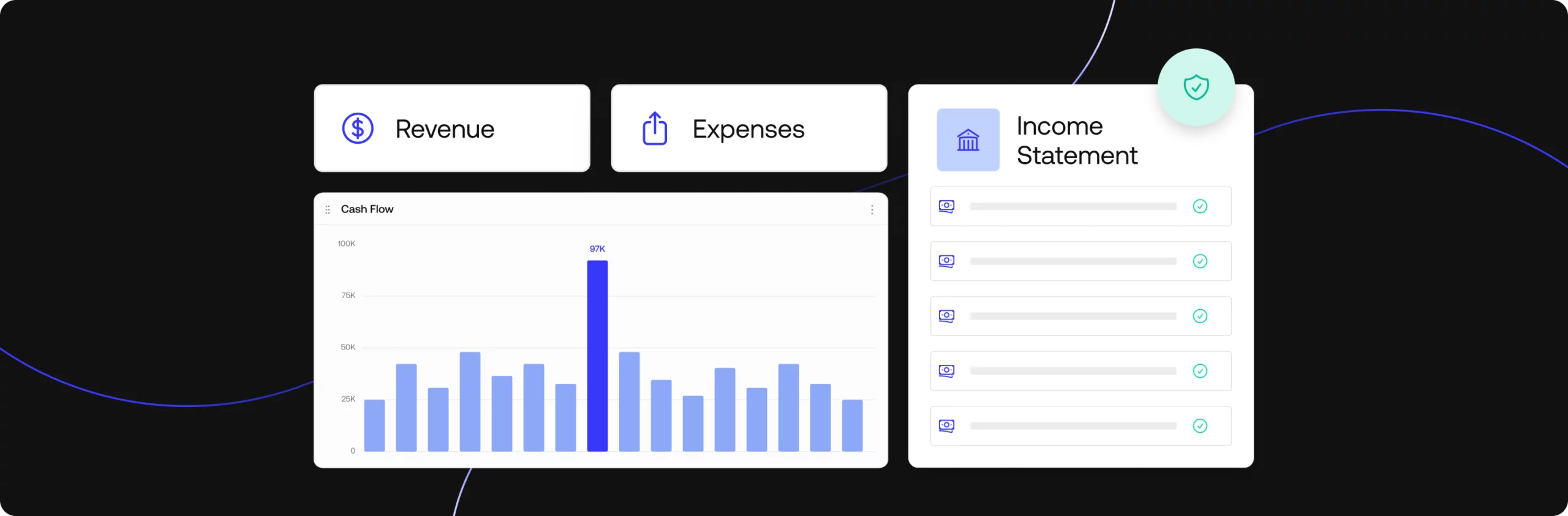
Financial reporting software is a tool that automatically compiles financial statements, dashboards, and compliance reports from a company’s accounting and transaction data. Instead of building each report manually in a spreadsheet, it pulls from connected systems, applies accounting logic, and helps maintain audit-ready reporting
What financial reporting software typically includes
Most platforms in this category -sometimes marketed as reporting software, automated financial reporting software, or financial statement software- cover the same five layers, regardless of vendor:
- Core financial statements: balance sheets, income statements, cash flow statements, and profit and loss statements.
- Connections to your accounting data: your ERP, general ledger, chart of accounts, and accounts payable/receivable, turning manual entry into automated financial reporting.
- Compliance and audit controls: GAAP/IFRS alignment, audit trails, and multi-entity consolidation.
- Analytics and forecasting: KPIs, variance analysis, and FP&A-style financial models used to analyze performance and plan ahead.
- Dashboards and management reporting software: the outputs finance and non-finance stakeholders actually see.
Vendors also sell this under names like financial statement reporting software or financial automation software: different labels, same five layers. What separates a connected platform from a spreadsheet is financial reporting automation: reports get assembled from live data instead of rebuilt by hand every cycle.
Simetrik, for example, integrates no-code with ERPs and core systems, and leaves a traceable, exportable audit trail over every reported figure.
Benefits of using financial reporting software
Beyond the definition, here’s what teams actually gain when they move from manual spreadsheets to automated financial reporting:
- Faster, more predictable close: automated data flows reduce the manual work required to assemble and validate reports at month-end.
- Fewer manual errors: connected data reduces the need to copy and paste information between spreadsheets and source systems.
- Stronger audit readiness: traceable reporting makes it easier to follow reported figures back to their source.
- More timely visibility for decision-making: automated dashboards can surface updated KPIs without requiring teams to rebuild reports manually.
- Better scalability: automation helps finance teams handle more entities, currencies, and transaction volume without increasing manual work at the same rate.
Common misconceptions about financial reporting software
Some assumptions about this category, sometimes lumped in with financial automation software or financial statement analysis software, are worth clearing up before comparing options:
Myth: it replaces your accounting software or ERP
Reality: it sits on top of your accounting software or ERP, not instead of it.
Your ERP still records transactions and owns the books – the reporting layer just organizes that data into statements, dashboards, and audit-ready reports.
Myth: it eliminates all manual review
Reality: it narrows the amount of work that requires human review.
Automated data processing and reporting handle routine work, while exceptions and judgment calls still require human review.
Myth: any dashboard tool counts as financial reporting software
Reality: a BI tool can visualize numbers, but financial reporting software specifically connects to accounting data, applies accounting logic, and maintains an audit trail.
A generic dashboard on top of an export doesn’t do any of that.
Myth: it’s only worth it for large enterprises
Reality: the trigger isn’t company size, it’s complexity – multiple entities, currencies, or a reporting cadence that’s outgrown a spreadsheet.
Some mid-size teams hit that point well before they’re considered “enterprise.”
Financial reporting software vs. accounting software and ERPs
Accounting software and ERPs – systems like Xero, NetSuite, or QuickBooks Online – record transactions and keep the books. Financial reporting software sits on top of that data to produce financial statements, dashboards, and analysis; some platforms combine both.
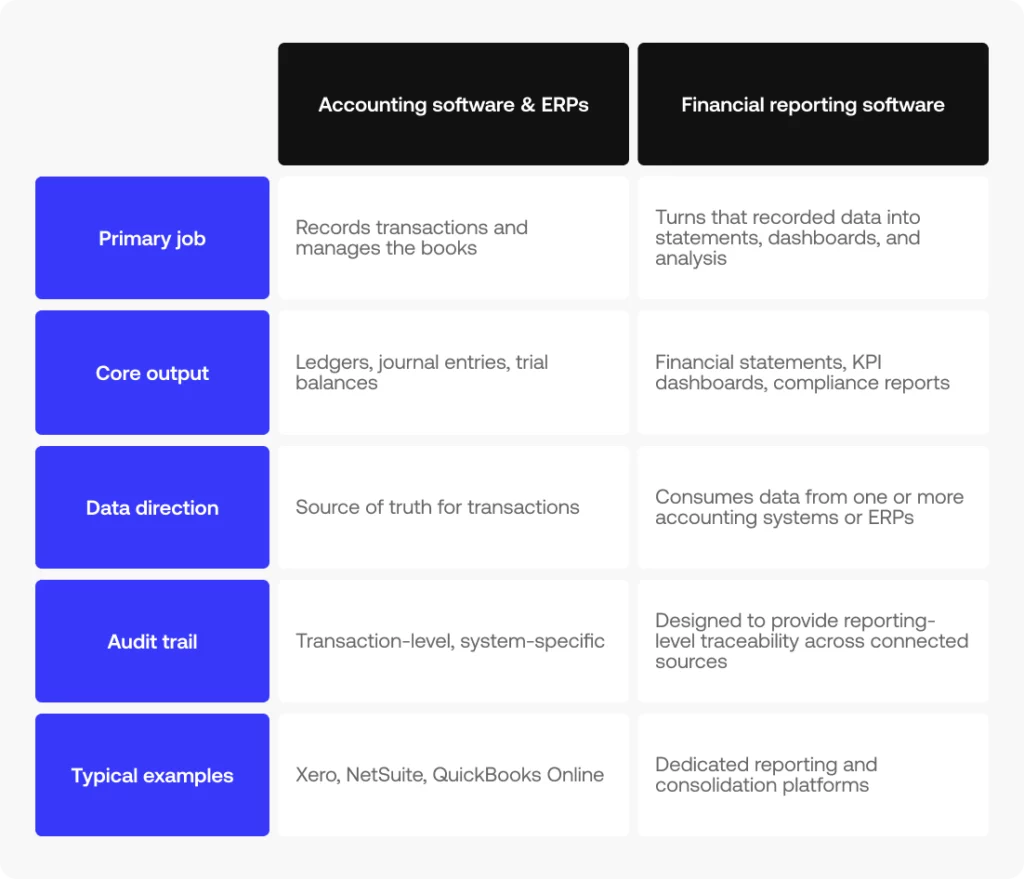
That distinction matters when you’re evaluating options: the best financial reporting software for your team is the one that plugs cleanly into the accounting system you already run, not just the one with the longest feature list.
How Simetrik approaches financial reporting
Simetrik is an AI-native financial operations control platform.
It isn’t built around financial statements or FP&A by name, but it covers several of the capabilities reliable reporting depends on. It connects to ERPs and more than 100 payment, banking, and core systems through no-code integrations, continuously syncs general ledger and subledger data, and maintains traceability back to source transactions. Finance teams can then use no-code dashboards and alerts to monitor KPIs and exceptions in real time.
For finance teams already fighting manual reconciliation before they even get to reporting, Simetrik solves the reconciled data layer that reliable financial reporting software is built on.
| See how reconciled data becomes audit-ready reporting If your reporting is only as reliable as the reconciliation behind it, it’s worth seeing how Simetrik connects the two. Request a demo |
Financial reporting software FAQs
What’s the difference between an ERP system and financial reporting software?
An ERP system, like NetSuite or QuickBooks Online, is where transactions get recorded and the books get kept.
Financial reporting software sits on top of that: it pulls the ERP’s data and turns it into statements, dashboards, and compliance reports.
Most companies need both: the ERP as the system of record, and the reporting layer to make sense of what’s in it.
Does financial reporting software help with accounts receivable?
It can surface AR data inside reports and dashboards, but it doesn’t manage the AR process itself (invoicing, collections, aging schedules).
That still lives in the accounting system or ERP. What the reporting layer adds is visibility: AR balances flow into the same audit-ready statements as everything else, instead of getting pulled manually from a separate export.
Is financial reporting software GAAP and IFRS compliant?
Most dedicated financial reporting software is built to support both GAAP and international financial reporting standards, not just generate generic statements.
That usually means built-in templates and controls aligned to whichever standard applies, plus the audit trail to back up how a number was calculated.
Companies reporting across multiple jurisdictions should confirm exactly which standards a given vendor supports, rather than taking “compliant” at face value.
Can financial reporting software handle intercompany eliminations?
Multi-entity consolidation, including intercompany eliminations, is one of the features that separates dedicated financial reporting software from a basic ERP report or a spreadsheet. It’s not universal across every tool in the category, so it’s worth confirming directly if you’re consolidating across multiple entities.
What role does machine learning play in financial reporting software?
Machine learning shows up mostly on the data side: flagging anomalies, suggesting how new data should map into existing report structures, and catching patterns a person might miss at scale.
It’s less about generating the report itself and more about making sure what feeds into it is accurate.
Is bank reconciliation part of financial reporting software?
Not directly, though the two are closely linked. Bank reconciliation confirms that transaction records match what actually happened, and financial reporting software depends on that reconciled data being accurate before it builds statements or dashboards on top of it. Some platforms combine both; others expect reconciliation to already be handled upstream.
What are customizable dashboards in financial reporting software?
Customizable dashboards let different teams see the metrics that matter to them (finance might track close status and variance, while ops looks at cash flow) without either group having to rebuild a report from scratch.
The underlying data is the same. What changes is which slice of it gets surfaced, and to whom.
What does data consolidation mean in financial reporting?
Data consolidation is the process of combining financials from multiple entities, currencies, or systems into a single, comparable set of numbers, usually a step required before multi-entity reporting or intercompany eliminations can happen.
Without it, each entity’s data stays siloed and someone has to reconcile totals by hand.
Is financial planning and analysis the same as financial reporting?
They’re related but distinct.
Financial reporting looks backward, compiling statements and dashboards from what already happened. Financial planning and analysis (FP&A) looks forward, using that same data to forecast, budget, and model scenarios. Reporting is usually the foundation FP&A builds on, not a replacement for it.
Does financial reporting software include expense management?
Not usually as a core function. Expense management (capturing receipts, approving spend, categorizing transactions) typically lives in a separate tool or an ERP module. Financial reporting software picks up downstream of that: once expenses are recorded, it pulls them into reports and dashboards alongside everything else.
How does data visualization fit into financial reporting software?
Data visualization turns reconciled financial data into charts, KPI cards, and trend lines instead of raw tables. It’s less about the underlying accuracy of the numbers and more about making patterns (a variance spike, a cash flow dip) visible at a glance instead of buried in a spreadsheet.
Can financial reporting software help with financial forecasting?
Some platforms extend into forecasting, using historical reported data to project future performance, but it’s not a given across the category. Dedicated FP&A tools tend to go deeper here; financial reporting software’s core job stays closer to reporting what already happened rather than modeling what’s next.
Does financial reporting software show retained earnings?
Retained earnings typically appear on the balance sheet and the statement of changes in equity, both of which financial reporting software can generate automatically from connected accounting data. The software surfaces the number; the underlying calculation still depends on what’s recorded in the general ledger.
Does financial reporting software handle data migration?
Not as a primary function, though most platforms need some form of it during setup, pulling historical data from ERPs, spreadsheets, or legacy systems into the new environment. Once that initial migration is done, ongoing data flow happens through live connections rather than repeated manual imports.
Next step: see financial reporting software features in detail
Now that you know what financial reporting software does and how it differs from your ERP or accounting system, the next step is understanding which capabilities matter most. See the key features of financial reporting software to know what to evaluate.