Category: News

How fast-growing fintechs fix reconciliation at scale

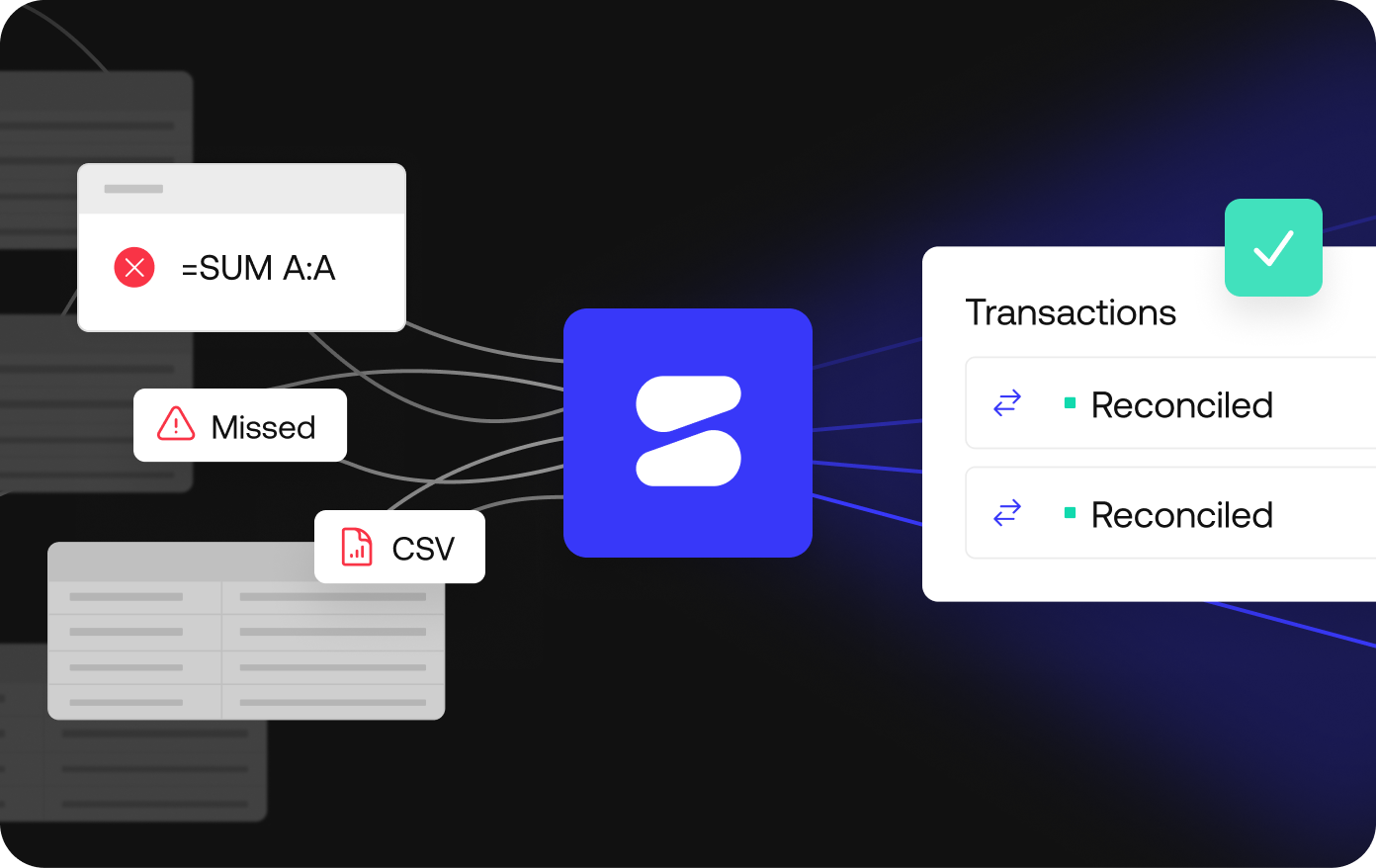
When companies scale quickly, the first cracks often appear in back-office processes. Reconciliation is usually the most visible and the most painful. Teams start each morning inside spreadsheets, pulling CSVs from processors, painstakingly matching transactions, and hoping the numbers line up. But while manual workarounds might be sufficient at a small scale, they quickly turn into structural risk as volumes explode and partners multiply.

This is a familiar story: multiple bank and processor accounts, dozens of payment stakeholders, hundreds of thousands of daily entries, and activity spread across many time zones all contribute to a level of complexity that’s hard to reign in. 

At scale, reconciliation must work for everyone. Finance leadership needs speed and reliability, operations wants transparency and control, and everyone is asking for a single source of truth. In this post, we break down the real problems behind manual reconciliation and how an automation-first approach with Simetrik turns daily firefighting into a durable operating model.

The cost of spreadsheet-driven reconciliation
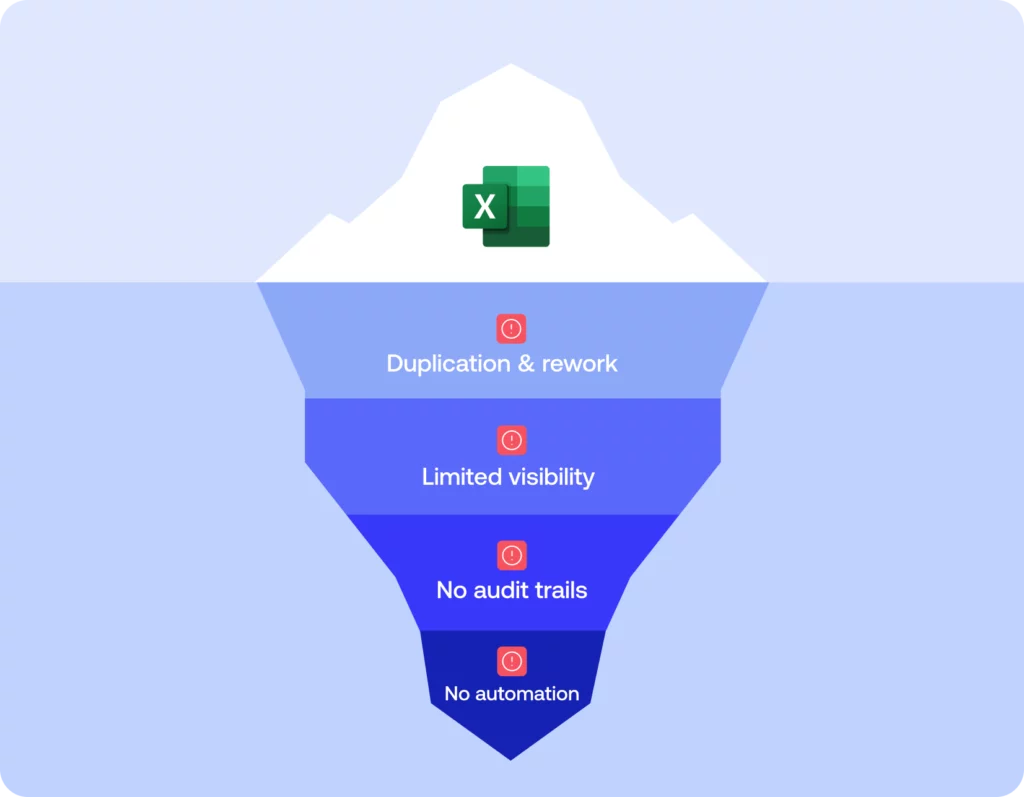
Spreadsheets are flexible and fast at the start. At scale, however, they create hidden costs that compound daily.

Instead of a single, cohesive view of transactions and financial data, spreadsheets only offer a disparate snapshot of the numbers at any given point in time. There’s no way to accurately pinpoint what’s reconciled, what’s pending, or where risk is concentrated across the organization. Context lives in people’s heads and scattered tabs, not in a scalable system.

Take this recent story: The Federal Reserve Board and the FDIC imposed a total of $250 million in civil penalties on Discover Financial Services for overcharging merchants on interchange fees and failing to tell them. That’s on top of the $1.2 billion they already agreed to settle a class action lawsuit over card misclassification.

Could this all have been remedied by better recordkeeping? Maybe. When things go wrong, you don’t want to present outdated, untraceable spreadsheets or messy legacy system files to your auditors. Using an industrial-strength, proven system is a much better way to face off with a regulator in any region.

The cost of spreadsheet-driven reconciliation is due to several factors:

  • Duplication and rework that wastes hours and adds risk
  • Limited visibility that stunts leadership’s ability to make decisions
  • Lack of clear, immutable audit trails needed for compliance
  • Lack of automation, with experience analysts reduced to data movers

These are not simply inconveniences. They are control failures waiting to surface. And the higher the transaction volumes, the worse these failures will be.

Why volume breaks spreadsheets and how to fix it

The largest PSPs and marketplaces process millions of transactions a day. At that scale, two things matter most. First, you must reconcile at the transaction level, not only by balance. Second, you must do it without forcing humans to wait on a screen.

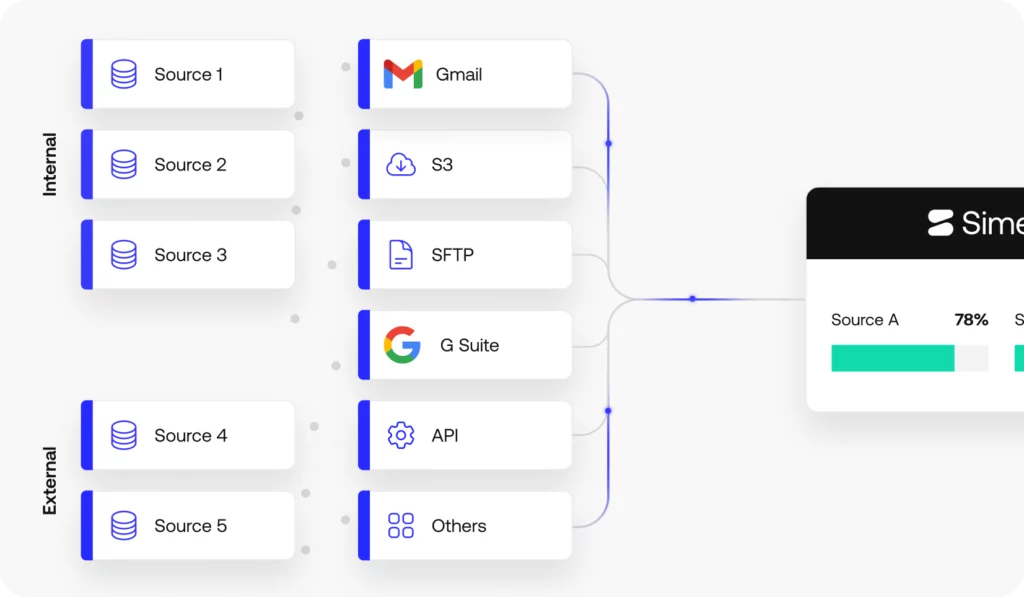
To accomplish this, you need a system that ingests data from processors, banks, and internal systems in parallel, normalizing heterogeneous files and APIs into a standard schema. When the massive burden of data management is automated, analysts can focus on the tasks that need manual attention, working from a live queue of exceptions rather than full datasets. 

The outcome is far greater efficiency. Opens get cleared the same day. Aged items shrink and stay visible. No one builds intermediate spreadsheets to make the tools work. Performance is constant whether you process ten thousand or ten million rows. 

Modern reconciliation platforms like Simetrik were built to usher in this change. 

What modern reconciliation should deliver by default

A modern reconciliation platform improves visibility, efficiency, and traceability by providing end-to-end financial control, from transaction record ingestion to compliant reporting.

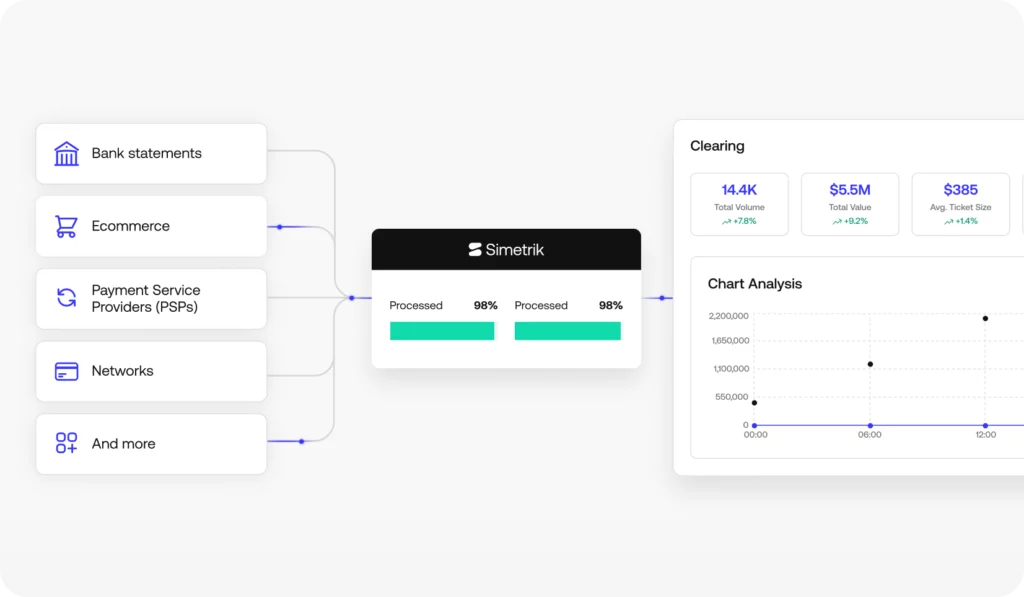
In practice, it’s one place to see everything related to finance operations and money movement. All accounts, partners, and processors are in a unified dashboard with real-time status on transactions processed, fees charged and incurred, what’s cleared vs. outstanding, and dozens of other metrics that matter to the office of the CFO.

The only way to consolidate and validate this kind of data at enterprise scale is by using AI-driven, intelligent matching and reconciliation logic to automate the work that spreadsheets and workarounds can’t – all while giving the finance team complete control. 

When considering a modern reconciliation platform, check for these critical features:

  • AI-driven matching. Configurable rules and logic that automatically ingest, normalize, and enrich transaction data with disparate formats, currencies, and fields.
  • Enterprise-grade infrastructure. Elastic compute so performance scales with volume without slowing analysts down.
  • Granular access control. Configurable profiles that give reconcilers, engineers, finance leaders, and other stakeholders the level of access and visibility they need. Every action is permissioned and recorded for audit trails.
  • Collaboration across teams. Customer support and payments operations can view and update the status of items that need their action, no forwarding spreadsheets required. Context and conversation stay attached to the underlying transaction.
  • A real audit trail. Immutable logs of every match, change, note, and approval, with timestamps and user attribution. Evidence is built into the workflow, not recreated later.
  • Automated close workflows. Roll-ups for fees, failed payments, chargebacks, and more without the scramble. Audit ready, compliant reports configured to relevant standards.

These features not only reduce risk and cost by streamlining reconciliation, they allow you to get new financial products to market faster while still guaranteeing security, traceability, and profitability.

How Simetrik aligns with your operational reality

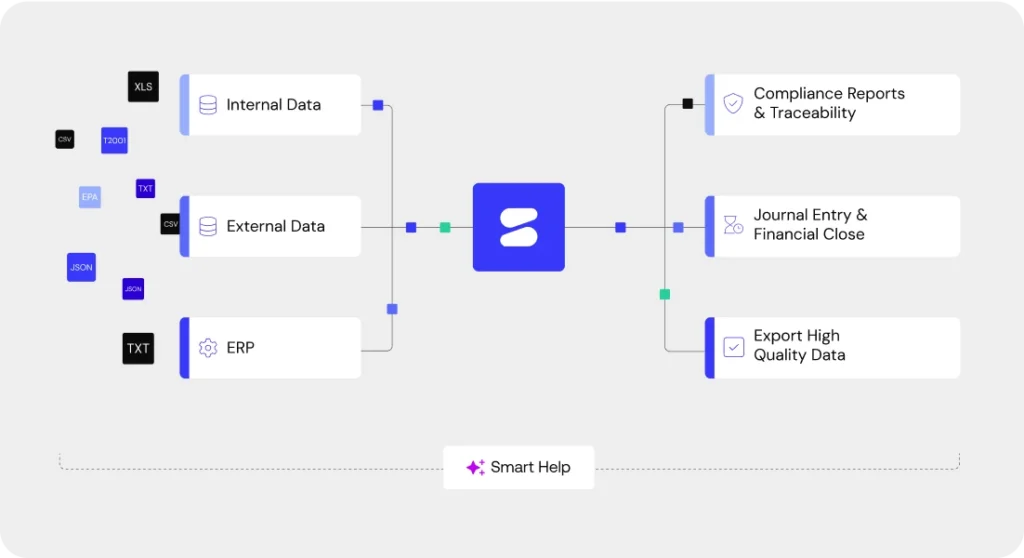
Simetrik is an AI reconciliation platform that’s designed to solve your real-world challenges in scaling finance operations. It automates and streamlines the reconciliation process from beginning to end, starting with enterprise-grade data ingestion and management and ending with advanced workflows powered by your reconciled data. 

The use cases for Simetrik are nearly limitless – our customers use real-time, transaction-level data to power forecasting and risk models, automate collections and customer outreach, and shore up losses due to miscalculations in the reconciliation process. But they all have one thing in common: they can move faster and smarter without giving up control.

From data movers to investigators

By adopting an AI reconciliation platform, you allow analysts to take on a more impactful, strategic role. They can see discrepancies and exceptions in their dashboard, along with all the context they need to investigate and resolve the issue.

With Simetrik, exceptions arrive enriched with the fields that help you act. Counterparty, flow type, currency, amounts, references, prior attempts, and related items are presented together. Ownership is assigned automatically based on rules. Notifications bring in the right teammate from support or payments when their input is needed.

Analysts spend their day resolving, not assembling. They close items, add root cause codes, and propose rule changes when patterns emerge. Managers see throughput, backlog age, and the value at risk by team and partner. Leadership gets a clear view of operational health and financial exposure, not a stack of spreadsheets.

Reporting that’s ready to share and act on
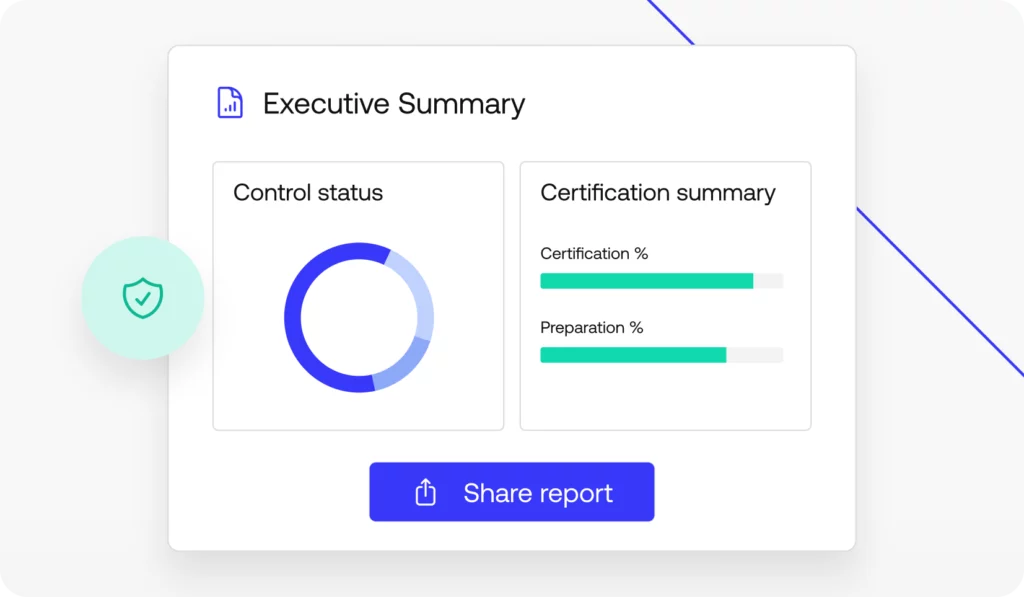
Most teams still struggle with reporting at the end of a period. Lack of traceability, manual data collection, and missing information all make it difficult to close fast without errors.

Regulatory requirements and internal protocols add complexity to reporting, too. Documentation must meet the requirements of each organization, region, and regulatory body, often adding days of prep onto an otherwise-finished close process.

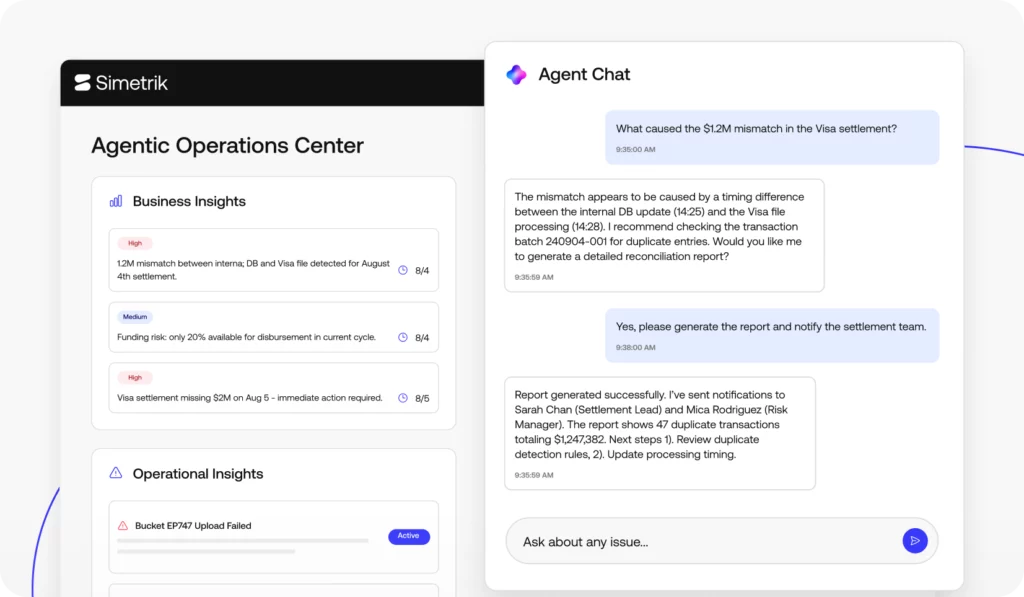
Simetrik turns commonly required information and recurring questions into easily accessible answers. When users ask Simetrik’s AI agent questions like, “Which partners drive most exceptions this quarter?” or “Which accounts are consistently closing late?”, they’re saved for future use in reporting. The platform also generates compliant documentation for the standards and reporting requirements most relevant to your business.

These reports are always on and drillable to the underlying transactions. Finance doesn’t wait for operations to compile data. Operations doesn’t rebuild the same pivot table for the tenth time.

Integrations that keep systems aligned

Fast-growing companies often implement accounting systems on a separate track from operations. Reconciliation then becomes a bridge between external movement and internal books. That bridge needs to be stable.

Simetrik connects to banks, processors, ledgers, and data warehouses. It publishes cleared positions and exception summaries downstream. It ingests reference data upstream so matching rules reflect reality. If you are still in the process of standing up an ERP, Simetrik can export structured files that slot into your current process immediately. When you are ready for deeper integration, you already have consistent data and a clean audit trail.

What the first 90 days look like

Teams often ask how to move from today’s spreadsheet reality to a controlled operating model without losing momentum. At Simetrik, we’ve designed a path that’s straightforward and optimized for your success.

  • Week 1-4: Connect the highest volume processors and bank accounts. Mirror today’s matching logic inside Simetrik. Start clearing exceptions in the platform while keeping spreadsheets as a shadow for comfort. Deliver the first executive dashboard that shows completion and aged items.
  • Week 5-8: Retire spreadsheet workflows for in-scope accounts. Add rule stages that reduce manual touches. Turn on ownership routing and notifications. Introduce notes and reason codes for learning. Publish monthly reports directly from the platform.
  • Week 9-12: Expand coverage to remaining accounts and partners. Tighten access profiles. Enable maker checker on sensitive actions. Integrate with your downstream systems or automate file exports. Conduct the first month-end close entirely from Simetrik with a postmortem on remaining gaps.

This approach keeps risk low and momentum high. Value lands in the first month, and confidence grows as exceptions shrink and reporting becomes self-service.

Finding ROI: seeing fast outcomes on Simetrik
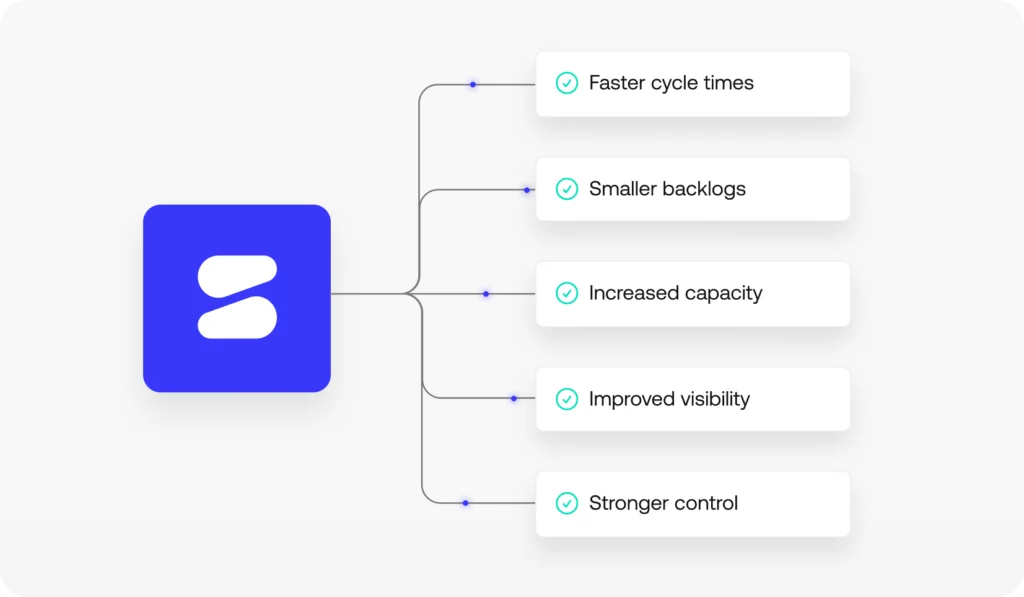
Moving to Simetrik leads to tangible and repeatable results in as little as a few weeks. The larger your scale, the more impact you’ll see – the platform finally consolidates data and workflows across many global partners, disparate files and formats, and your own distributed processes. 

Here’s what Simetrik customers see once they deploy:

  • Faster cycle times. Most exceptions are resolved on the same day, with no month-end redo because the system reconciles continuously.
  • Smaller backlogs. Aged breaks are visible, prioritized, and owned. Items don’t get lost because a row was not copied forward.
  • Increased capacity. Analysts spend their time investigating and fixing root causes. Teams can handle higher volumes without adding headcount at the same rate.
  • Improved visibility. Leaders see risk by value and by age, broken down by partner and flow. Finance closes with confidence because exceptions and adjustments are traceable.
  • Stronger control. Every action is logged, rule change versioned, and approval flow enforced. Audits become a walkthrough, not a reconstruction.

You need a platform that is powerful yet easy to adopt, respects roles and keeps people accountable, and generates the reporting finance needs without creating new work for operations.

Simetrik is built for exactly this environment. We combine robust data ingestion, flexible matching, granular access, and rich auditability in one product, transforming reconciliation from a spreadsheet nightmare into an operational strength that scales with you. Request a demo of Simetrik here and see how easy it is to adopt AI reconciliation.

Managing liquidity in an age where money moves faster than ever

The payments landscape is a multi-trillion-dollar industry that touches nearly every corner of the world. Transactions increasingly happen in near-real time across many participants — the average payment touches 5-7 intermediaries, and platforms and marketplaces now process an estimated 30% percent of global consumer purchases.

This complexity greatly complicates the role of treasury and finance teams. Variance among currencies, settlement times, and data management protocols makes it hard to track liquidity and accurately apply cash at scale, often leading to millions of unaccounted-for dollars a year. 

How can the office of the CFO tackle liquidity and forecasting challenges when money moves faster than it ever has? Keep reading for the answer – and a look into the emerging world of AI reconciliation.
What’s so hard about liquidity management?

Treasury and finance teams used to be able to rely on batch settlement data to understand their cash positions. With the proliferation of flexible payment methods and new payment services, complexity grew. 

The addition of real-time payment (RTP) networks brings even more nuance and risk to the market. These new payment rails give businesses faster ways to handle payroll, pay out merchants, and manage AR/AP – they also tend to push internal reconciliation and finance teams to the limit.

The challenges to managing liquidity effectively today include:

  • Funds come and go many times throughout the day. Without a continuous tracking system, finance teams can’t be sure enough cash is available at any given point.
  • Settlement times vary and don’t always coincide with transaction time stamps. Bank balances may be off by thousands of dollars, leading to poor funding decisions, unplanned fees, and unnecessary panic. 
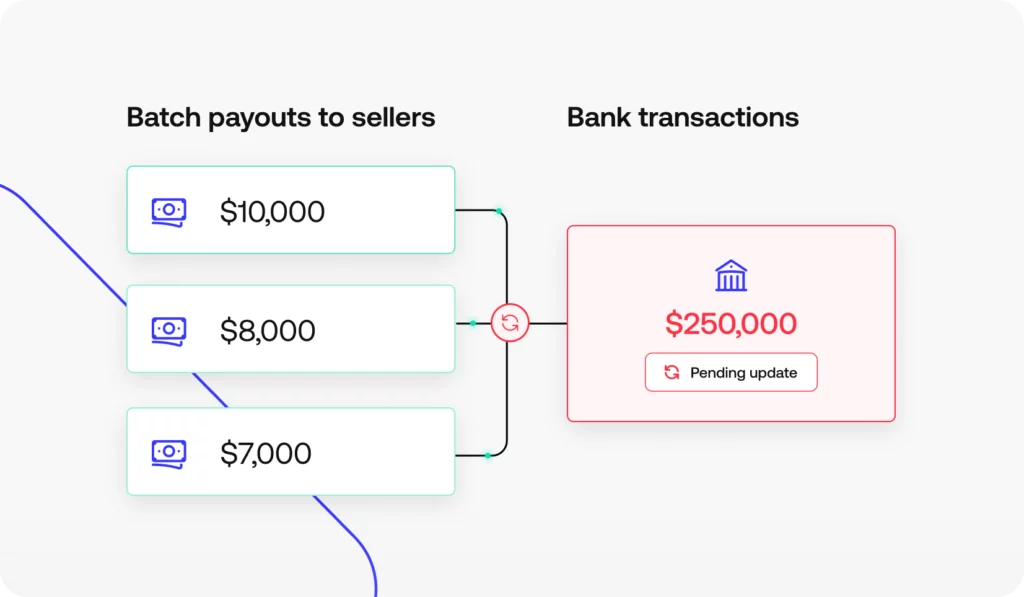
  • Batch payments don’t map back to individual transactions. This adds hours of manual reconciliation to ensure cash and fees are applied correctly.
  • Discrepancies and errors slow reconciliation and make it hard to calculate cash on hand. 

Move too cautiously, and the opportunity cost is steep. Cash sits idle in accounts instead of being deployed to fund growth or reduce short-term borrowing. Move too aggressively, and you risk the opposite problem.

Underfunded RTP accounts, for example, can break funding agreements with sponsor banks – the very relationships that make instant payments possible. Without timely reconciliation, teams may not realize how quickly real-time payouts are draining balances until transactions start failing.

Cross-border settlements introduce another layer of complexity. Funds often pass through multiple correspondent banks and FX providers before reaching their destination. When timing or conversion delays aren’t captured immediately, treasury teams can mistake in-transit balances for available cash, exposing the business to liquidity gaps and currency risk.

Merchant payouts add risk, too, as marketplaces and retailers often pay merchants ahead of card network settlement. Without clear visibility into pending inflows, finance teams may overextend working capital, effectively funding payouts with money that hasn’t yet arrived.

To accurately monitor liquidity and maintain a clear line of sight into balances, AR, and AP across  your entire payments ecosystem, look no further than reconciliation. 

The role of reconciliation in understanding liquidity 

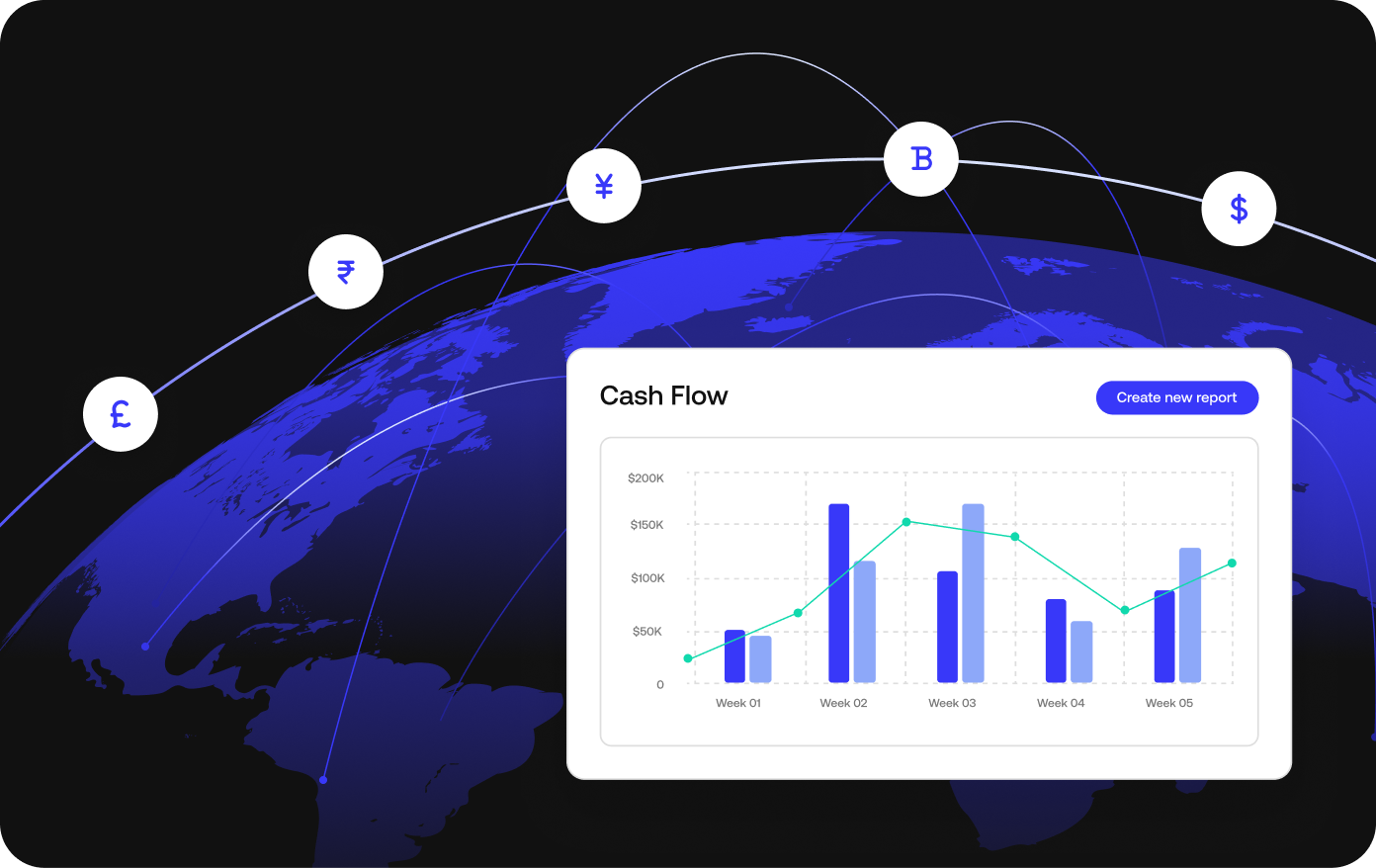
Reconciliation helps finance teams manage liquidity and cash flows by maintaining accuracy and financial integrity at every step of every transaction.

At the most granular level, the reconciliation process validates and matches transaction records across all parties. At a higher level, it ensures operational balances accurately reflect the reality of the company’s cash position.

Once reconciled, the data can be used to make all kinds of decisions about liquidity: whether to acquire more funding, what payment terms to offer or accept, how to allocate working capital, and many more. 

But while AI and automation have transformed other key enterprise workflows, too many companies have yet to invest in modern reconciliation solutions that can handle the volume and complexity associated with real-time, global payments today.

The problem with legacy financial platforms

Many finance teams still rely on manual entries, spreadsheets, and brittle systems that can’t paint a real-time picture of cash flows and liquidity. Even with a strong treasury management system (TMS), the gap between balances shown in banking systems or financial analytics tools vs the reality of minute-by-minute transactional data leads to substantial discrepancies and excess costs.

Legacy, manual solutions aren’t just slower, they suffer from poor interoperability – too many disparate data formats, currencies, and protocols muddy visibility and hinder finance teams’ ability to use reconciled data for critical decision-making around liquidity. 

Fragmented tech stacks also force engineering to spend time on costly integrations and workarounds, rather than working on initiatives that will eventually drive revenue. The bottom line? It’s expensive to stick to the status quo.

AI-powered transaction reconciliation: the key to transforming liquidity management

AI reconciliation gives finance teams the tools they need to understand their cash position and make profitable decisions around working capital and funding. Modern reconciliation platforms automate the majority of transaction processing and reconciliation while maintaining complete control, generating accurate dashboards and reports to drive smarter liquidity decisions. 

These newer, AI-enhanced systems are designed to handle exactly the kind of high-volume, complicated transaction data that enterprise finance teams struggle with. Each incoming and outgoing payment is instantly validated, matched across every party involved (PSPs, real-time payment rails, card networks, etc.), and applied to the correct customer and account. 

Unlike legacy and manual solutions, AI reconciliation centralizes all of your transaction and finance operations data into a single source of truth, enriching records and filling in gaps automatically so balances can be updated in real time. This results in a complete, clear picture of your cash position at any given point in the day, as well as granular transaction data that can be used to optimize prefunding on real-time payment rails. 

Treasury and finance decision-makers can log into their TMS, business intelligence tools, ERP, or any other connected system and work from the same data, eliminating the guesswork from liquidity management altogether.

Strengthen liquidity with complete visibility and control on Simetrik

Simetrik is an AI reconciliation built for highly complex, heavily regulated finance operations where liquidity management depends on real-time visibility. 

The platform ingests transaction data from any source and system, processing it according to configurable, AI-driven logic. Every incoming payment is applied instantly to the right invoices and updated in your ERP to paint a complete picture of your cash position—even if settlement hasn’t happened yet.

This level of automation and efficiency lets your finance team focus solely on exception management and accurate forecasting. Simetrik ensures that:

  • Operational balances always accurately reflect transaction data
  • Prepayments and credits are factored into cash positions
  • Batch payouts and bulk payments from PSPs are automatically disambiguated
  • Follow-up on aging receivables is automated to collect more revenue
  • Fraud and risk models are improved with trusted, reconciled data
  • Errors and discrepancies are automatically addressed upon discovery
  • Data in your TMS and ERP reflects true liquidity levels

Simetrik helps finance and treasury teams transform their operations while maintaining global governance and control. To learn more about how our AI reconciliation platform improves liquidity and drives profitable decision-making, explore our solutions or get in touch with us to schedule a demo.

From “Where’s that transaction?” to “All matched—next!”: A guide to modern payments reconciliation

If you work in card payments, you already know the feeling: a network file lands at 3:07 a.m., a processor export shows up at 3:12 a.m., and by 9:00 a.m., your operations team is trying to explain why a handful of transactions don’t line up with anything. Somewhere, a compliance partner is asking for sub-merchant chargeback trends. Somewhere else, an engineer is rewriting a rule and planning yet another redeploy.

With automated reconciliation, you’ll never have to deal with this scenario again. Simetrik’s reconciliation platform streamlines transaction processing and matching in one place, simplifying all the downstream workflows that follow. 

This post turns a live platform walkthrough on the platform—centered on reconciling processor files (think Stripe/Checkout.com) with network files (Visa/Mastercard) and then packaging the results for finance, ops, and compliance—into a practical blueprint for cost and variance control, optimal liquidity, and stress-free regulatory reporting.

The reality on the ground

Here’s the truth most teams quietly share:

  • Data variety is exploding across many participants, systems and formats, and s in the payments value chain. Networks, processors, gateways, banks, internal ledgers, ERPs, bank statements, settlement files, dispute/chargeback feeds—each with its own lifecycle and set of processes.
  • Rules change constantly. Networks revise specs and set mandates, partners add columns, merchants expand cross-border, and your team adds new products (like instant payments or a crypto wallet) to stay competitive in the market.
  • Engineering is a bottleneck. Your rules live in code. Adjustments require a PR, a redeploy, and cross-team coordination. That’s not “operations”—that’s software development.
  • Visibility is fragmented. You can produce totals for billing (mostly). But surfacing discrepancies, their root causes, and sub-merchant trends on chargebacks? That still takes a hunt through SQL, email threads, and some good luck.

If any of that reads a little too familiar, keep going.

The five tenets of modern reconciliation (and how Simetrik implements them)
1) Ingest anything, as-is

Goal: Treat inbound data like a first-class citizen, not a problem to be “pre-cleaned.”

How it works in practice: Simetrik Sources accept raw files—network packages, processor exports, bank statements, dispute/chargeback feeds—exactly as they come. If a single PDF or flat file contains 30 tables, we extract the tabular parts, keep each table as a distinct Source, and retain the original structure for audit. No pre-transformation scripts, no brittle staging jobs. Just drop files via SFTP/secure bucket/API and let the platform build structured tables that “look like a spreadsheet” but scale to billions of rows.

Why this matters: It short-circuits the classic “we’ll fix the data before it hits the tool” trap. You won’t. And you shouldn’t have to.

2) Normalize for resilience (hello, Source Union)

Goal: Make format drift a non-event.

How it works: Simetrik’s Source Union maps heterogeneous partner files to your standard schema. If Visa changes a column name next Tuesday or a processor inserts a new field on Thursday, you remap in the UI, keep your history intact, and move on. You can unionize dozens—or hundreds—of partner sources into one “canonical partner feed,” then compare that to your internal ledger, your network settlements, or both. Best of all, Simetrik’s AI, through its suggestions and normalization, and autocomplete features, guides you and makes the process even easier.

Why this matters: Reconciliation shouldn’t break because someone added Ref2 next to Ref1. Normalization is an operational capability, not a one-off project.

3) Match with no-code logic (rules and rule sets)

Goal: Put the brain of reconciliation where it belongs: in the hands of the operations and finance teams who own the outcomes.

How it works: Simetrik lets you define Rules (e.g., amount = amount, currency = currency, date within T+1, reference A ~ reference B) and group them into Rule Sets with priority. Start strict—amount + currency + multiple references + settlement date tolerance; then gracefully relax (e.g., fall back to a secondary reference parsed from a long string). Add as many Rule Sets as you need. There’s no hard limit; some customers operate in the triple digits for maximal automation.

Why this matters: You shouldn’t open a ticket to tweak matching logic. Period. When operations can adjust rules in minutes, discrepancies stop piling up, engineers get their weekends back, and audit trails get clearer, not messier.

4) Analyze results like a product, not a spreadsheet

Goal: Turn reconciled outputs into living intelligence.

How it works: Every reconciliation produces a results table (again, think spreadsheet UX with database scale). From there, build dashboards to answer the real questions:

  • What % reconciled today, and what’s the value of the delta?
  • Which partners or geographies contributed most to unreconciled volume?
  • Which Rule Set cleared each transaction? (For audits, this is gold.)
  • Where are fee variances, FX impacts, and take-rate swings?
  • What’s the chargeback rate over time per sub-merchant, brand, BIN, or country?
  • Are processors complying? Where’s my CBK data? Was it all booked right?

You can go from transaction-level detail to executive summaries in a couple of clicks – and back again-, and you can export or schedule the reports you owe to clients and regulators.

Why this matters: Reconciliation is not just “making files equal.” It’s a control function and an analytics function. Treat it like one.

5) Control the process (alerts, SLAs, and completeness checks)

Goal: Put exceptions on autopilot

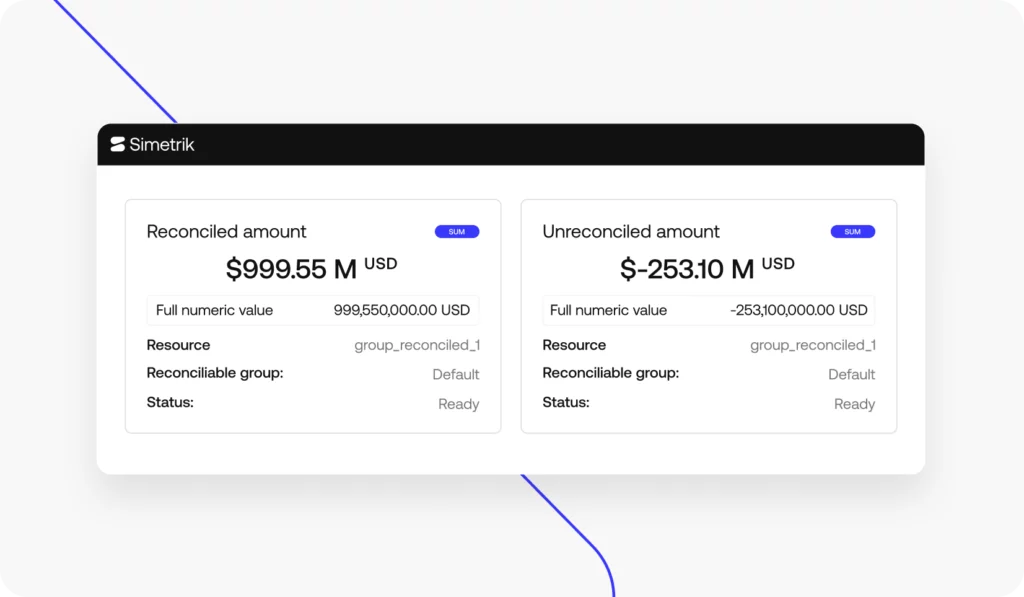
How it works: Set thresholds and alarms across the lifecycle: “Expected file not received,” “reconciled rate < 99.5%,” “chargeback rate for Merchant X > Y% day-over-day,” “fee variance exceeds tolerance.” Route alerts to Slack/email, open a task, and attach the exact rows in question. You can also track amounts, not only counts—because three unreconciled transactions totaling $250,000 are more urgent than 300 for $12.60.

Why this matters: Controls are what separate a working process from a nightly fire drill.

A walk-through: reconciling processor vs. network, end-to-end

Let’s put the pieces together in the most common payments-ops flow.

Step 0: Drop files
  • Acquirer processor daily transactions (e.g.,Global Payments, Fiserv)) → SFTP folder.
  • Network settlement package (Visa/Mastercard) → SFTP folder.
  • (Optional) Bank statement & dispute/chargeback feed → SFTP folder.

Simetrik picks them up automatically and renders them as Sources.

Step 1: Normalize partners
  • Use Source Union to map and enrich processor files into a common structure (dates, amounts, currencies, multiple reference columns).
  • Keep a separate union for network files if needed.
Step 2: Prepare the data
  • Add enrichment columns (purple columns in the UI): fees per txn, FX conversions, derived references extracted from long strings, standardized timestamps, etc. These are formula-like, documented, and auditable.
Step 3: Define matching
  • Rule Set 1 (strict): amount == amount, currency == currency, auth/reference match among any of {R1,R2,R3}, settlement date within tolerance, identical payment method.
  • Rule Set 2 (fallback): If R1 fails, parse fallback reference from long entry string; allow ±1 day settlement drift; permit minor rounding differences.
  • Rule Set 3 (edge cases): Gateway-specific quirks, cross-border FX rounding thresholds, partial captures/refunds logic.

Priority executes top-down. Each matched pair records which Rule Set did the job.

Step 4: Review results
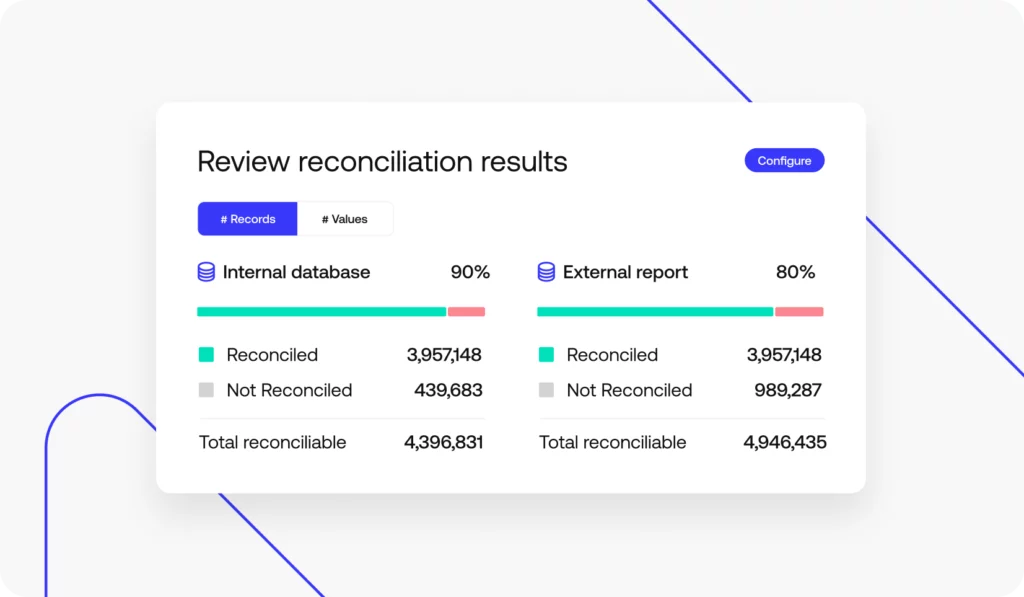
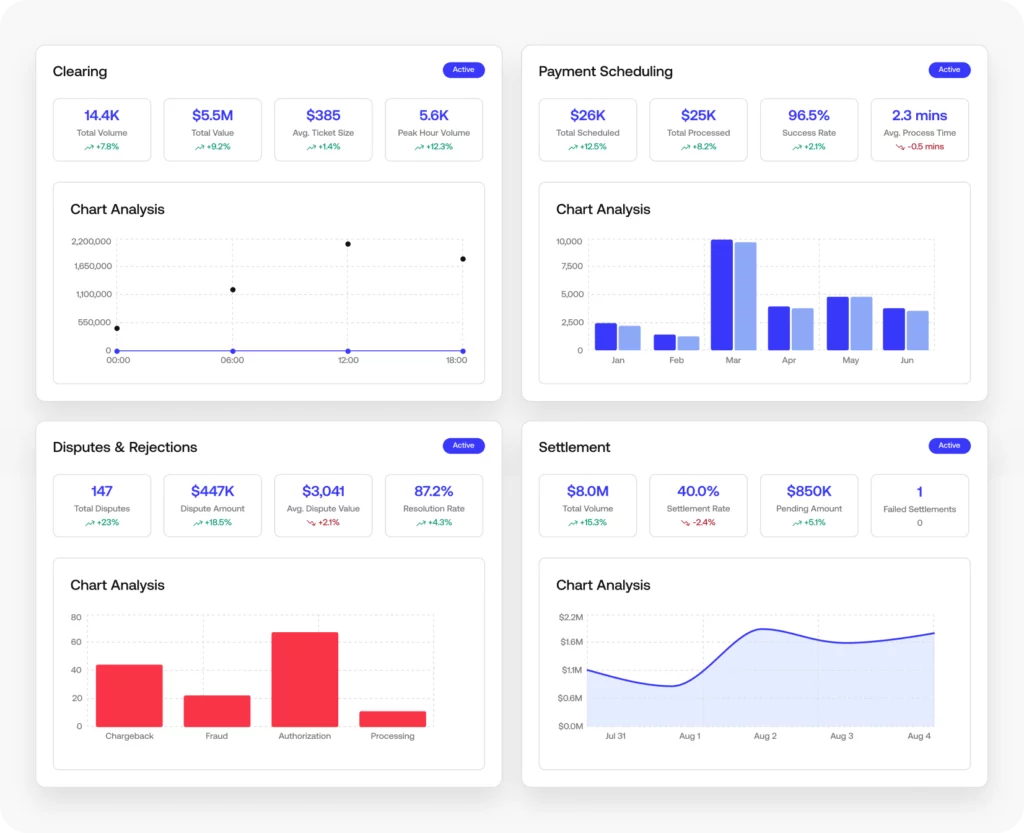
  • Dashboard shows total records, matched %, unmatched count, and unmatched value.
  • Drill into unreconciled transactions by partner, payment method, merchant, and geography. See the exact reason each row failed (e.g., missing reference, amount variance, settlement drift beyond tolerance).
Step 5: Act and export
  • Trigger alerts if KPIs fall below thresholds.
  • Export client-facing reports (daily summaries, settlement confirmations, fee breakdowns) automatically.
  • Keep the audit trail: original raw data, transformations, rule logic, user actions, timestamps.

That’s the flow. No redeploys. No “who changed the rule last week?” Just operational control.

Chargebacks & sub-merchant visibility: the compliance must-haves

Card networks expect principal members and their sponsor banks to know their sub-merchants: volumes, chargeback rates, and how those metrics change over time. In practice, that means two things:

  1. Unify the view. Chargeback feeds often live in their own silo. Bring them into the same model as authorizations, captures, refunds, and settlements. When a chargeback deduction has no underlying transaction match, flag it as revenue leakage and quantify the impact.
  2. Trend granularly. Track chargeback rates per sub-merchant, per brand, per country, per BIN, daily. Alert on spikes. Show both counts and amounts. For teams that report to networks, regulators, or enterprise merchants, being able to slice and ship that report in minutes is the difference between “we’re on top of it” and “give us a week.”

Simetrik’s analysis module was built for exactly this level of slicing. If you can describe the cut, you can chart it—and schedule it.

Performance and scale: two non-negotiables

A common question: What happens when we run a million transactions through dozens of Rule Sets?

Short answer: the system is designed for it. Customers run into the hundreds of millions of records per day across multiple reconciliations, with execution measured in minutes. Matching is parallelized, transformations compile down efficiently, and unions avoid the rework of one-off pipelines. The practical benefit: teams can ratchet up automation (more Rule Sets) without worrying that each new edge case will drag the nightly run into the next day

Build vs. buy: the honest math

If you’re already halfway through building an in-house reconciliation platform, you’re not alone. Many teams start there. The core trade-offs we see:

  • Time to adapt: In-house rules = code = sprint time. Simetrik rules = UI = minutes. The gap compounds every time a spec, partner, or product changes.
  • Coverage: In practice, internal platforms hit ~60% coverage first, then progress slows as long-tail exceptions consume engineering cycles. Simetrik flips that: operations expand rules as they learn, quickly squeezing the tail.
  • Auditability: Regulators and auditors love an immutable source record, clear transformations, and a row-level trail of which rule matched what. You can build that in-house, but it takes a lot to build it well.
  • Opportunity cost: Every hour your engineers spend on reconciliation is an hour not spent on customer-facing features, risk systems, or issuer/acquirer enhancements.

Simetrik prices by data processed (not by number of rules, users, or dashboards), which aligns incentives: bring more sources in, automate more reconciliations, and expand visibility without worrying that “one more use case” breaks the budget.

What “good” looks like after go-live

Within a few cycles, teams that implement a universal reconciliation approach typically report:

  • >99.95% matched daily, with the remainder explainable and trending down.
  • Exception queues that are focused, small, and attributable (e.g., “missing network reference for Processor X on YYYY-MM-DD”).
  • Automated reporting to networks, merchants, partners, and internal finance—delivered on time, with the same definitions every day.
  • Chargeback intelligence delivered by sub-merchant and geography, with alerts on spikes and easy exports for network reviews.
  • Fewer tickets to engineering, because ops owns the knobs. Developers still build, they just build things that move your product forward.

The best part is, your next integration doesn’t mean “start a new mini-project.” It means “add a Source, update the Union mapping, extend a Rule Set.” It’s an entirely different operating model.

A short plan you can actually follow

If you want to test whether this approach works for your stack, here’s a pragmatic six-week outline:

  1. Week 0–1: Connections. Set up SFTP/API to drop processor, network, and (optionally) bank/chargeback files daily.
  2. Week 1–2: Normalize. Build the Source Union(s) for processor and network feeds. Add 3–5 enrichment columns you know you’ll need (fees, FX, parsed references).
  3. Week 2–3: First reconciliation. Define 3–5 Rule Sets to cover 80% of volume. Run two weeks of historical data to validate.
  4. Week 3–4: Exceptions & dashboards. Create unreconciled root-cause views. Stand up chargeback and sub-merchant dashboards. Enable alerts.
  5. Week 4–5: Iterate. Add long-tail Rule Sets to squeeze remaining exceptions. Validate exports your clients need (CSV/XLS, SFTP delivery).
  6. Week 6: Review. Compare run-time, match rates, and effort against your in-house baseline. Decide whether to expand to additional networks/processors or add bank settlement reconciliation.

It’s deliberately lightweight. The goal is proof—of-coverage, of control, and of speed.

And if you use our pre-configured solutions, available for specific partners such as Visa and Mastercard, you can cut this time in half.

Final thought: make reconciliation boring (in the best way)

Reconciliation will never be glamorous. But it should be predictable, explainable, and fast. Your teams should spend their energy on insights and decisions rather than chasing down errors. Auditors should relax when they see your logs, not mentally tack on another six weeks of discovery. And when a partner changes a column name on a Thursday, it should be a two-minute fix, not a post-mortem.

That’s what we build for at Simetrik: an operating system for financial data quality—rooted in workflows you can trust, matching logic you own, analytics that tell the story, and controls that keep you ahead of the next review.

If you’d like to see this with your own data—processor, network, bank, chargebacks—we’re ready to plug in. Bring your messy files and we’ll clean it all up on Simetrik.

Scaling real-time payments: a guide for PSPs 

By 2029, global payment revenues are expected to reach $2.4 trillion. That’s an increase of over 25% from today’s figures, spread across a fragmented landscape of banks, card schemes, clearinghouses, payment processors, and other payments stakeholders.

Real-time payment rails have added a new level of complexity and opportunity to the landscape. These relatively new networks make it possible to move money instantly from party to party, regardless of currency, region, or protocol. Payments service providers (PSPs) are embracing instant payments to stay competitive, but the move doesn’t come without risk.

As customers demand more immediacy and convenience, PSPs must closely examine their technology investments and financial partners to optimize the benefits of real-time payments. As you plan for scale at your own organization, make reducing complexity a top priority for your finance team.  

The growing complexity of instant payments

Real-time payments haven’t been around for long, but they’ve transformed the industry. The Unified Payments Interface (UPI) in India was launched in 2016, the US-based Clearing House’s RTP Network launched in 2017, Brazil-based Pix went live in 2020, and alongside global counterparts in more than 70 countries they have already processed trillions of dollars in real-time transaction volume per year.

The impact of these rapidly adopted new payment rails is that PSPs can enable faster, more convenient ways for merchants to accept payments from their customers. From a user perspective it’s easy to make instant payments on these platforms, but behind the scenes there are many moving parts that often eat into margins and cause regulatory confusion.

Let’s dive into each of them.

The sponsor bank relationship: a delicate balancing act 

Finding the right sponsor bank is key to your long-term success as a US PSP. To select the best partner, ensure agreements are structured to optimize outcomes on both sides. 

First, consider which regions you operate in now or plan to in the future. Partnering with banks that have agreements in place with multiple RTP networks will make it easier to scale. Talk through how quickly you can enable payments via networks like the EU’s SEPA Instant Credit Transfer (SCT Inst), India’s UPI, and Singapore’s FAST, even if you’re not currently in those regions. 

Next, examine the bank’s technology. Make sure they have robust infrastructure and integrations in place to support a large volume of real-time transactions on your platform without disruption. Ask about their adoption of shared standards like Swift GPI and ISO 20022 XML V9 to understand the reconciliation roadblocks you may encounter. Check for strong risk management and liquidity guardrails that keep money moving even if volumes spike unexpectedly.

Then discuss the bank’s available funding models, including the pros and cons of each and how much flexibility you’ll have to move among them. Banks and credit unions typically offer one or more of the following modes:

  • Pre-funding agreements – PSPs deposit a certain amount at the sponsor bank as to cover transactions up to that balance. This is a simple, low-risk option for the bank but requires you to tie up a significant amount of working capital and may pause transactions if the account falls below its threshold. However, variations on these models offer more flexibility, like just-in-time top-ups or hybrid pre-funding/credit models that keep transactions moving if volumes surpass the agreed-up threshold.
  • Intraday sweeps – The sponsor bank monitors RTP volume and sweeps funds from PSP accounts throughout the day. This option reduces the need for large prefunding deposits but requires constant reconciliation and clear visibility into liquidity to be effective. If you’re still using legacy finance systems or struggling to reconcile payments at the transaction level, this model might not be feasible.
  • Credit lines – The sponsor bank extends credit to PSPs, funding RTP activity to a certain limit and interest rate. Batch settlements occur via ACH daily, weekly, or monthly, complicating the reconciliation process but freeing up significant capital for the PSP. 

Selecting the right sponsor banks and funding models is important, but in reality even the best partnerships can’t solve all of the big-picture challenges around reconciliation, liquidity management, and revenue leakage in today’s instant payment ecosystem.

The reconciliation challenge

Reconciliation, or the process of validating and matching transactions to ensure financial integrity, becomes nearly impossible at the volume and complexity described above. The sheer number of partnerships, regulatory bodies, consortiums, and technologies needed to support instant payments across traditional and emerging systems calls for an entirely new approach to reconciling and managing transaction data.   

Even at the enterprise level, many finance teams are still using spreadsheets and semi-manual processes to check each transaction against bulk settlements, fee deductions, and other activity along the payment journey. This gap between the ability to send and receive real-time payments vs. clearly tracking their business impact leads to major issues: revenue leakage, excess spending, and painfully drawn-out audits and close cycles. 

To reconcile instant payments accurately and cost-effectively, PSPs must have a clear view of the entire RTP value chain in one place. But because these networks are fairly new and run by disparate government and hybrid public/private entities, there is still limited interoperability between them. 

The effect of real-time payments on liquidity

PSPs that don’t address these challenges will find that instant payments hinder their liquidity and financial health. Lack of visibility at the transaction level leads to poor working capital management and blind decisions around financing, while losses due to reconciliation errors, fraud, and missed collections directly eat into available cash. 

Paired with the right partners and technology, however, real-time payments boost your financial resilience and help you retain customers in a crowded market. Modern reconciliation platforms automate your finance team’s most error-prone, inefficient workflows, making it possible to process and reconcile millions of real-time transactions each day.  

Reconciliation also makes it easier to optimize your agreements with sponsor banks. Keeping a healthy balance over the accounts connected to RTP rails is key for any pre-funding, sweeps, or hybrid model, and having full visibility into the details of past transactions helps predict future demand so you always have appropriate funding in place.

Once reconciliation isn’t a blocker, instant payments become a strength. Instead of worrying about a sudden lack of working capital, you can focus on providing cutting-edge services to your customers. 

Simetrik: AI reconciliation for the instant payment era

Simetrik is a comprehensive transaction reconciliation platform that unifies data across every system involved in real-time payments, automates multi-way matching, and exposes exceptions before they become a problem.

PSPs rely on Simetrik to achieve new levels of scale and auditability across four distinct areas:

  • Cost control and fee management – Expose, validate, and optimize all of the fees associated with RTP rails.
  • Cash position and liquidity – Accelerate settlement, reduce working capital drag, and improve forecasting and visibility.
  • Regulatory reporting – Reduce risk and automate reporting across SOX, PCI, GLBA, and other obligations.
  • Cross-border and crypto transactions – Tame FX, network variance, and on/off-ramp complexity with reliable, scalable reconciliation.

By 2028, real-time payments will account for over a quarter of global electronic payments. To learn how Simetrik streamlines RTP complexity and turns this fast-evolving market into a strategic profit lever, request a demo of our platform.

Streamline reconciliation with preconfigured solutions for acquirers

Acquirers play a pivotal role in the modern financial ecosystem, facilitating card payments and disbursing the right amount to merchants with every purchase. But each transaction is a potential point of failure that’s subject to risk from errors, disputes, and revenue leakage.


To handle high transaction volumes and maintain your reputation in a fragmented payments market, you must reliably automate reconciliation and reporting—starting with activity related to the card networks that make up a major portion of your transactions.


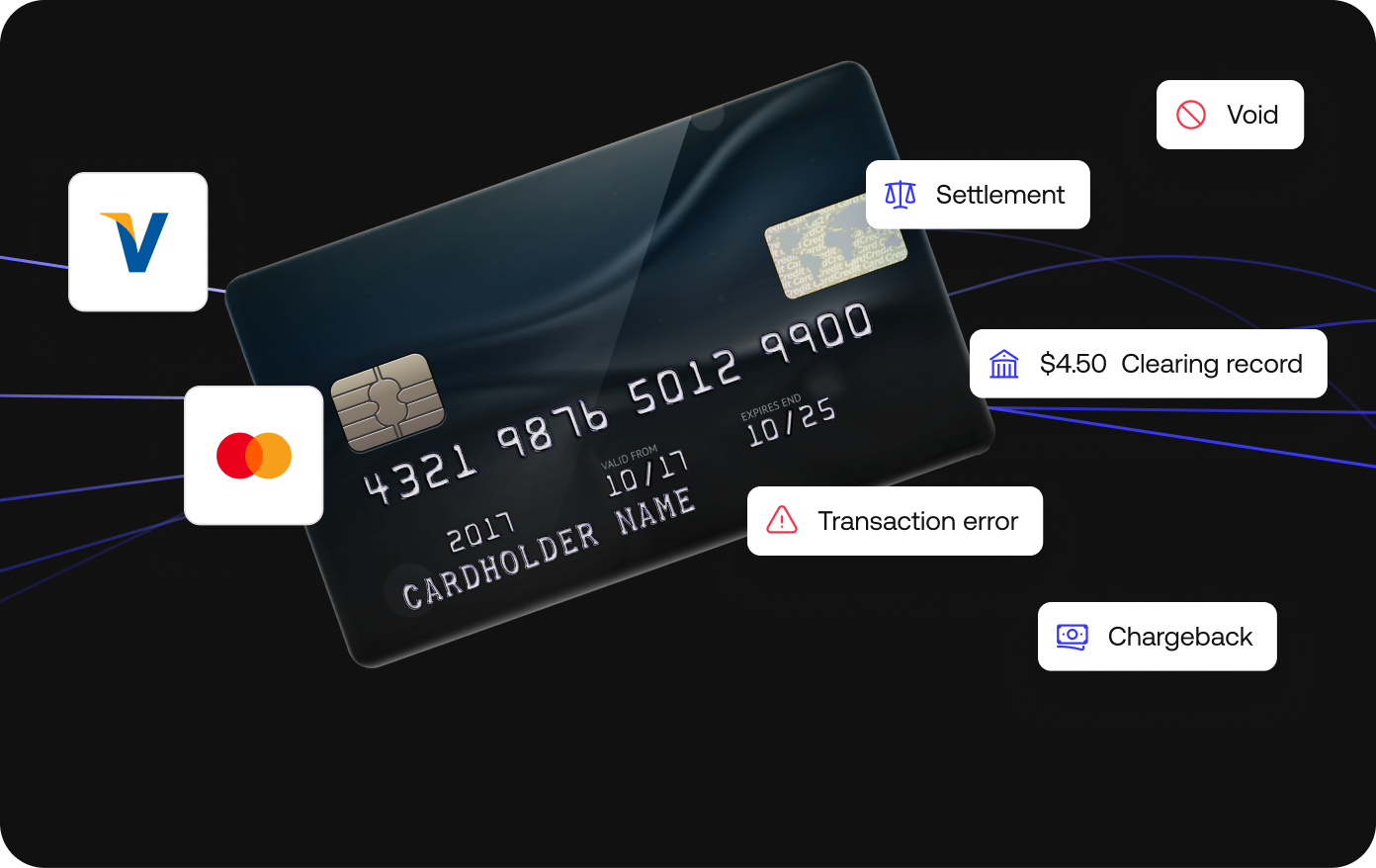
Simetrik’s preconfigured Visa and Mastercard solutions make this possible without exorbitant costs or a heavy engineering lift. It’s designed to help you set up best-practice reconciliation workflows with no code, guided by an intelligent setup assistant and a dedicated onboarding team, and maintain full visibility into the inner workings of your rulesets and logic as they evolve.

We’ve connected nuanced capabilities and financial controls to enable six key use cases, from authorization to dispute management, in a way that’s easy to deploy and adopt.

Why should acquirers automate reconciliation?

Monitoring and reconciling card network transactions is critical to your success as an acquirer. Visa and Mastercard not only make up a large portion of total transactions, they also each have their own set of requirements for acquirers, including specific audit frameworks and scheme fees that must be tracked meticulously.


Simetrik automates reconciliation down to the transaction level, matching records across internal and external systems and generating reports for your merchants, auditors, and other stakeholders that are already aligned with Visa and Mastercard’s requirements. Instead of managing spreadsheets and scrambling to organize data for network reports like the QMR (Mastercard Quarterly Member Report) and GOC (Visa Global Operating Certificate), you can focus on quickly remediating errors and disputes.


Once data is reconciled and verified, it can be used by your team and your merchants to make better operational decisions, from forecasting to fee strategies.

5 reasons to automate Visa and Mastercard reconciliation:
  • Improved cash-flow visibility
  • Accurate forecasting
  • Efficient fee management
  • Faster dispute resolution
  • Stronger risk management
6 key functionalities you can enable on Simetrik

Simetrik connects acquirer-supplied scheme files, bank statements, and records from internal systems like your ERP, automating six key reconciliation use cases for Visa and Mastercard transactions:

  • Funding – Validate programmed versus received bank receipts, investigating partials or delays to ensure compliance and timely execution.
  • Authorization – Ensure control and reduce fraud by reconciling authorized requests and responses with network data and matching clearing files to issuer records.
  • Clearing – Validate scheme fees, interchange fees, and network adjustments against acquirer records to prevent overbilling and missed charges.
  • Disputes – Confirm funds debited from issuers, reconcile pre-arbitration and arbitration cases, and help merchants manage evidence.
  • Settlement – Calculate daily net settlement and validate receipts against bank statements for optimal liquidity management.
  • Agenda – Split domestic and international agendas, with or without deferment, validating expected financial movements to prevent loss from delayed or missing settlements.
Minimize risk with fast, guided deployment

Simetrik leverages a dedicated onboarding team alongside AI-enhanced setup flows to help you quickly improve reconciliation and reporting. The platform eliminates careless errors while giving users control over the final output, complete with built-in governance and guardrails that maintain the integrity of your data.

With Simetrik, you don’t have to worry about managing a tough implementation alone. Our Visa and Mastercard solutions can be delivered in weeks, not months, with help from a dedicated onboarding team and an intelligent, guided setup assistant.

Simetirk customers can also choose from prebuilt, customizable dashboards that highlight the metrics acquirers care about the most—out-of-the-box KPIs with drill-down capability and AI-driven recommendations. 

Get started with a personalized demo

Want to see Simetrik’s card network solutions in action with your own data? Get in touch to request a demo and we’ll show you how to scale reconciliation with modular, ready-made workflows.


Learn more about our Visa and Mastercard solutions.

Reconciliation maturity: A path to AI-driven excellence for finance operations teams

When you think about resilient finance operations, what comes to mind? 

Accurate numbers, limited risk exposure, data-driven decisions, and well-controlled costs—all of these are made possible through the process of reconciliation.

Today, however, the reconciliation process is still plagued by outdated technology and manual number-crunching. It’s tedious, rife with errors (as seen in recent public cases where mistakes have cost companies millions), and unscalable in a market where complexity seems to grow by the minute. 

It’s time to adapt. In this guide, we’ll take a look at a model for reconciliation maturity that will guide you toward fully automated, AI-enabled reconciliation at every level. From siloed, costly operations to expertly orchestrated workflows with clear ROI, each advancement reduces cost and drives efficiency across the organization.

5 factors making reconciliation painful:
  1. Massive transaction volumes involving many fintech, payments, and banking partners
  2. Highly complex, nonstandardized remittance data in varied formats
  3. Stringent, inconsistent regulations across many regions and industries
  4. A fast-growing market that regularly requires new partnerships, integrations, and workflows 
  5. The en masse adoption of AI that requires real-time, trusted data to operate
Why reconciliation maturity matters now

Until recently, the standard response to reconciliation complexity was to add headcount, boost engineering spend, or accept a baseline level of revenue leakage, audit fees, and costly errors. 

But the modern financial ecosystem has reached an inflection point that makes this path impossible to stay on. The last decade has seen sweeping changes in global regulations, an explosion of payment companies and offerings, open banking standards, and an AI boom that reset the bar for real-time data access and deep interoperability.

Legacy reconciliation solutions can’t meet the demands of today’s market, always one step behind and far too unreliable for the speed and volume of modern money movement. and Miss out now, and you’ll face increasingly prohibitive costs as you try to keep up with competitors who’ve adopted  scalable, AI-ready reconciliation platforms.

The great enabler: the AI reconciliation platform

To reach full reconciliation maturity, companies need technology that can handle enterprise complexity. While it’s possible to make it past the first stage of reconciliation maturity using point solutions or home-grown scripts, you won’t get much further without a unified platform for all of your reconciliation data, controls, and workflows.

AI reconciliation platforms help you integrate internal and external transaction data sources, connect internal systems like your ERP or core banking system, and deploy sophisticated governance and automation in a way that doesn’t plunge you into technical debt as regulations and business needs change.

Get reconciliation right, and everything else falls into place. 

The best reconciliation platforms do more than just reconcile multi-way transactions. They incorporate agentic AI and intelligent, adaptive rulesets to reconcile data at three distinct levels:

  • Transaction level – Matching individual transactions to create a reliable source of truth for all downstream processes, detecting anomalies and discrepancies in real time.
  • Financial level – Using reconciled data to manage cash flow and control costs, supporting strategic decisions, and reporting accurately to internal and external auditors.
  • Accounting level – Aligning transaction and financial data with journal entries to ensure compliant, accurate reporting and accelerate close cycles.

In the next section, we’ll show you how adopting an AI reconciliation platform is essential to increasing the maturity of your finance operations. There are many paths to success—keep reading to explore ways to advance that fit your unique use case, resources, and goals.

What can an AI reconciliation platform do?
  • Process massive transaction volumes with low latency at T+1 speed 
  • Standardize and match multi-platform, highly varied transaction data
  • Meet stringent, inconsistent regulations across many regions and industries 
  • Keep TCO manageable with no-code, scalable deployment and iteration
  • Support constant change and scale with zero downtime
An actionable model for reconciliation maturity

Fully mature, AI-optimized reconciliation drives value beyond just reporting the numbers. It gives you trusted, real-time financial data to use in any downstream application you can dream up. 

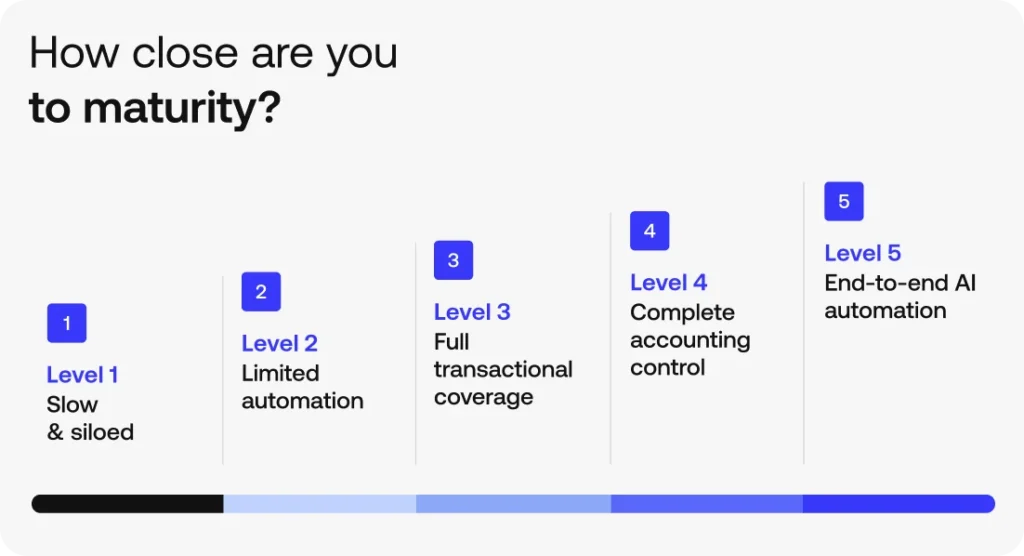
The Simetrik reconciliation maturity model consists of five stages, starting with completely manual finance operations and ending with transformative, continuously improving reconciliation automation. From instant customer refunds and nuanced loyalty programs to advanced, predictive FP&A modeling, getting to Stage 5 will put you at a huge competitive advantage.

Stage 1: Slow & siloed 

At the first stage, reconciliation is almost entirely manual. Minimal data integration, no scalability, and a lack of confidence in the numbers hurts the business.

  • Data management: Spreadsheets and macros are the finance team’s primary tools, and siloed transaction data must be exported, validated, and entered correctly into backend systems. 
  • Development: Any attempt at integration or automation is reliant on engineering, so progress is slow and costly. There’s no path to leveraging AI or using transaction data in decisioning models. 
  • Exception handling:  Finance teams manually check for discrepancies and fraud to a limited degree of success. When found, outreach and remediation can take weeks.
  • Financial oversight: Little insight into current operational balances makes decision-making difficult. Transaction data often doesn’t match bank statements, bank balances, revenue forecasts, and other indicators of financial health.
  • Accounting integrity: Transactional data is not aligned with operational balances or ledgers, slowing the financial close and often resulting in reporting errors. 
  • Risk: Risk is at a critical level, with many unexpected, unexplained losses and siloed internal knowledge. If a key employee leaves, they take the understanding of reconciliation logic with them.
  • Compliance: Without audit trails, data must be compiled manually. Audits are costly and drawn out, and compliance gaps can lead to fees and reputational harm.
Stage 2: Limited automation

Benefits start to materialize at stage two, but reconciliation still isn’t scalable. With many data sources not yet integrated, AI adoption is not yet possible.

  • Data management: Some integrations are in place, but transaction data remains fragmented.  Manual data exports and spreadsheets are still common. 
  • Development: Automations are homegrown or piecemeal and rely on constantly changing logic and data sources. Engineering costs to add new integrations are high.
  • Exception handling: Anomaly detection and transaction matching is automated for some sources, lightening the burden of exception management. Remediation is still entirely manual.
  • Financial oversight: Increased visibility into transaction data helps with financial modeling and performance tracking, but isn’t enough to inform major decisions or drive AI innovation. 
  • Accounting integrity: Transactional data is still not aligned with general and sub-ledgers. Close cycles are long, and reporting is error-prone.  
  • Risk: Risk is still high, but the number of unexplainable losses starts to drop. Siloed internal knowledge is still a problem, with many black boxes across teams and information held by a select few team members.
  • Compliance: Rev rec and reporting for standards like ASC 606 and IFRS 15 is manual and lacks complete audit trails. Internal audits can take months due to visibility gaps.
Stage 3: Full transactional coverage 

At this stage, transaction-level reconciliation is fully automated, scalable, and prepared for financial reporting and downstream innovation. Accounting-level reconciliation remains manual.  

  • Data management: All transaction records are integrated, standardized, and automatically reconciled. Finance teams have real-time visibility into granular transaction details and discrepancies.
  • Development: No-code tools and AI agents accelerate time to value and alleviate reliance on engineering as new workflows are needed. Anyone with permission can adapt the rulesets and business logic that power automated reconciliation and reporting. 
  • Exception handling: With the day-to-day reconciliation fully automated, team members can focus on exception handling. As discrepancies, chargebacks, disputes, and potential fraud are detected in real-time transaction streams, alerts tell the FinOps team it’s time for remediation.  
  •  Financial oversight: Transaction data is occasionally reconciled against operational balances in the ERP, but records quickly outdated. Finance operations and accounting teams must manually compare ERP data with transactions for a true picture of the company’s finances. 
  • Accounting integrity: Accounting-level reconciliation is still manual. Transaction data doesn’t always match the GL and subledgers. The financial close takes days longer than it should due to manual data collection and reporting.
  • Risk: Risk is greatly reduced due to transactional visibility, with losses easier to explain and quickly resolve. Knowledge of transactional reconciliation logic is accessible across the company—key employees can leave with zero disruption to the business.
  • Compliance: Detailed transaction-level audit logs exist, but the audit process is still slowed by outdated reporting mechanisms. Documents are created manually or using scripts, without being connected to updated source data.
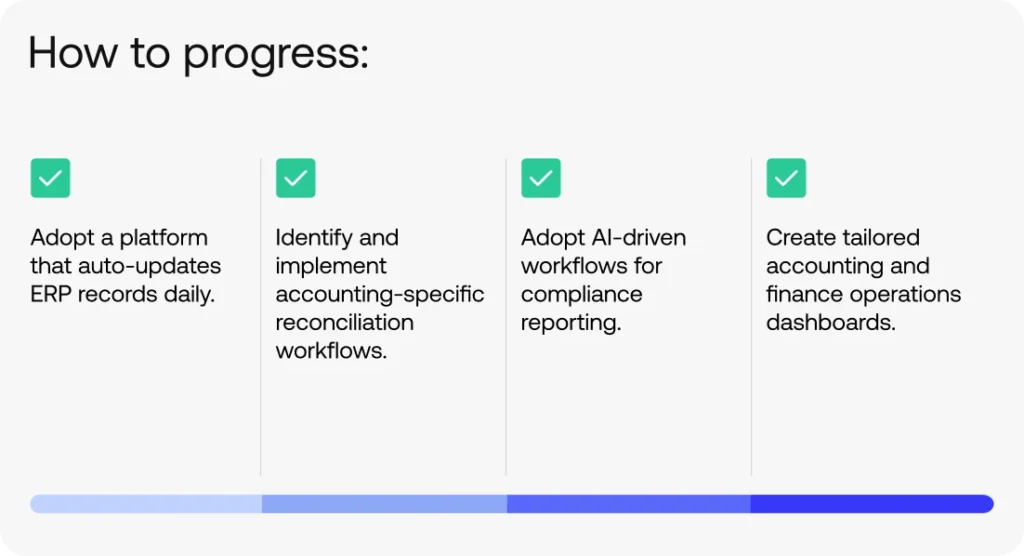
Stage 4: Complete accounting control 

Transaction data is automatically reconciled against accounting balances. Accounting teams have dynamic, dedicated dashboards for the metrics they care about. Financial oversight is strong, but room for innovation remains.

  • Data management: ERPs and other internal accounting systems are integrated alongside transaction data sources, all on a single reconciliation platform. Accounting teams can see always-updated, reconciled journal entries in the GL and sub-ledgers.
  • Development: Users can deploy no-code workflows and update accounting rulesets to correctly transform data and sync it with the ERP. AI agents simplify the process of automation without diminishing control. 
  • Exception handling: The accounting team receives real-time alerts for discrepancies between transactional data and accounting balances. Exceptions are caught and remediated before the end of the close period.
  • Financial oversight: Data is synced at least daily with the ERP and prepped for downstream reporting and AI analysis. Finance leaders can make fast decisions without digging into transaction details. 
  • Accounting integrity: Accounting leadership can see calculated balances, auto-reconciled journal entries, and progress against the close at a glance. The financial close is reduced by an average of five days. 
  • Risk: Operational loss and revenue leakage happens rarely, with complete explainability. Finance operations, accounting, product teams, and leadership all have visibility into reconciliation logic without needing to understand code. 
  • Compliance: Transaction- and accounting-level audit logs accelerate compliance efforts and minimize cost. Reporting is automatically tailored to relevant regulations and internal compliance requirements.
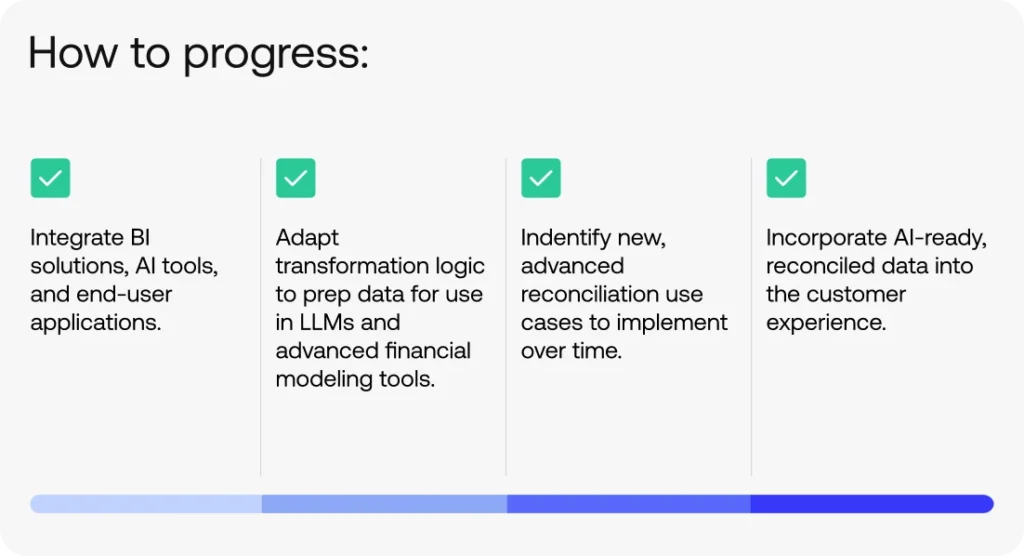
Stage 5: End-to-end AI automation

The final stage is an ongoing journey of iteration, scale, and increased ROI. New use cases are continuously deployed with zero code. AI agents learn and suggest improvements as the business and ecosystem evolves.

  • Data management: Every data source, internal and external system, and regulatory requirement is unified on an AI reconciliation platform. Adding a payment partner, adapting to new laws, and expanding into new markets is painless.  
  • Development: Scalable, no-code automation makes adding a payment partner, adapting to new laws, and expanding into new markets painless. Massive changes to the financial ecosystem no longer pose a threat.
  • Exception handling: Agentic AI powers every step of risk detection and exception management. Users manage sophisticated automations that quickly remediate issues like chargebacks, disputes, and refunds.
  • Financial oversight: AI-ready, reconciled data powers a multitude of innovative financial modeling, forecasting, and performance tracking. New use cases are easy to implement as requirements change.
  • Accounting integrity: The books always align with transactional data. AI agents drive a fully automated and auditable financial close, with reporting and documentation dynamically aligned to evolving IFRS standards and business-specific workflows. 
  • Risk: Risk due to reconciliation errors is eliminated, with advanced predictive models and no-code automation driving complete transparency across the org. 
  • Compliance: AI agents and intelligent logic powers adaptive, accurate reporting across many internal and external compliance use cases.
What’s next on the path to maturity?

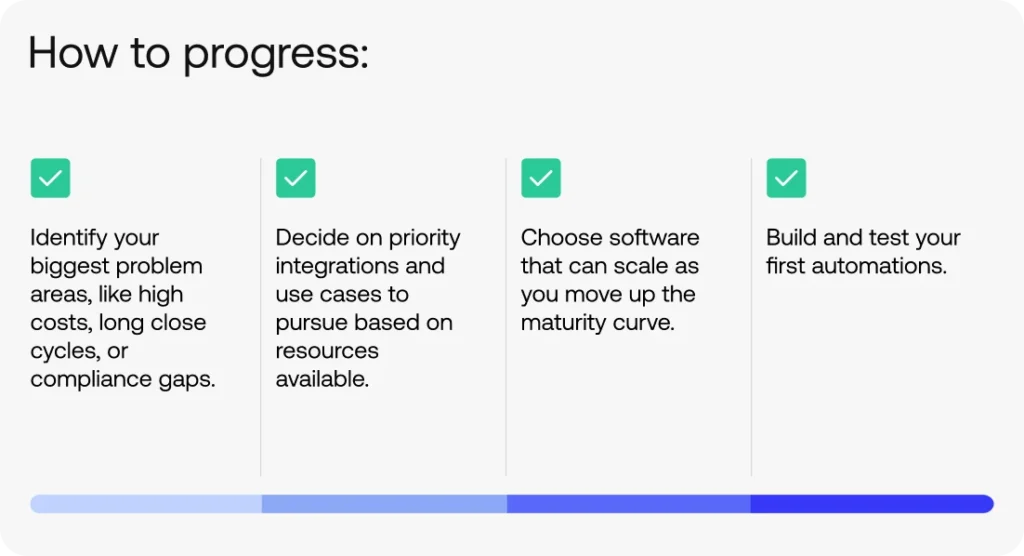
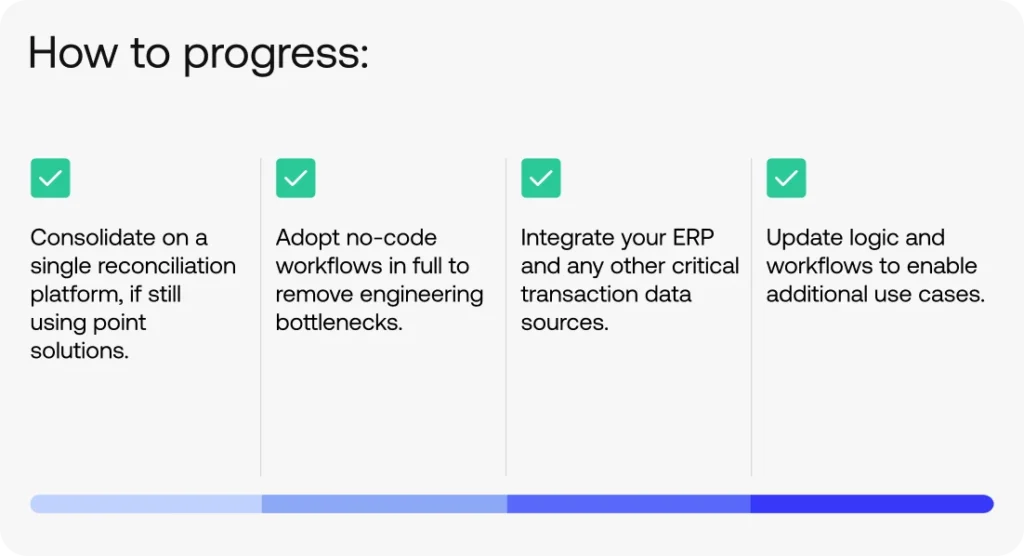
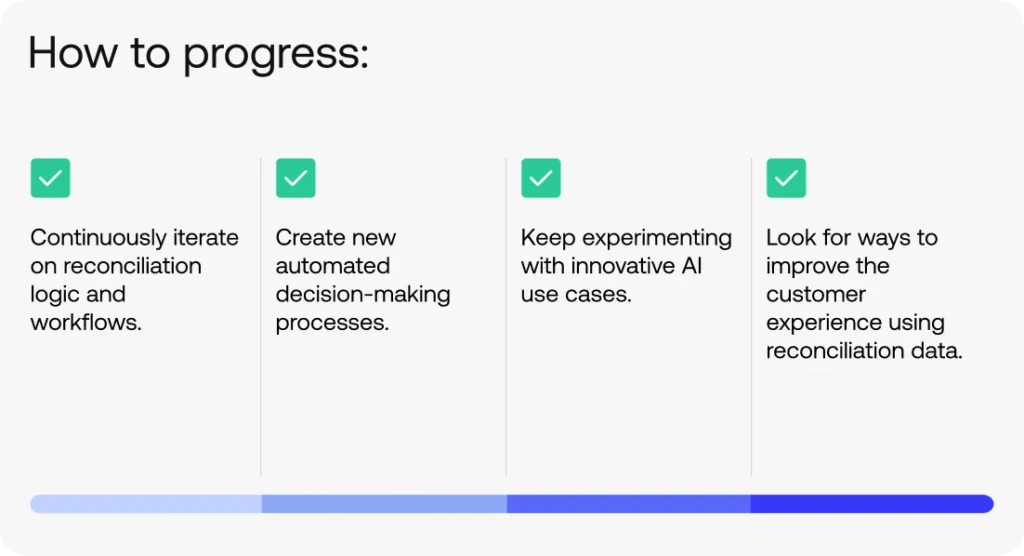
Now that we’ve laid out a vision for full reconciliation maturity, it’s time to get to work. Plot yourself on the model, outline next steps, and prioritize the use cases that are most likely to move you to the next stage. 

At Simetrik, we’ve helped finance operations teams across top financial services, retailers, and marketplaces move from costly manual transaction matching and reporting to AI-enabled, fully automated reconciliation. 

Get in touch with our team to request a demo.

FDIC proposed rule update: the latest on recordkeeping and reporting requirements for custodial FBO accounts

In September 2024, the FDIC proposed a rule to improve recordkeeping for custodial (also called FBO, or “for benefit of”) accounts, where fintechs and non-bank entities pool customer funds in FDIC-insured banks. The goal is to ensure that banks can accurately identify individual fund owners and their balances, even when intermediaries track transactions.

The rule, aimed at enhancing depositor protection and increasing public confidence in insured deposits, could become law any day. When it happens, unprepared banks will have to scramble to put new technology and workflows in place to maintain compliance. 

The catalyst: the 2024 Synapse bankruptcy 

The proposed FBO rule is largely a response to the 2024 bankruptcy of Synapse Financial Technologies, a middleware provider that allowed businesses to integrate banking services into their own applications. 

After a subsidiary of Synapse began offering cash management accounts to their partners’ end users, the company filed for bankruptcy protection. One of their partner banks, Evolve, froze access to Synapse accounts to the tune of over $200 million, stating lack of access to an essential system of record. 

The result was chaotic. End customers couldn’t access their funds, but to release them the FDIC needed transaction and ledger records from Synapse. Between access issues and inadequate recordkeeping, there was no way to recoup losses using FDIC insurance. With $96 million missing and over 100,000 customers affected, the saga still isn’t fully resolved.

What are custodial, or FBO, accounts?

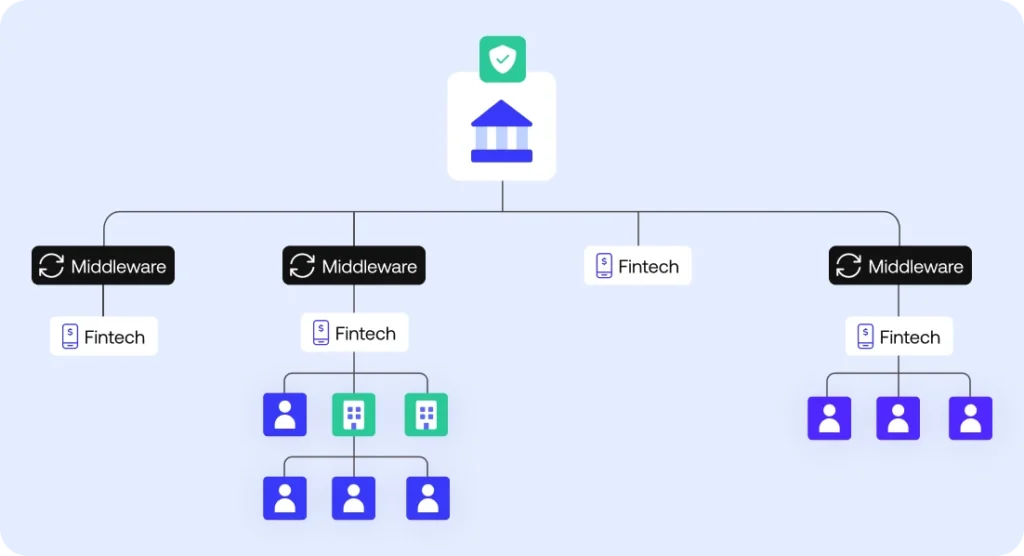
Custodial accounts are bank accounts held by one party (the “custodian”) on behalf of another (the “beneficial owner”). In fintech-bank partnerships, these accounts typically hold pooled customer funds under the fintech’s name or a third party’s, with individual user balances tracked outside of the core banking system by the third party.

This arrangement creates a visibility gap for the bank. It doesn’t inherently know who the end users are or how much each is owed, making things complicated for FDIC insurance determinations when something goes awry. 

Why is custodial account recordkeeping so complicated? 

Over the past decade, a huge influx of fintech companies have entered the market. These entities aren’t allowed to provide the full spectrum of financial products, so they rely on partners to enable them. 

In the case of custodial accounts, these partners are banks (referred to in the rule as Insured Depository Institutions, or IDIs) who already are licensed and insured to provide accounts insured by the FDIC. 

These partnerships create a complex ecosystem of intermediaries and fintech partners that each enable their own customer base to open accounts with the custodian bank. For most banks, it’s nearly impossible to keep track of who manages whose accounts, transaction details, and daily balances across all of the different systems.

For example, while individual customers may initiate millions of transactions each day on the fintech side, the details aren’t necessarily preserved by various members in the ecosystem. Some will initiate bulk movements that aggregate individual transactions into a single amount, making them hard to disambiguate later. 

Any company growth, new partnerships, or regulatory changes just increase this complexity, risking the loss of visibility and traceability of critical financial movements. Catastrophic events like the Synapse bankruptcy don’t happen every month—but losing millions to leakage, inefficient operations, and audit fees is far more common. 

What are the FDIC’s proposed changes to FBO accounts?

The FDIC’s proposed rule, Part 375, outlines new requirements for maintaining and reconciling records for FBO accounts. IDIs holding custodial deposit accounts with transactional features would be required to:

  • Meet new recordkeeping requirements, including maintaining records of custodial account details like the beneficiary, owner, and the balance attributed to each end user in a standardized format.
  • Be subject to an annual validation by an independent person or entity to assess and verify that third parties are maintaining accurate and complete records consistent with the proposal’s requirements.
  • Implement internal controls to ensure that balances of custodial deposit accounts are accurate and reconciled daily.
  • Complete an annual certification of compliance and an annual report of compliance.

Banks would be allowed to partner with a trusted third-party to meet these requirements, as long as certain conditions are satisfied. They must have direct, continuous, and unrestricted access to the records maintained by the third party, as well as have continuity plans and internal controls in place.

How do the FDIC’s proposed changes affect PSPs and fintechs?

For banks to meet these requirements, their fintech and intermediary partners must be able to provide daily transaction-level data on money moving to and from custodial accounts. These individual records must be reconciled against FBO balances, taking into account complications like rolling reserves and delayed settlements. 

To facilitate this, PSPs and other fintechs should invest in scalable, real-time transaction tracking and reconciliation technology that can sync data across all systems at least once per day.

How Simetrik helps you prepare for the new FDIC rule

Simetrik is an enterprise reconciliation platform that helps banks maintain and govern this improved method of recordkeeping that will soon be required by the FDIC. 

Here’s how it works:

  • Banks can integrate data from all of their fintech and middleware providers in one place, standardizing it to meet the specific requirements outlined in the proposed rule.
  • Transactions are monitored and reconciled daily, catching discrepancies and potential fraud instantly so they can be handled before reporting to the FDIC.
  • Bulk money in/money out records are automatically disambiguated to keep end user balances accurate.
  • Simetrik dashboards inform stakeholders of individual beneficiary activity and balances, total daily net movement, daily cumulative balances, and more.
  • Simetrik users can search and explore a subset of custodial accounts, like a specific partner.
  • Reporting is automatically prepared for appropriate third-party auditors and shared in the correct format. 

A similar process applies to fintech and middleware providers who choose to follow suit by adopting Simetrik. Transaction data from their platforms is monitored and reconciled daily with bank balances. This reconciled data is always accurate, searchable, and ready to use in customer-facing products or to meet additional reporting requirements. 

Scaling with no code automation

Unlike legacy or homegrown solutions you may have used in the past, Simetrik doesn’t require expensive integrations or hours of engineering work to set up each partner. Unify your custodial account transaction data and configure advanced reconciliation logic faster with flexible, no-code building blocks—so you’ll be ready when the proposed rule becomes enacted law.

Don’t get caught unprepared

The FDIC hasn’t yet announced when this rule will go into effect, but it may happen soon. While you still have time, adopt a unified reconciliation platform that will make the whole process painless and successful. 

To learn more about Simetrik, request a demo here.

Simetrik raises $85M to redefine financial reconciliation with AI

Back in 2024, we landed our Series B led by Growth Equity at Goldman Sachs Alternatives. It was an exciting time even then, but we didn’t know what was coming. Since then, we’ve raised a Series B1, witnessed a rapid shift in the financial ecosystem, and watched the AI boom transform the world of software forever.

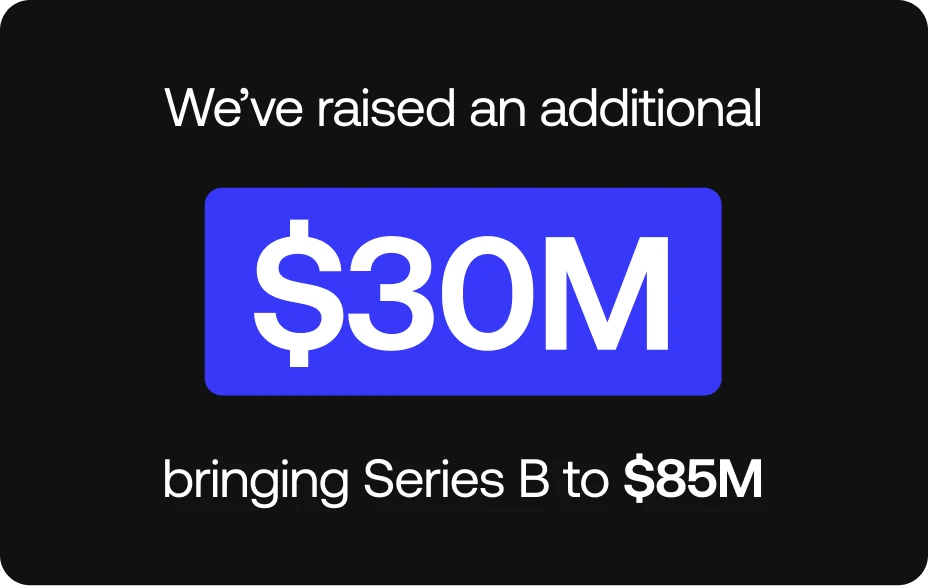
Today we’re thrilled to announce an additional $30 million investment, with Goldman leading once again. This financing brings our Series B to $85 million, accelerating Simetrik’s expansion into the United States and other new high-volume, highly regulated markets.

Reconciliation today is an outdated function that plagues even the best teams with wasteful manual work and margin-eroding technology costs. Until now, it has been impossible to process and reconcile enterprise transaction volumes at any scale, leaving significant visibility gaps and exposing financial operations to substantial risk. 

Simetrik is an AI reconciliation platform that automates transaction matching, mitigates risk, and ensures compliance at enterprise scale. We simplify complex financial operations for our customers, with reconciliation at the heart of everything we do.

By applying agentic AI and no-code automation to reconciliation, exception management, and compliance workflows, we help companies achieve new levels of financial oversight and efficiency at every level. The platform now processes more than one billion records per day in 40+ countries, automatically reconciling multi-way transaction data and then aligning it with journal entries and operational balances. 

“Fragmented systems, skyrocketing volumes, and shifting regulations are pushing traditional reconciliation to a breaking point.”

Santiago Gómez, Simetrik’s co-founder and COO.

“We give FinOps teams the automated workflows and controls they need to stop making costly errors, shorten the monthly close by days, and export AI-ready data for forecasting, risk modeling, and product innovation. All without writing a single line of code.” 

For companies subject to multiple nuanced regulations and internal audits, this approach to automation has powerful downstream effects. Reconciled data is reported accurately down to the transaction level, simplifying audits and alerting the finance team to exceptions in real-time. Simetrik customers automate 100% of their reconciliation workflows, strengthen margins, and open up new paths to innovation in an increasingly complex international payments environment.

“Goldman Sachs’ continued support validates the global demand for a purpose-built AI reconciliation platform.”

“With this investment, we’ll scale our US presence and deliver even faster time-to-value, helping finance teams cut waste, act immediately on discrepancies, and turn reconciled data into a strategic advantage.”

Alejandro Casas, co-founder and CEO of Simetrik.

Simetrik’s customers include Stax Payments, Santander Group, Sephora, Possible Finance, Mercado Libre, Oxxo, Rappi, PayU, PagBank, Falabella, Itaú, and Nubank, among others, and strategic partners such as Deloitte. This trusted base has fueled the company’s 100% year-over-year revenue growth and rapid international footprint.

To learn more about Simetrik, request a demo here.